Full article · 6 min read
Exaptations: When Evolution Reuses Old Tools for New Jobs
Evolution is often imagined as a process that neatly designs a feature for a single purpose. But that picture is too simple. Many useful traits did not begin for the role they play today. Instead, evolution frequently reuses existing structures, altering or repurposing them over time. These recycled features are called exaptations.
An exaptation is a trait that originally evolved for one function but later became useful for another. This idea helps explain why living things so often look like improvised solutions rather than perfectly engineered machines. Evolution works with what already exists, modifying old parts instead of starting from scratch.
What exaptation means
An adaptation is a trait shaped by natural selection because it improves survival or reproduction in a particular environment. An exaptation is different. In an exaptation, a structure that already exists becomes useful in a new way.
This distinction matters because not every helpful feature was originally built for its current job. Sometimes a trait evolves for one reason, and only later turns out to be advantageous in a completely different context.
That is one reason evolution can produce surprising outcomes. Existing structures carry the history of earlier stages, and later evolutionary changes may redirect them toward new functions.
The lizard with a head that does double duty
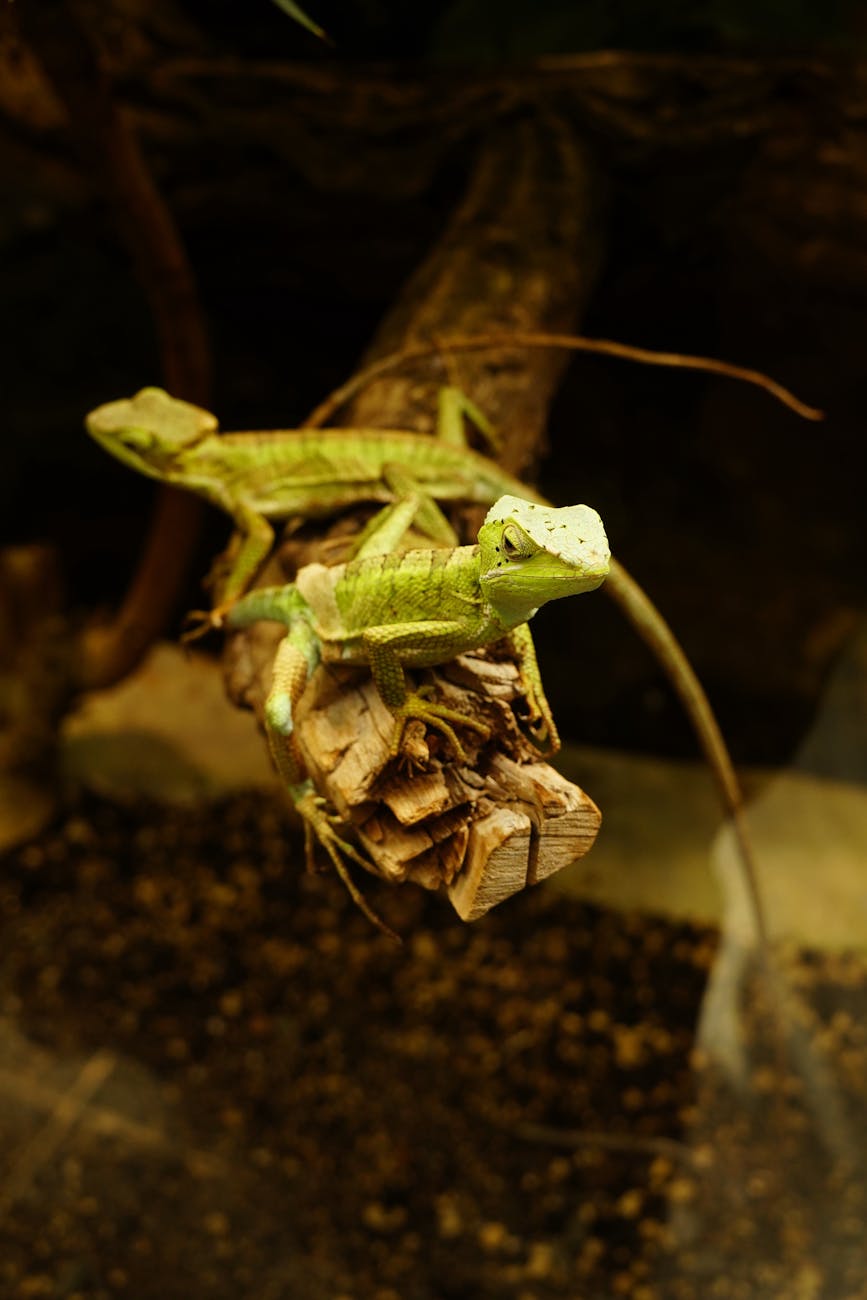
A vivid example comes from the African lizard Holaspis guentheri. This species evolved an extremely flat head for hiding in crevices. That original function is already useful: a flatter head helps the animal squeeze into narrow spaces.
But in this lizard, the story does not stop there. The head became so flattened that it also assists in gliding from tree to tree. In other words, a feature that first helped with hiding later became helpful for movement through the air.
This is a classic exaptation. The flattened head was not initially described as evolving for gliding. Yet once the structure existed, it became available for a second role.
That kind of reuse is central to how evolution operates. A trait need not arise with its eventual function already “in mind.” Evolution has no long-term goal. Instead, traits that happen to be useful in a given setting can be preserved and further modified.
Why evolution reuses instead of reinventing
Natural selection acts on variation that already exists in populations. Individuals differ in traits, those traits can affect survival and reproduction, and heritable traits can become more common over generations. But selection can only work with available biological material.
That is why evolution so often modifies existing structures rather than inventing entirely new ones. A body part, gene, or cellular component that evolved under one set of conditions may later be co-opted for another function when environments or ways of life change.
This helps explain why related organisms often share similar internal structures even when those structures do very different jobs. Evolutionary change is usually gradual modification of what came before.
Exaptation inside cells
Exaptations are not limited to obvious body parts like wings, teeth, or skulls. They also occur deep inside cells.
Complex molecular machines can evolve by recruiting pre-existing proteins that once had different functions. In other words, cellular systems may be assembled from reused biological parts. This is the microscopic version of the same principle seen in larger anatomy: evolution builds the new from the old.
One example given is the evolution of the bacterial flagella and protein sorting machinery. These systems evolved through the recruitment of several pre-existing proteins that previously had other functions. A molecular machine can therefore arise not because all its parts appeared at once, but because older components were brought together and repurposed.
Another example comes from the eye. Enzymes from glycolysis and xenobiotic metabolism were recruited to serve as structural proteins called crystallins in the lenses of organisms' eyes.
Some of these terms can sound technical, but the underlying idea is straightforward:
- Enzymes are proteins that help chemical reactions happen.
- Glycolysis is a cellular process involved in breaking down sugar for energy.
- Xenobiotic metabolism refers to processing foreign chemical substances.
- Crystallins are structural proteins in the lens of the eye.
So proteins that originally had jobs in chemical processing were later reused as building materials in the eye lens. That is exaptation at the molecular level.
Exaptation and deep evolutionary history
The broader history of life makes exaptations especially plausible. All organisms share common descent from a common ancestor, and evolution proceeds through modification across generations. Because living things inherit old structures, genes, and developmental systems, new biological features often emerge by altering inherited components rather than creating entirely novel ones from nothing.
This is also connected to the idea of deep homology. Even organs that seem very different can depend on a common set of homologous genes that control their assembly and function. Homologous genes are genes related through common ancestry.
This means that very old genetic toolkits can be reused in new contexts. Evolutionary novelty often comes from changing how and where existing components are used.
Adaptation versus exaptation
It is easy to confuse adaptation and exaptation because both involve useful traits. The key difference is historical.
An adaptation is a trait that evolved because it improved survival or reproduction in its role. An exaptation is a trait that became useful for a role different from the one associated with its earlier evolution.
A feature can even involve both ideas across time. A structure might first become useful in a new role as an exaptation, and then later be refined by natural selection for that new role. That makes evolutionary history layered rather than simple.
This is why biologists are careful about assuming that every feature was directly shaped for its present-day use. Some apparent adaptations may actually be reused older traits.
Why this idea is so important
Exaptations reveal something profound about evolution: it is opportunistic. It does not plan ahead, and it does not necessarily move toward perfection or greater complexity. Instead, it preserves variations that work well enough in the current environment.
That process can generate remarkable innovation. A structure for hiding becomes a tool for gliding. Proteins with one biochemical role become parts of a lens or a molecular machine. New functions emerge from old materials.
This also helps explain why organisms can appear patched together. Biological systems reflect their history. They are shaped by mutation, selection, recombination, gene flow, and other evolutionary processes acting on inherited structures over long spans of time.
A better way to see evolutionary creativity
Exaptations are one of the clearest reminders that evolution is creative without being deliberate. It produces novelty through reuse. Instead of inventing every useful feature from scratch, it modifies, recruits, and repurposes what is already there.
That makes the living world more interesting, not less. Features are not just tools; they are records of earlier lives and earlier functions. In every reused structure, evolution leaves clues about the past while opening new possibilities for the future.
So the next time a biological trait seems perfectly suited to its job, it is worth asking a deeper question: was it built for that task from the beginning, or did evolution cleverly recycle an older design?
Sources
Based on information from Evolution.
More like this
More about biology
More about science
Evolution loves reused parts — reuse your scroll time for something smarter. Download DeepSwipe and glide from fact to fact.