Full article · 8 min read
Biology: Why the Cell Is the Basis of Life
Biology is the scientific study of life, and one of its most important ideas is surprisingly compact: the cell is the basic unit of life. That single concept helps explain everything from bacteria drifting through water to the growth of plants, fungi, and animals.
Every living thing is made of one or more cells. Some organisms consist of just a single cell, while others are multicellular and built from enormous numbers of cells working together. Even in the largest and most complex bodies, life is still happening cell by cell.
The Big Idea Behind Cell Theory
Cell theory states three key things: cells are the fundamental units of life, all living things are made of one or more cells, and all cells arise from preexisting cells through cell division. This idea became central to biology in the 19th century, when scientists began recognizing the importance of the cell.
That may sound obvious now, but it was a profound shift in how life was understood. Instead of seeing organisms as indivisible wholes, biologists came to see them as built from tiny living compartments. Each cell carries out the processes associated with life, and together those processes scale up into tissues, organs, and whole organisms.
In multicellular organisms, every cell in the body ultimately comes from a single cell in a fertilized egg. That means the vast complexity of a mature organism begins with one cell that divides again and again.
Tiny Beyond Imagination
Most cells are extremely small, typically ranging from 1 to 100 micrometers in diameter. A micrometer is one millionth of a meter, which is why cells are usually invisible without a light or electron microscope.
Small does not mean simple. Inside the cytoplasm of a cell are biomolecules such as proteins and nucleic acids, all participating in the chemistry of life. Cells constantly process energy, build and break down molecules, respond to signals, and maintain internal stability.
The history of biology was transformed by the microscope. Dramatic improvements to microscopy opened up an unseen world and led to the discovery of bacteria, spermatozoa, infusoria, and the great diversity of microscopic life. Those discoveries helped establish the idea that life exists on scales far smaller than the unaided eye can detect.
The Boundary That Makes a Cell a Cell
Every cell is enclosed by a cell membrane, which separates the cell’s cytoplasm from the extracellular space around it. This membrane is not just a wrapper. It is a dynamic structure that controls what enters and leaves the cell.
A cell membrane consists of a lipid bilayer. In this arrangement, lipid molecules form a thin double layer that acts as a boundary. Cholesterols sit between phospholipids to help maintain membrane fluidity at different temperatures. The membrane is semipermeable, meaning some substances can pass through more easily than others. Small molecules such as oxygen, carbon dioxide, and water can cross, while larger molecules and charged particles such as ions are more restricted.
Membrane proteins are also part of this system. Integral membrane proteins extend across the membrane and can serve as transporters, while peripheral proteins attach more loosely to the membrane surface and may act as enzymes. The membrane also helps with cell adhesion, cell signalling, and storing electrical energy.
Two Main Kinds of Cells
There are generally two types of cells: prokaryotic cells and eukaryotic cells.
Prokaryotic cells do not have a nucleus. They include bacteria and archaea, and they are typically single-celled organisms. Their DNA is not enclosed inside a nucleus the way it is in more complex cells.
Eukaryotic cells do contain a nucleus, which holds most of the cell’s DNA. Eukaryotes can be single-celled, but they also include multicellular organisms such as plants, fungi, and animals. This kind of cell organization supports the development of larger and more structurally complex bodies.
This difference matters because the nucleus is one of the defining features of eukaryotic complexity. In eukaryotic cells, specialized internal structures called organelles allow different jobs to be handled in different places.
What’s Inside a Eukaryotic Cell?
Eukaryotic cells contain organelles, which are specialized structures with specific functions. The nucleus contains most of the cell’s DNA. Mitochondria generate adenosine triphosphate, or ATP, which powers cellular processes. ATP is often described as the usable energy currency of the cell.
Other organelles include the endoplasmic reticulum and the Golgi apparatus, which are involved in the synthesis and packaging of proteins. Lysosomes can engulf biomolecules such as proteins.
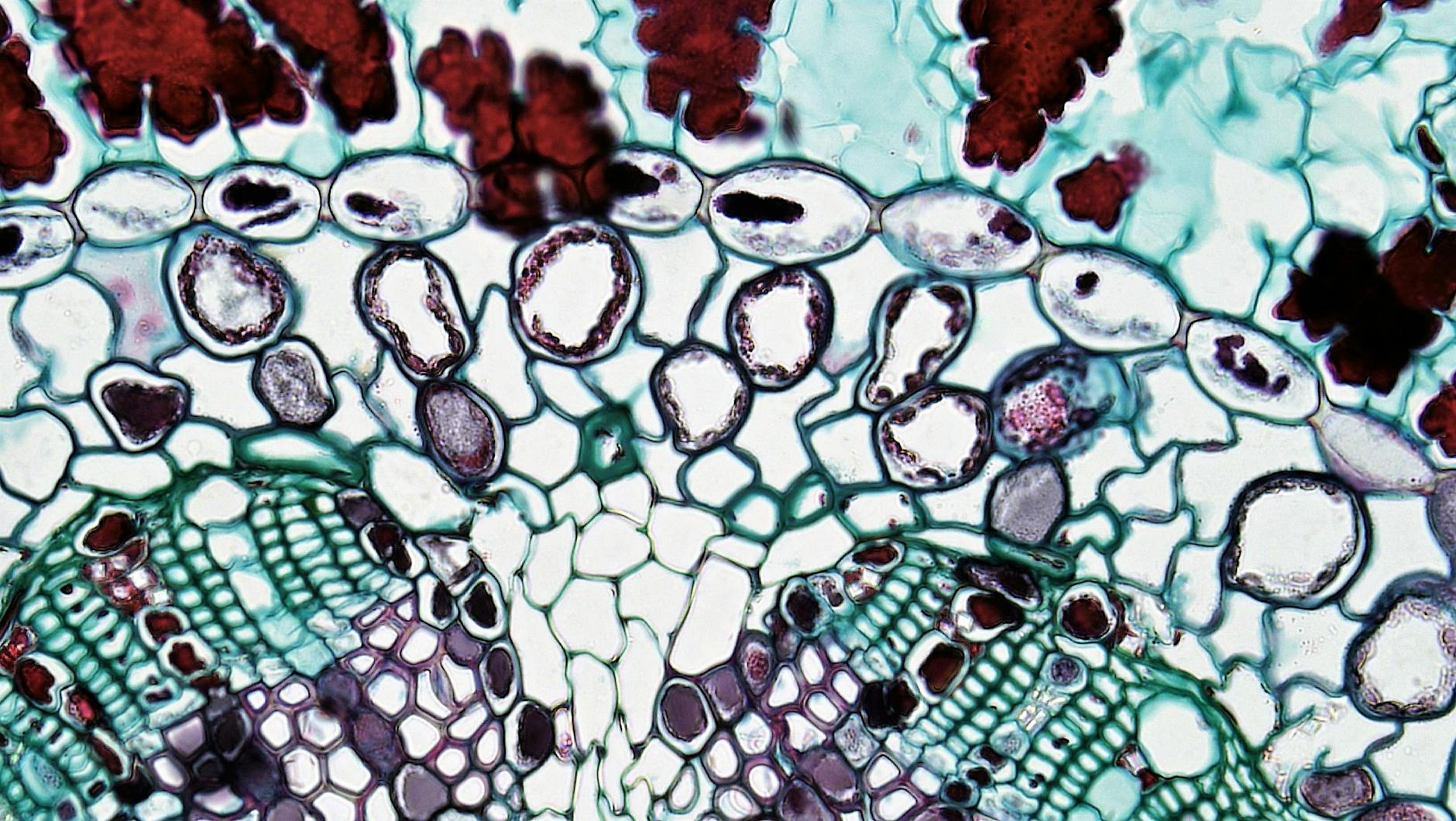
Plant cells include additional structures that distinguish them from animal cells. A cell wall provides support, chloroplasts harvest sunlight energy to produce sugar, and vacuoles provide storage and structural support while also being involved in reproduction and the breakdown of plant seeds.
Eukaryotic cells also have a cytoskeleton, an internal framework made of microtubules, intermediate filaments, and microfilaments. These structures provide support for the cell and help with movement of the cell and its organelles.
Cells Are Alive Because Chemistry Never Stops
A cell is not a static object. It is a site of nonstop chemical activity. All cells require energy to sustain cellular processes, and the full set of chemical reactions in an organism is called metabolism.
Metabolism has three main purposes: converting food to energy for cellular processes, converting food or fuel into building blocks such as monomers, and eliminating metabolic wastes. These reactions are catalyzed by enzymes, which are molecules that speed up chemical reactions without being consumed by them. Enzymes reduce the activation energy needed for reactions, making life’s chemistry possible at the conditions found inside cells.
Metabolic reactions can be catabolic or anabolic. Catabolic reactions break down compounds and release energy. Anabolic reactions build up compounds and consume energy. Together, these reactions allow cells to grow, reproduce, maintain their structures, and respond to their environments.
How Cells Get Energy
One of the most important cellular processes is cellular respiration. This is the set of reactions by which cells convert chemical energy from nutrients into ATP and release waste products.
In animal and plant cells, glucose is the main nutrient used in respiration. When oxygen is present, aerobic respiration takes place through four stages: glycolysis, the citric acid cycle, the electron transport chain, and oxidative phosphorylation. These steps ultimately generate ATP, the energy source that powers cellular activity.
In eukaryotes, part of this process happens in the mitochondria. The transfer of electrons through a series of protein complexes releases energy, which is used to pump protons across the inner mitochondrial membrane. This creates a proton motive force that drives ATP synthase, an enzyme that synthesizes more ATP.
If oxygen is not present, cells can rely on fermentation instead. In this case, pyruvate remains in the cytoplasm and is converted into waste products, allowing NAD+ to be regenerated so glycolysis can continue. In skeletal muscles, this can produce lactic acid. In yeast, it produces ethanol and carbon dioxide.
Cells Can Also Capture Energy From Light
Some cells do more than use existing nutrients. Photosynthetic cells can capture light energy and convert it into chemical energy.
Photosynthesis is used by plants and other organisms to convert light energy into chemical energy stored in carbohydrates such as sugars. In most cases, oxygen is released as a waste product. This process is largely responsible for producing and maintaining the oxygen content of Earth’s atmosphere and supplies most of the energy necessary for life on Earth.
In plant cells, chloroplasts harvest sunlight energy to produce sugar. During photosynthesis, light is absorbed by chlorophyll pigments attached to proteins in thylakoid membranes. The energy from light drives electron transport, ATP synthesis, and carbon fixation, ultimately helping synthesize glucose from carbon dioxide and water.
Cells Communicate, Divide, and Specialize
Cells do not live in isolation. They receive, process, and transmit signals, both from their environment and from other cells. This is called cell signaling. Signals may be chemical, electrical, or even physical, such as light or heat. When a chemical signal, or ligand, binds to a receptor, it can change the behavior of a cell.
Cells also divide. The cell cycle is the sequence of events that leads a cell to duplicate its DNA and divide into daughter cells. In eukaryotes, mitosis produces genetically identical cells, while meiosis produces haploid daughter cells and is central to sexual reproduction. In prokaryotes, division occurs by binary fission.
In multicellular organisms, cell division is how a single fertilized egg becomes a mature organism. It is also how tissues such as hair, skin, and blood are renewed.
As development proceeds, cells can become specialized through differentiation. Even though different cells in the same organism generally have the same genome, they can take on very different forms and functions because gene expression is tightly controlled.
The Cell Connects All of Biology
The idea that the cell is the basic unit of life links together nearly every part of biology. Genetics depends on DNA inside cells. Physiology depends on how cells use energy and respond to signals. Development depends on cells dividing and differentiating. Ecology ultimately depends on countless living cells interacting in organisms, populations, and ecosystems.
Life may appear in many forms, but the cell is where living processes actually happen. Whether an organism is a single-celled bacterium or a complex multicellular animal, the same principle holds: to understand life, start with the cell.
Sources
Based on information from Biology.
More like this
Your whole body started as one cell — start your next knowledge journey with one swipe. Download DeepSwipe today.