Full article · 8 min read
Cells: the tiny units that built life
Life looks wildly different on the surface. A bacterium, an oak tree, a mushroom, and a human seem to have almost nothing in common. Yet they all share the same basic unit: the cell. Every organism is built from cells, and that simple fact is one of the biggest ideas in biology.
The word itself comes from the Latin cellula, meaning “small room.” That old name fits surprisingly well. A cell is like a tiny enclosed space with a boundary around it and a busy interior packed with molecular activity. Most cells are so small that they can only be seen under a microscope, but despite their size, they are the structural and functional foundation of life.
Cells are not just little containers. They are active systems. Most cells can replicate, meaning they can produce new cells. Most can also carry out protein synthesis, the process of building proteins that keep the cell functioning. Some cells are even motile, meaning they can move.
And this design is ancient. Cells emerged on Earth about four billion years ago, making the cellular plan one of the oldest enduring features of life.
What every cell has in common
At the most basic level, a biological cell consists of a semipermeable cell membrane enclosing cytoplasm that contains genetic material. That short description hides a lot of fascinating detail.
The cell membrane is the cell’s outer boundary. It is selectively permeable, which means it controls what enters and leaves. This matters because a cell must take in useful substances, remove waste, and maintain a stable internal environment.
Inside that boundary is the cytoplasm, the gel-like interior that surrounds the cell’s internal components. The cytoplasm is not empty fluid. It is an active, crowded environment where many essential processes happen.
Cells also contain genetic material, the information used for building and maintaining the cell. In many cells this information is DNA. That stored information helps direct processes such as replication and protein synthesis.
Most cells are capable of copying themselves and making proteins. These abilities are central to growth, repair, and survival. Protein synthesis in particular is essential because proteins do much of the work inside cells.
Why cells are called the building blocks of life
Calling cells the building blocks of life is not just a metaphor. Cell theory states that all organisms are composed of one or more cells, that cells are the fundamental unit of structure and function in all organisms, and that all cells come from pre-existing cells.
This means there is no known life form built from anything simpler than cells as its basic living unit. A single-celled organism is one cell doing everything needed for life. In multicellular organisms, many cells work together, often specializing into different roles.
That specialization is one reason large organisms can be so complex. All multicellular organisms are made up of many different types of cell. In plants and animals, the diploid cells that make up the body are called somatic cells. These do not include the haploid gametes.
If terms like diploid and haploid sound technical, the key point is simple: not all cells in a body have the same role. Some make up tissues and organs, while others are specialized for reproduction.
Two great cell designs: prokaryotes and eukaryotes
All organisms are broadly grouped into prokaryotes and eukaryotes, and the difference starts at the cellular level.
Prokaryotes are single-celled organisms and include bacteria and archaea. Their cells are simpler and generally smaller than eukaryotic cells. They do not have a membrane-bound nucleus. Instead, their DNA is found in a region called the nucleoid.
Eukaryotes include animals, plants, most fungi, some algae, and protists. Eukaryotes can be single-celled or multicellular. Their cells have a membrane-bound nucleus, which encloses the genetic material. Eukaryotic cells also contain membrane-bound organelles, specialized compartments that carry out particular tasks.
A eukaryotic cell can be 2 to 100 times larger in diameter than a typical prokaryotic cell. That size difference helps explain why eukaryotic cells often have more internal complexity.
The crowded interior of a cell
The inside of a cell is not a random soup. It is organized, dynamic, and full of specialized structures.
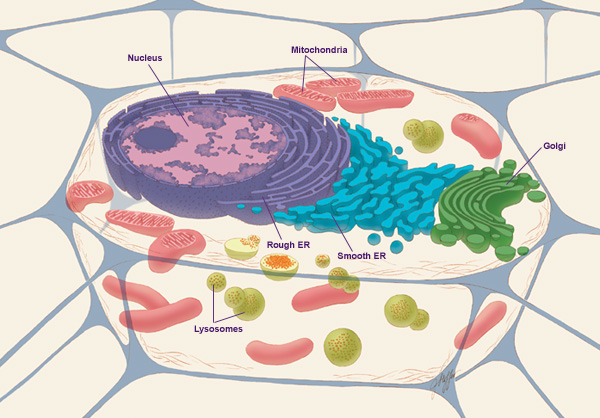
In eukaryotic cells, the nucleus stores chromosomes and is the place where almost all DNA replication and RNA synthesis occur. RNA is involved in carrying and using genetic information. Messenger RNA, or mRNA, is made from DNA and then transported out of the nucleus, where it is used to help build proteins.
Ribosomes act like assembly lines for protein synthesis. They use mRNA instructions to synthesize proteins from amino acids. Ribosomes are found in both prokaryotic and eukaryotic cells, though they differ between the two groups.
Mitochondria provide energy for cell functions. In animal cells, aerobic respiration in the mitochondria generates energy in the form of adenosine triphosphate, or ATP, using oxygen to release energy stored in cellular nutrients.
Other organelles also help make the cell’s interior feel crowded with purpose. The endoplasmic reticulum forms a transport network for certain molecules. The Golgi apparatus processes and packages proteins and lipids. Lysosomes digest worn-out organelles, food particles, and engulfed viruses or bacteria. Peroxisomes contain enzymes that rid the cell of toxic peroxides. Vacuoles can sequester waste products.
The cytoskeleton gives shape and support to the cell and helps organize its components. It also contributes to processes like cell division and movement.
So when a cell is described as a tiny enclosed space with a crowded interior, that is not poetic exaggeration. It is literally a packed microscopic world of membranes, structures, molecules, and constant activity.
Some cells can move
Not all cells stay still. Some types of cell are motile, meaning they can move. Movement can help a unicellular organism find food or escape predators. In multicellular organisms, cells can move during wound healing, immune responses, and cancer metastasis.
Cells can move using structures such as flagella and cilia, or through amoeboid movement using pseudopodia. These are different solutions to the problem of getting from one place to another at a tiny scale.
In bacteria, cell-surface appendages can include flagella and pili. Flagella help facilitate movement, while pili can assist in communication and attachment.
In animal tissues, cilia can have important roles as well. Some are sensory, acting like cellular antennae that coordinate signaling pathways. Others are motile and help move substances, such as mucus in the respiratory epithelium.
So even though cells are tiny, some are anything but passive.
Cells can copy themselves
One of the defining traits of cells is that most can replicate. During cell division, a mother cell divides into daughter cells. This is how tissues grow in multicellular organisms and how single-celled organisms reproduce.
Prokaryotic cells divide by binary fission. Eukaryotic cells usually undergo mitosis, which is nuclear division, followed by cytokinesis, the division of the cell itself.
DNA replication happens when a cell divides through mitosis or binary fission. This is the process of duplicating the cell’s genome so that new cells receive genetic material.
This ability to copy is one reason the cell became such a powerful design for life. A cell is not only a functioning unit, but also a unit that can make more units.
Cells make proteins, and proteins keep cells running
Most cells are able to synthesize new proteins, and this is one of the most important things they do. Protein synthesis is the formation of new protein molecules from amino acid building blocks based on information encoded in DNA and RNA.
This process has two major steps: transcription and translation. In transcription, information in DNA is used to produce a complementary RNA strand. That RNA is processed into messenger RNA. In translation, ribosomes use the mRNA sequence to build a polypeptide sequence, which then folds into a functional protein.
This matters because proteins are essential for the modulation and maintenance of cellular activities. In plain language, proteins help cells do their jobs.
How old is the cellular plan?
Cells appeared on Earth about four billion years ago. The first cells were most likely heterotrophs, and early cell membranes were probably simpler and more permeable than later ones.
Much later, eukaryotic cells were created about 2.2 billion years ago in a process called eukaryogenesis. This is widely agreed to have involved symbiogenesis, where an archaean and a bacterium came together to create the first eukaryotic common ancestor.
That later step added a new level of complexity, including a nucleus and mitochondria. Still, the truly striking fact is the timescale: the core cellular design reaches back almost to the beginning of life’s history on Earth.
The discovery that changed biology
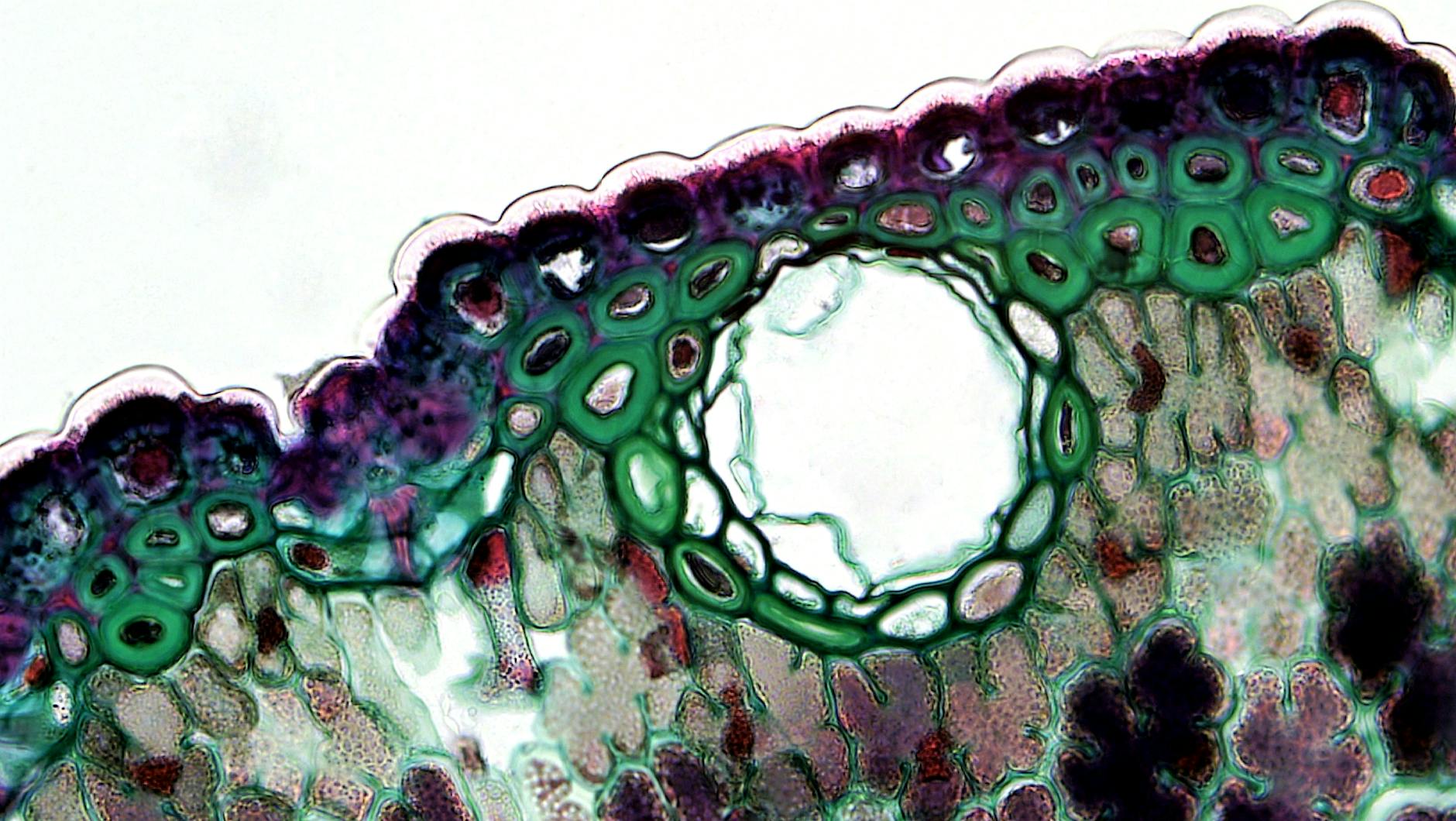
Cells were discovered by Robert Hooke in 1665 when he examined a thin slice of cork under a microscope and saw small enclosures. He named them after their resemblance to cells in a monastery.
That observation helped open the door to one of biology’s most important frameworks. In 1839, Matthias Jakob Schleiden and Theodor Schwann established the principle that plants and animals are made of cells, founding cell theory. In 1855, Rudolf Virchow stated that new cells come from pre-existing cells by cell division.
These ideas transformed the study of life. Once scientists recognized that all organisms are built from cells, biology gained a unifying concept that connected microbes, plants, animals, and everything in between.
Tiny rooms, endless complexity
A cell may be microscopic, but it is not simple in the everyday sense. It has a boundary that protects it, an interior full of organized activity, genetic instructions, ways to build proteins, and often the ability to copy itself or move.
Whether it is a single-celled prokaryote or part of a multicellular animal or plant, a cell is the smallest living unit that carries the machinery of life. That is why the story of life is, in many ways, the story of cells: tiny rooms that built everything alive.
Sources
Based on information from Cell (biology).
More like this
More about biology
More about science
Your body is built from cells—build your daily knowledge the same way. Download DeepSwipe and stack one tiny lesson at a time.