Full article · 8 min read
Biology: Genes, DNA, and Inheritance
Genes and DNA sit at the heart of modern biology because they explain how living things store information, pass it to offspring, and turn it into real-world traits. From eye color in fruit flies to the broad diversity of life on Earth, heredity helps connect the smallest molecular details to the biggest questions in evolution.
What genes actually are
A gene is a unit of heredity. It corresponds to a region of deoxyribonucleic acid, or DNA, that carries genetic information controlling an organism’s form or function. In simple terms, genes are stretches of DNA that contribute to how an organism is built or how it works.
DNA is especially important because it stores hereditary information. That means it carries the biological instructions that can be passed from parents to offspring. This idea transformed biology by giving inheritance a physical basis instead of leaving it as an abstract concept.
The full set of chromosomes in a cell is called its genome, and the complete genetic assemblage of an organism is its genotype. These terms matter because they help distinguish between the stored information and the traits that may eventually appear.
The famous double helix
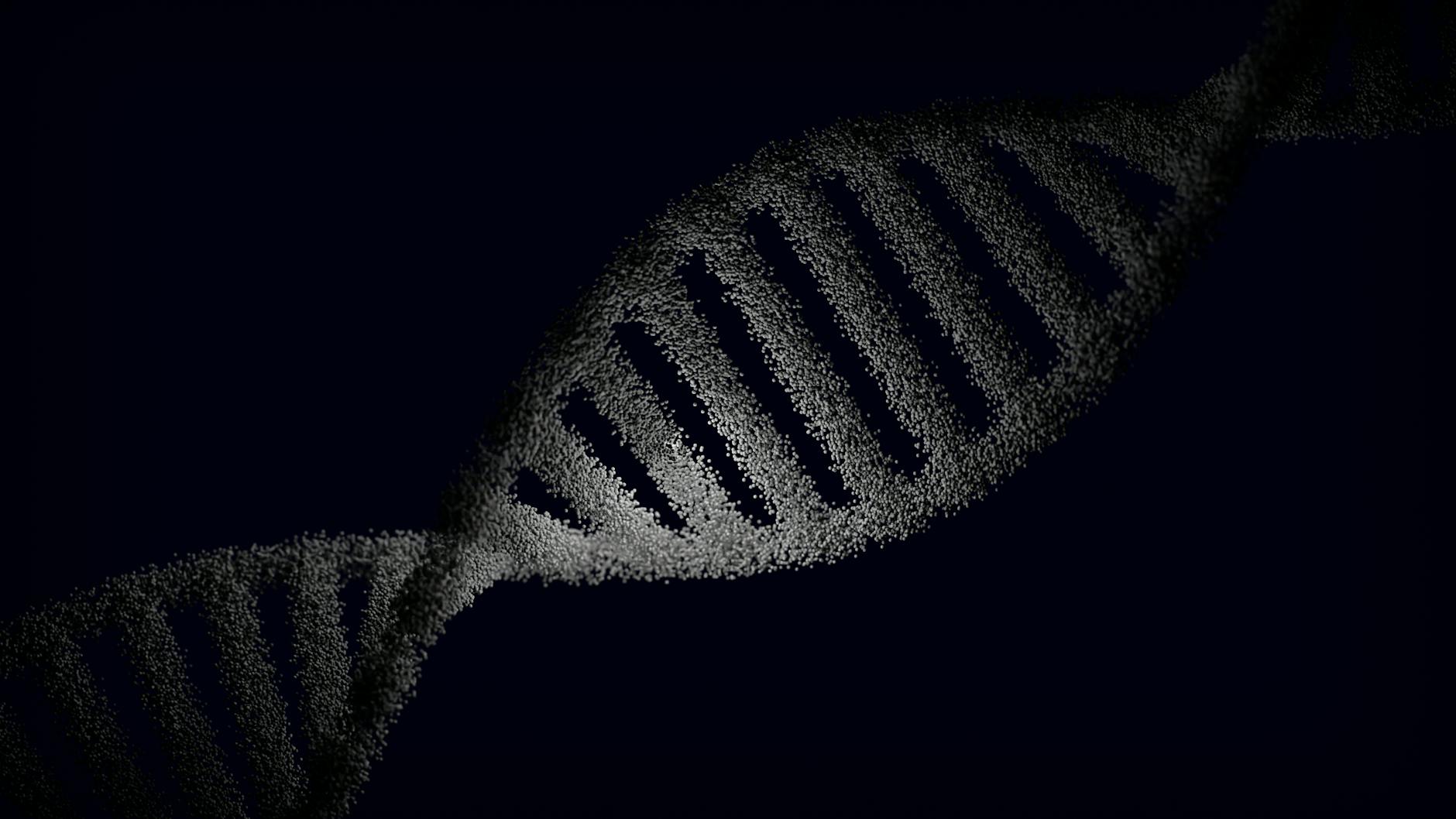
DNA is composed of two polynucleotide chains that coil around each other to form a double helix. That twisted shape has become one of the most recognizable images in science, but its importance is practical, not just visual. DNA’s structure helps it store information and copy itself.
Where DNA is found depends on the kind of cell. In eukaryotes, DNA is mainly located in the cell nucleus. Eukaryotes include organisms whose cells contain a nucleus. In prokaryotes, which do not have a nucleus, DNA is held in a region called the nucleoid.
DNA is also arranged differently in these groups. In eukaryotes it is found as linear chromosomes, while in prokaryotes it occurs as circular chromosomes. These differences are part of the larger distinction between more structurally complex eukaryotic cells and simpler prokaryotic cells such as bacteria.
How DNA gets passed on
Inheritance is the scientific focus of genetics, the study of how traits pass from one generation to the next. Mendelian inheritance describes how genes and traits are transmitted from parents to offspring through several core principles.
One principle is that genetic characteristics are carried by alleles, which are alternate forms of a gene. An organism inherits one from each parent. Some alleles are dominant and others are recessive. If at least one dominant allele is present, the organism will display the phenotype associated with that dominant allele.
Phenotype means the observable traits of an organism. Genotype means its genetic makeup. This distinction is central to biology because an organism can carry genetic information that is not obvious just by looking at it.
During the formation of gametes, the alleles for each gene segregate so that each gamete carries only one allele for each gene. Another Mendelian principle, independent assortment, states that genes for different traits can segregate independently during gamete formation when those genes are unlinked.
Scientists can investigate inheritance patterns experimentally. A test cross can help determine the genotype behind a dominant phenotype, and a Punnett square can be used to predict the outcomes of a cross.
From genotype to phenotype
One of the most powerful ideas in molecular biology is that stored genetic information can be turned into working biological molecules. This is gene expression: the molecular process by which a genotype encoded in DNA gives rise to an observable phenotype in the proteins of an organism’s body.
This process is often summarized as DNA to RNA to protein. That summary comes from the central dogma of molecular biology, formulated by Francis Crick in 1958. The two main stages are transcription, in which information moves from DNA to RNA, and translation, in which RNA is used to build protein.
Proteins are crucial because they do much of the cell’s work. They include enzymes, transport proteins, signaling molecules, antibodies, and structural proteins. Through protein production, genetic information becomes visible in an organism’s structure and function.
This is how the leap from code to creature happens. A genotype is not just passive information sitting in a cell. Through gene expression, it helps shape the phenotype we can observe.
Why the same DNA can lead to different cells
In multicellular organisms, different cells can have very different physical characteristics despite having the same genome. This happens because gene expression is tightly controlled.
Gene regulation can occur at many steps, including transcription, RNA splicing, translation, and post-translational modification of a protein. Regulatory proteins called transcription factors can increase or decrease transcription depending on where they bind near DNA.
Positive regulation happens when an activator stimulates transcription. Negative regulation happens when a repressor binds to an operator and prevents transcription. Some genes can be turned on by inducers, while others are constitutively active and are almost always on.
Gene expression can also be influenced by environmental factors and by development. This helps explain how specialized cells arise. During development, cells undergo differentiation, becoming more specialized in form and function. Even without changing the DNA sequence itself, controlled differences in gene expression and epigenetics can produce major differences between cell types.
DNA replication and the continuity of life
For hereditary information to persist, DNA must be copied. DNA replication is a semiconservative process in which each strand serves as a template for a new strand. This is one reason DNA is such an effective information archive: cells can duplicate it before division.
Cell division then passes that information onward. In eukaryotes, mitosis produces genetically identical daughter cells and maintains the total number of chromosomes. This process is essential for growth, development, and the renewal of tissues such as hair, skin, blood cells, and some internal organs.
In sexual reproduction, meiosis produces four haploid daughter cells after one round of DNA replication followed by two divisions. Homologous chromosomes separate in meiosis I, and sister chromatids separate in meiosis II. Meiosis is a central feature of sexual reproduction in eukaryotes and helps maintain the integrity of the genome passed on by parents.
Mutations: change, risk, and opportunity
Mutations are heritable changes in DNA. They may arise spontaneously from replication errors that were not corrected by proofreading, or they can be induced by environmental mutagens such as chemicals or radiation.
These changes can have different effects. Mutations can produce loss-of-function, gain-of-function, or conditional outcomes. Some are harmful, especially if they damage genes needed for survival. But not all mutations are bad. Some are beneficial and provide genetic variation, which is essential for evolution.
That makes mutation one of biology’s most fascinating double-edged ideas. A mutation can disrupt an important function, but it can also introduce a new variation that becomes useful in a changing environment.
DNA, genes, and evolution
Evolution is the change in heritable characteristics of populations over successive generations. Genes and mutations matter to evolution because natural selection acts on heritable variation.
Populations contain a mix of traits, and if certain inherited traits are better adapted to the environment, individuals carrying them are more likely to survive and produce offspring. Over many generations, favorable traits can accumulate.
This link between heredity and selection turned evolution into a much more complete scientific framework. Modern biology rests on both natural selection and the molecular understanding of genes encoded in DNA.
Genetic variation produced through sexual reproduction can also provide long-term advantages. Meiosis, recombination, and outcrossing are associated with benefits such as recombinational repair of genomic DNA damage and genetic complementation, which can mask the effects of deleterious recessive mutations.
How biology reached the DNA era
The modern understanding of genes did not appear all at once. The basis for modern genetics began with Gregor Mendel in 1865, when he outlined the principles of biological inheritance. The importance of his work was fully recognized only in the early 20th century, when evolution and classical genetics were brought together in the modern synthesis.
A major shift came in the 1940s and early 1950s, when experiments by Alfred Hershey and Martha Chase pointed to DNA as the chromosome component that held genes. Soon after, the discovery of DNA’s double-helical structure by James Watson and Francis Crick in 1953 marked the transition to molecular genetics.
From the 1950s onward, biology expanded deeply into the molecular domain. The genetic code was cracked by Har Gobind Khorana, Robert W. Holley, and Marshall Warren Nirenberg. Later, the Human Genome Project, launched in 1990, aimed to map the human genome.
Why genes and DNA remain central to biology
Genes, DNA, and inheritance connect many of biology’s biggest themes. They explain how traits are transmitted, how cells make proteins, how organisms develop, and how evolution has generated biological diversity over time.
They also link older biological ideas with newer ones. Cell theory explains that cells are the fundamental units of life. Genetics explains how information is preserved and used inside those cells. Evolution explains how hereditary variation changes populations over generations. Together, these ideas form a powerful framework for understanding life itself.
Sources
Based on information from Biology.
More like this
Twist your brain around the double helix — download DeepSwipe and pass more knowledge on to your future self.