Full article · 8 min read
Idaho Beaver Drop: The Strange but Brilliant Plan to Parachute Beavers
In 1948, Idaho carried out one of the most unusual wildlife relocation projects ever attempted: beavers were loaded into wooden boxes, attached to parachutes, and dropped from an airplane into remote country. As odd as it sounds, the plan was not a stunt. It was a practical solution to a real conservation problem.
Officials needed to move beavers away from settled areas where they were causing property damage, but they also wanted those same animals in places where their presence could help restore wetland ecosystems. The result was the famous Idaho Beaver Drop, a program that became both a conservation success story and a lasting piece of state folklore.
Why Idaho Needed to Move Beavers
After World War II, many Idaho residents moved from cities into rural parts of the state, especially in the southwest. That shift brought people into closer contact with beavers, and complaints increased. Beavers were cutting down trees and building dams near towns, which damaged property and created headaches for residents.
But the answer was not simple extermination. Beavers were considered extremely important to the health of Idaho’s wetlands. Wetlands are areas of land saturated with shallow water, such as marshy ground. In those environments, beavers play a major role. Their activity helped reduce erosion, meaning the wearing away of soil by water or wind. They also improved water quality and created habitat for birds and fish.
That made beavers both a nuisance in the wrong place and a valuable ally in the right one.
There was another reason to protect and relocate them: Idaho’s beaver population had fallen to low levels after heavy hunting for the fur trade. Because of that decline, the United States Department of the Interior had already been relocating beavers into Idaho since 1936. The effort was considered highly successful. Officials estimated that relocating a single beaver cost $8, while the value of the work that beaver could do over its lifetime was estimated at $300. From a conservation and practical standpoint, moving beavers made a lot of sense.
The Problem With Moving Beavers by Land
The destination selected for the 1948 relocation was the Chamberlain Basin in central Idaho, in the Sawtooth Mountain Range. It was a remote area well suited for beavers, but getting animals there was difficult.
For years, relocation had been done over land, and the process was exhausting for both people and animals. Trappers first had to capture the beavers and load them onto a truck. The animals would then be delivered to a conservation officer, loaded onto trucks again, and eventually strapped onto horses or mules for the trip across more mountainous terrain.
This method was described as arduous, prolonged, and expensive. It also resulted in high mortality. Mortality rate means the number of animals that die during a process. The journey exposed the beavers to heat and stress. Some overheated in the sun, and others became so stressed that they stopped eating.
In short, the old method was slow, costly, and often deadly.
The Airborne Idea
That is when an Idaho Department of Fish and Game employee, Elmo W. Heter, proposed a bold alternative: fly the beavers to the remote basin and parachute them safely to the ground.
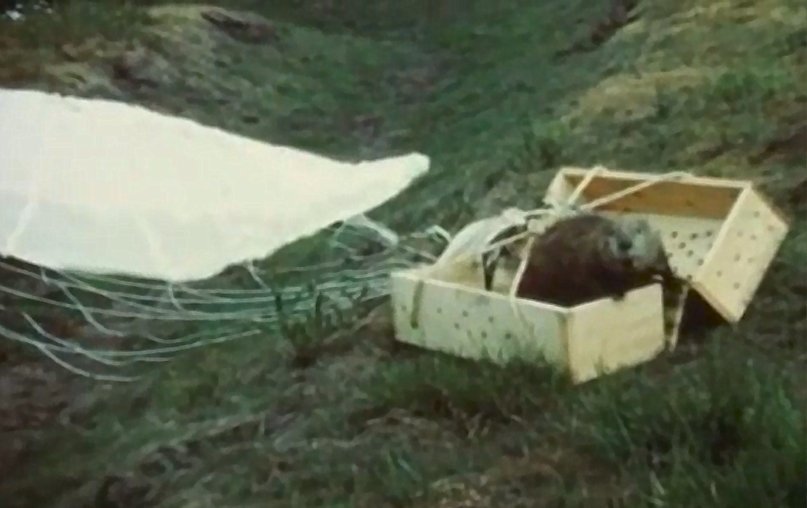
The plan used leftover World War II parachutes along with specially designed wooden boxes. These boxes had breathing holes and were made in two fitted halves, hinged together like a suitcase. Heavy elastic bands were attached to the bottom and up the sides. These acted like double springs, so when the box hit the ground, it would snap open automatically.
The boxes were held shut by ropes during the descent. Once they landed, the release system allowed the box to open so the beavers could emerge.
This was not done carelessly. The design was tested before the full operation began, including a trial using a beaver nicknamed Geronimo. Each wooden crate measured 30 inches by 12 inches by 8 inches, and two beavers were placed in each box.
The boxes were dropped from between 500 and 800 feet above the ground. That may sound dramatic, but the parachutes and spring-loaded crate design were intended to make the landing survivable and controlled.
Choosing the Right Beavers and the Right Sites
The operation involved more than simply loading up random animals and hoping for the best. Conservation officers worked with the Idaho State Fur Supervisor to choose suitable release sites carefully.
They also used what they had learned from earlier relocation efforts. Younger beavers were thought to be easier to move successfully. Officials also found that the best group for relocation was four beavers at a time: one male and three females.
That detail shows how much planning went into the project. The goal was not just to drop animals into the wilderness, but to give them a strong chance of establishing themselves in a new environment.
The 1948 Beaver Drop
On August 14, 1948, a twin-engine Beechcraft took off carrying eight crates of beavers, along with a pilot and a conservation officer. Over the following days, 76 beavers were parachuted into meadows in the Chamberlain Basin.
The result was remarkable: 75 of the 76 survived.
The only loss came when one beaver forced its way out of its box during the parachute descent and fell to its death. Even with that casualty, the operation compared very favorably with older transportation methods, which had caused much greater stress and death.
For a project that sounds almost absurd at first hearing, the survival rate was exceptionally high.
Why the Beaver Drop Worked
The Idaho Beaver Drop solved several problems at once.
First, it removed beavers from settled areas where they were damaging property.
Second, it placed them in remote wetlands where their dam-building and habitat-shaping behavior could benefit the environment.
Third, it avoided the long and punishing overland transport system that had caused overheating, stress, and high mortality.
And finally, it was more cost-effective. In simple terms, that means it delivered better results for less money and effort than the old method.
By 1949, officials judged the operation a success after observing that the relocated beavers had built homes in their new area. The strange experiment had accomplished exactly what it set out to do.
From Conservation Project to Idaho Legend
The beaver drop quickly became famous because it sat at the perfect intersection of practical conservation and sheer improbability. In 1949, Popular Mechanics published a story on the operation and gave the animals a memorable nickname: “Parabeavers.”
Over time, the project came to be remembered as both ingenious and bizarre. Those two descriptions are not contradictory. It was bizarre because parachuting beavers from an airplane sounds like something invented for a tall tale. It was ingenious because it genuinely solved a difficult logistical problem.
Decades later, the story found a new audience. In 2015, fish and game historian Sharon Clark discovered film footage of the beaver drops. The film had been mishandled and misclassified, so it was digitized and uploaded to YouTube by the Idaho State Historical Society.
The unusual footage helped turn the episode into an internet-era curiosity. The story’s afterlife kept growing. In 2022, New Colony Beer Company in Boise changed its logo to a parachuting beaver to honor the project. In 2023, East Idaho News described the effort as an Idaho icon, noting that the parachuting beaver image had appeared on locally made clothing, in a children’s book, and even as brewery branding.
The legend continued into sports as well. In 2025, the Boise Hawks baseball team announced a temporary rebrand as the “Boise Battle Beavers” in commemoration of the beaver drops.
Did Idaho Keep Parachuting Beavers?
Idaho continued trapping and relocating beavers long after the famous 1948 mission, but the airborne method did not remain in regular use. In 2015, Idaho state fur bearer manager Steve Nadeau said it had been 50 years since the state had relocated beavers by air.
Why the project ended is not fully clear. Idaho Fish and Game’s Steve Liebenthal said he did not know the exact reason, but assumed officials had achieved what they wanted in the area and no longer needed to continue.
Even without repeated use, the original mission had already secured its place in wildlife history.
A Wildlife Story That Still Stands Out
The Idaho Beaver Drop remains memorable because it captures a rare combination of creativity, practicality, and conservation thinking. It recognized that beavers could be destructive in one setting and deeply beneficial in another. Instead of simply removing the animals, officials found a way to relocate them where they could thrive and help rebuild wetland systems.
That solution involved trucks, traps, mountain terrain, wartime surplus parachutes, custom spring-loaded crates, and a leap of imagination that few people would ever have proposed.
What sounds like a joke today was, in reality, a carefully planned operation that reduced costs, lowered mortality, and successfully established beavers in a new landscape. Few wildlife projects have ever been so strange, so effective, and so unforgettable.
Sources
Based on information from Beaver drop.
Related articles
More like this
More about biology
More about history
More about nature
Take the leap into weird and wonderful history — download DeepSwipe and let knowledge drop in daily.