Full article · 8 min read
Great Molasses Flood: When Boston Drowned in Syrup
The day Boston faced a wave no one could imagine
On January 15, 1919, Boston’s North End was struck by one of the strangest and deadliest industrial disasters in American history. A huge storage tank at the Purity Distilling Company facility on Commercial Street burst open, releasing 2.3 million U.S. gallons of molasses into the neighborhood.
This was not a slow ooze. The collapsing tank unleashed a massive surge that raced through the streets at an estimated 35 miles per hour. At its peak, the wave reached about 25 feet high. In seconds, a substance most people associate with baking and sweetness became a force powerful enough to crush buildings, hurl debris, and kill 21 people while injuring 150 more.
The event became known as the Great Molasses Flood, or the Boston Molasses Disaster. More than a century later, it still stands out because it sounds almost unreal. Yet the destruction was devastatingly real.
Why there was so much molasses in the first place
Molasses is a thick, dark syrup often produced during sugar refining. In this case, it was valuable for more than food. Molasses can be fermented to produce ethanol, which is the alcohol used in beverages and was also an important ingredient in munitions.
The Commercial Street tank stood near Boston Harbor, where molasses could be offloaded from ships and stored before being sent by pipeline to a Purity ethanol plant in nearby Cambridge. The tank itself was enormous: about 50 feet tall and 90 feet in diameter. When full, it held as much as 2.3 million gallons of molasses, weighing roughly 13,000 short tons.
That sheer mass mattered. Because molasses is denser than water, the tank held an immense amount of stored energy. Once the structure failed, that weight and pressure were suddenly released into the streets.
What caused the tank to burst
The disaster happened around 12:30 p.m. Witnesses described the ground shaking and a roar that sounded like a train, a crash, a thunderclap, or even machine-gun fire as rivets shot out of the tank.
Several factors may have contributed to the collapse. Temperatures in Boston had suddenly climbed above 40 degrees Fahrenheit after a stretch of frigid weather. The day before, a ship had delivered a fresh load of molasses that had been warmed to make it easier to transfer. One possible explanation is that the warmer new molasses expanded the older, colder molasses already inside the tank, increasing the pressure.
There were also serious structural problems. The tank may have leaked from the first day it was filled in 1915. It was poorly constructed and insufficiently tested. An inquiry found that Arthur Jell, treasurer of the United States Industrial Alcohol Company, had neglected basic safety tests during construction, including properly filling the tank with water to check for leaks. He also reportedly ignored warning signs such as groaning noises whenever the tank was filled.
The leaks were no secret. The tank reportedly leaked so badly that it was painted brown to hide the escaping molasses, and local residents collected the drips for home use.
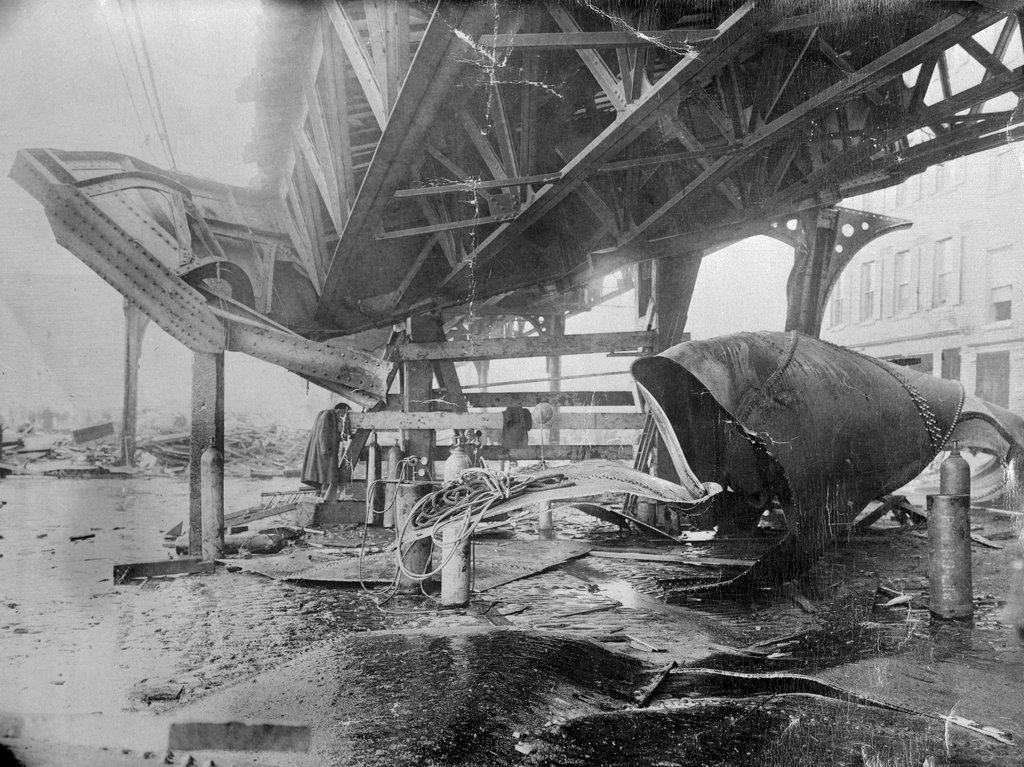
Later analysis added more detail. A 2014 engineering investigation concluded that the steel was only about half as thick as it should have been for a tank of that size, even by the standards of the time. The steel also lacked enough manganese, making it more brittle, meaning more likely to crack instead of bending safely under stress. The rivets were apparently flawed as well, and cracks seem to have formed at rivet holes. The failure occurred near a manhole cover at the base, where a fatigue crack may have grown until the tank gave way.
Why the molasses moved so fast
One of the most surprising parts of the Great Molasses Flood is how quickly it traveled. Many people would assume molasses would creep, not surge.
But molasses does not always behave in a simple way. It is described as a non-Newtonian fluid, meaning its viscosity, or resistance to flow, changes depending on conditions. Under pressure and heat, it can thin and flow much more quickly than expected. During the initial collapse, that helped produce a fast-moving, destructive wave.
Researchers at Harvard University revisited the disaster in 2016 using historical data, weather reports, old maps, and scale-model experiments with cold corn syrup. Their conclusion supported the reports that the flood’s speed was credible. They also found that the warmer molasses added shortly before the collapse likely reduced the syrup’s viscosity at first, helping it spread rapidly.
So the flood had a terrible two-stage character: first a fast, violent rush, then a thickening trap.
From moving wall to deadly snare
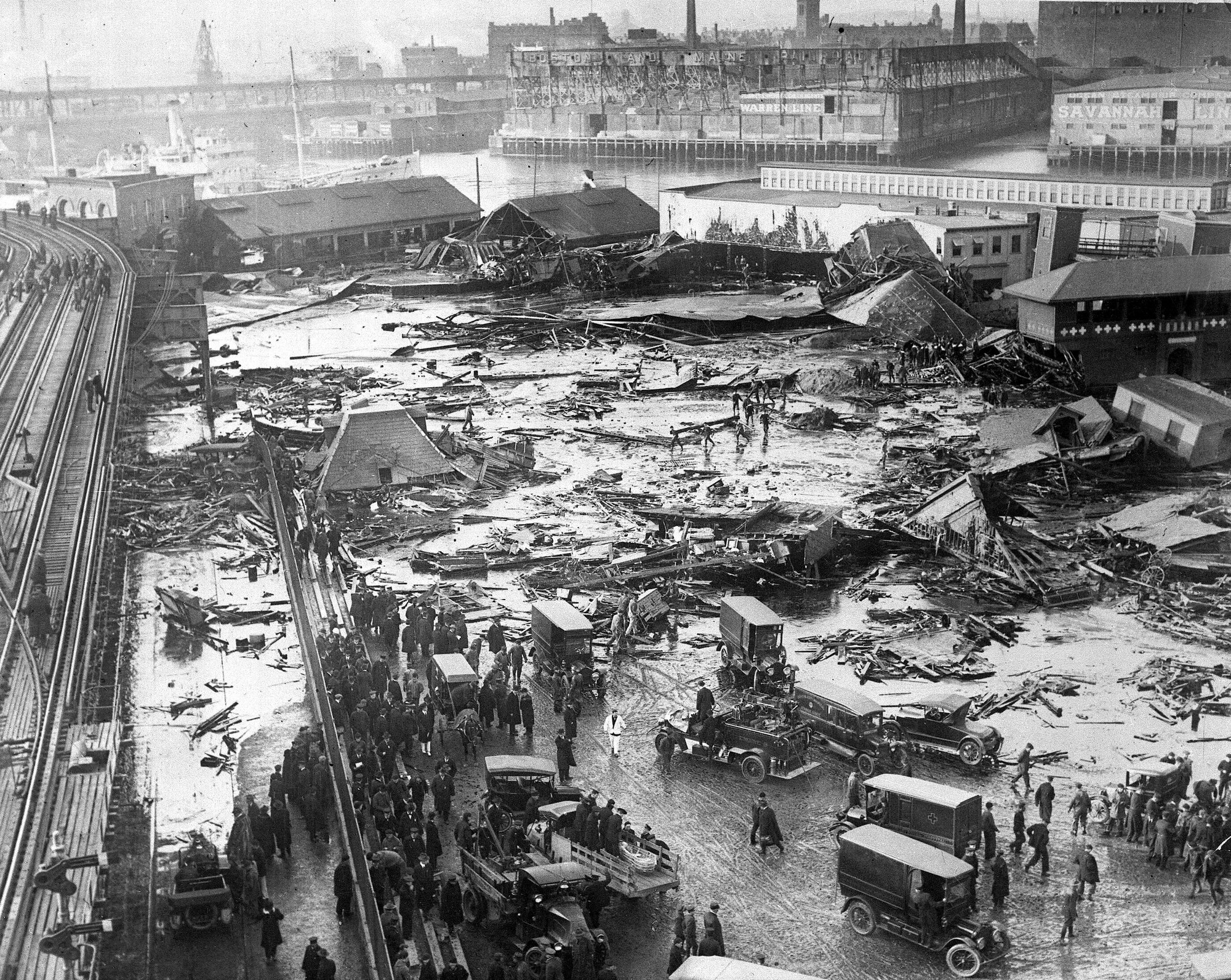
The initial wave was powerful enough to sweep buildings off foundations, shove steel tank panels into the adjacent elevated railway structure, and even tip a streetcar momentarily off its tracks. Several blocks were flooded to a depth of 2 to 3 feet.
Then the cold changed everything.
As the molasses spread through Boston’s winter air, it cooled quickly and became far more viscous, meaning thicker and stickier. That made rescue much harder. People and animals caught in the wave were not just struck by it; many were trapped in it.
This helps explain why the flood was so deadly. Victims were crushed, swept away, pinned by debris, or suffocated in the syrup. Horses, people, and dogs were among the injured. Coughing fits were one of the most common ailments after the blast. Some victims were carried all the way into Boston Harbor, and a few were not found until months later.
The combination of speed and stickiness is what made this event so unusual. Water floods can knock people down and wash them away. This flood did that at first, then hardened into a smothering mass that resisted every rescue effort.
The rescue effort in the North End
The first rescuers were 116 cadets from USS Nantucket, a training ship of the Massachusetts Nautical School docked nearby. Under Lieutenant Commander H. J. Copeland, they ran several blocks to the scene and entered the knee-deep molasses to pull out survivors.
Soon Boston police, the Red Cross, and Army and Navy personnel joined the effort. Red Cross nurses both treated the injured and, in some cases, plunged into the molasses itself. Doctors and surgeons created a makeshift hospital in a nearby building because so many people needed immediate care.
The work was grueling. Rescuers struggled to move through the syrup, and searching continued for four days before it stopped. Some of the dead were so coated in molasses that they were difficult to identify.
Cleanup that turned an entire city sticky
Cleaning up after the flood was a major challenge. Crews used salt water from a fireboat to wash away the molasses and spread sand to absorb it. The harbor remained brown with molasses until summer.
The immediate area took weeks to clean, and several hundred people worked on the effort. But the stickiness did not stay neatly in one place. Rescuers, workers, and sightseers tracked molasses through streets, onto subway platforms, into train and streetcar seats, onto pay telephone handsets, and into homes.
The result was a citywide mess so memorable that one report summed it up by saying that everything a Bostonian touched was sticky.
The lawsuits and lasting legal impact
After the disaster, 119 residents brought a class-action lawsuit against the United States Industrial Alcohol Company, which had purchased Purity Distilling in 1917. This case became one of the first class-action suits in Massachusetts and is considered a milestone in the development of modern corporate regulation.
The company argued that anarchists had blown up the tank, claiming that some of the alcohol produced there was intended for munitions. But after three years of hearings, a court-appointed auditor found the company responsible. USIA eventually paid $628,000 in damages. Relatives of those killed reportedly received around $7,000 per victim.
The disaster also helped bring broader changes. Laws and regulations governing construction were changed as a direct result, including requirements for oversight by a licensed architect and civil engineer.
The site today and the memory that lingered
The tank was never rebuilt. The former site later became part of a railway yard and is now the location of Langone Park, a city-owned recreational complex with a Little League baseball field, a playground, and bocce courts. Nearby Puopolo Park includes additional recreational space.
A plaque at the entrance to Puopolo Park commemorates the flood and notes that structural defects in the tank, combined with unseasonably warm temperatures, contributed to the tragedy.
Even after the wreckage was gone, the memory stayed. For decades, local residents said the North End still smelled like molasses on hot summer days. That detail helped transform the disaster into local folklore, but the human cost remained central. On the 100th anniversary in 2019, a memorial ceremony marked the event, and the names of the 21 people who died were read aloud.
Why the Great Molasses Flood still fascinates people
The Great Molasses Flood is remembered because it combines the unbelievable and the tragic. A tank of syrup bursting in a busy city sounds bizarre, almost comic at first glance. But the facts are grim: a 25-foot wave, streets swamped, buildings wrecked, victims trapped in thickening molasses, and a neighborhood transformed in moments.
It also endures because it says something larger about industrial safety. The disaster exposed what can happen when poor construction, ignored warning signs, and lack of oversight meet massive stored force. What looked like an ordinary storage tank was, in reality, a disaster waiting to happen.
That is why the story has lasted so long in Boston’s culture. It is unforgettable not just because it involved molasses, but because it revealed how something familiar and seemingly harmless could become catastrophic under the wrong conditions.
Sources
Based on information from Great Molasses Flood.
Related articles
More like this
More about culture
More about history
Don’t get stuck in the sticky side of history — download DeepSwipe and let fascinating stories rush your way daily.


