Full article · 7 min read
Wojtek the Bear in World War II: The Animal Who Became a Polish Soldier
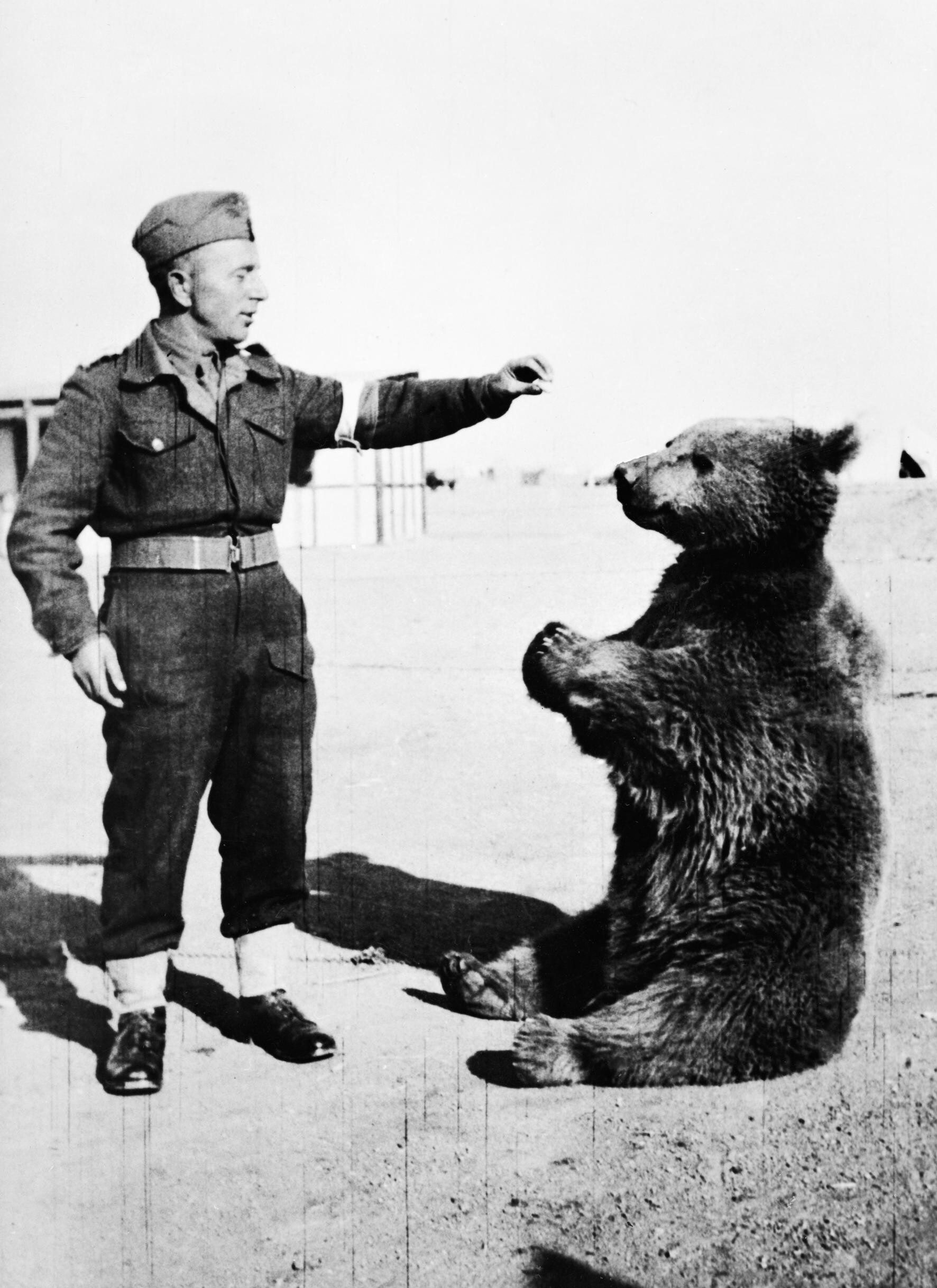
It sounds almost unbelievable: during World War II, a bear was officially enlisted in the Polish Army. But Wojtek, a Syrian brown bear, was far more than a mascot in military history. He had a rank, a paybook, and a serial number, and he traveled with Polish forces from the Middle East to Italy.
His story stands out because it combines the chaos of war with something deeply human: companionship, improvisation, and loyalty. What began with the rescue of a young bear cub became one of the most unusual wartime legends of the 20th century.
How Wojtek Joined the Polish Army
In the spring of 1942, Anders' Army left the Soviet Union for Iran. With them were thousands of Polish civilians who had been deported to the Soviet Union after the 1939 Soviet invasion of eastern Poland. During the journey from Pahlavi to Tehran on 8 April 1942, Polish soldiers came across a young Iranian boy who had found a bear cub after its mother had been shot by hunters.
An 18-year-old civilian refugee, Irena Bokiewicz, became especially attached to the cub and encouraged Lieutenant Anatol Tarnowiecki to buy it. For about three months, the bear lived in a Polish refugee camp near Tehran and was mainly cared for by Irena. In August, the cub was donated to the 2nd Transport Company, later known as the 22nd Artillery Supply Company. The soldiers named him Wojtek.
The name Wojtek is a diminutive, or familiar form, of the Polish given name Wojciech, an old Slavic name that is still common in Poland.
From Bear Cub to Camp Favorite
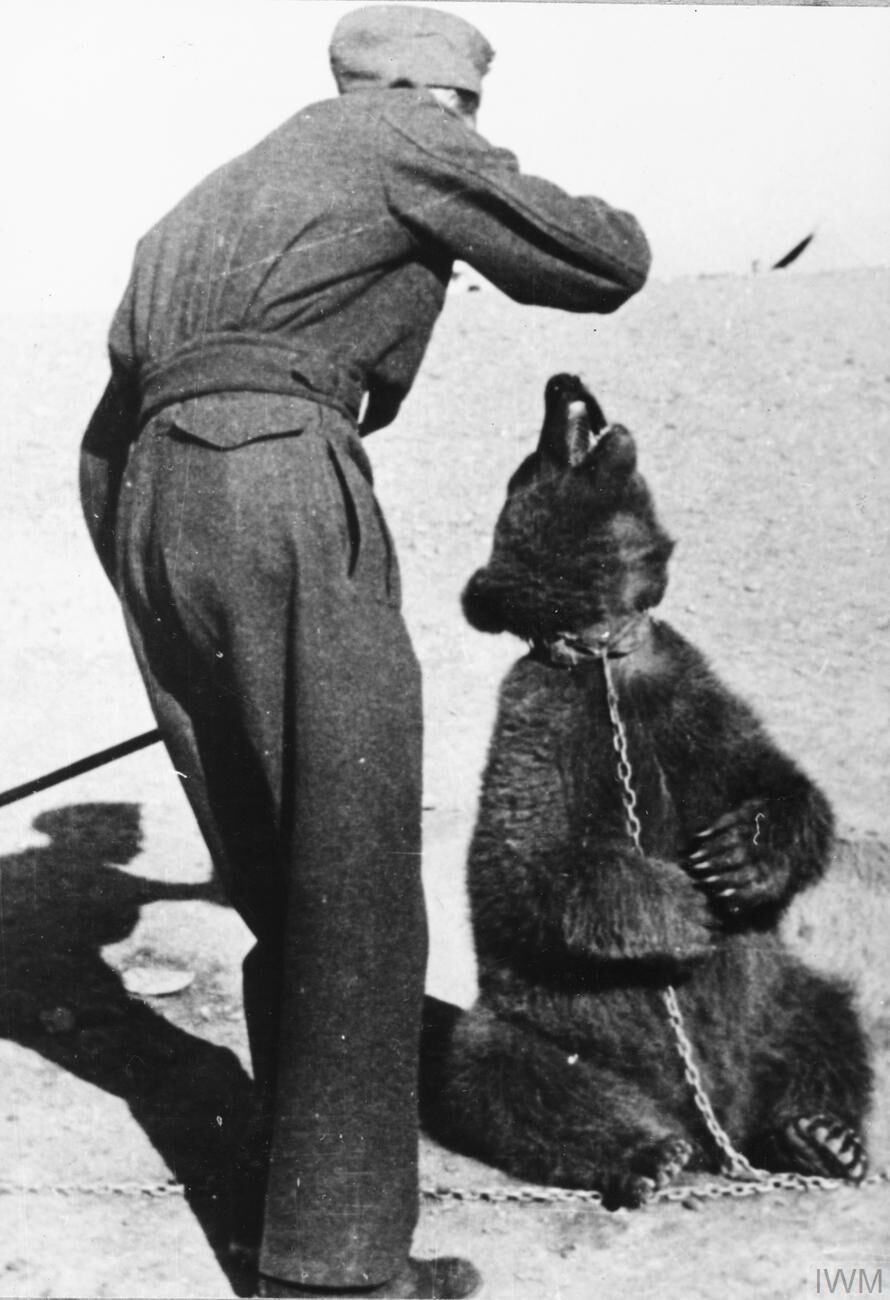
Wojtek’s early days with the soldiers were memorable for another reason: he had trouble swallowing. To feed him, the men gave him condensed milk from an old vodka bottle. As he grew, his diet expanded to include fruit, marmalade, honey, and syrup. He was also often rewarded with beer, which became his favorite drink.
Wojtek picked up some very human habits. He enjoyed smoking or eating cigarettes and drinking coffee in the mornings. He slept with the soldiers when nights were cold, wrestled with them for fun, and was taught to salute when greeted. Before long, he had become an attraction not only for the unit but also for nearby soldiers and civilians.
A mascot is an animal or symbol associated with a group, often representing its spirit or identity. Wojtek became much more than an unofficial mascot, but that role was an important part of how his legend began.
As the 22nd Company moved through Iraq, Syria, Palestine, Egypt, and Italy, Wojtek went with them. He even copied the soldiers by marching alongside them on his hind legs. He had his own assigned caregiver, and by the time of the Battle of Monte Cassino, he had grown to 90 kilograms, or about 200 pounds.
Why a Bear Was Officially Drafted
One of the strangest and most famous moments in Wojtek’s story happened before the unit sailed to Italy.
The Polish II Corps had been reassigned from Egypt to fight alongside the British Eighth Army. A corps is a very large military formation made up of several divisions. The British Eighth Army was already well known for fighting in North Africa, including at El Alamein, and later in the Italian campaign.
But there was a problem. British transport ship regulations did not allow mascots or pet animals on board. The soldiers found an extraordinary solution: they officially enlisted Wojtek in the Polish Army.
He was drafted as a private, which is a low-ranking enlisted soldier. This made him, on paper, a legitimate member of the 22nd Artillery Supply Company rather than a pet. Two men, Henryk Zacharewicz and Lew Worzowski, were assigned as his caretakers.
As an enlisted soldier, Wojtek had his own paybook, rank, and serial number. He lived with the other men, either in tents or in a special wooden crate transported by truck. Few wartime stories capture military bureaucracy and battlefield absurdity quite like a bear becoming an official soldier so he could board a ship.
Monte Cassino and the Ammunition Crates
Wojtek’s legend reached its peak during the Battle of Monte Cassino in 1944. This battle in Italy became one of the defining episodes of his wartime service.
At Monte Cassino, Wojtek reportedly helped carry ammunition for his unit. Specifically, he carried 100-pound crates of 25-pound artillery shells and never dropped them. Artillery shells are large explosive projectiles fired by heavy guns. Ammunition supply was vital in wartime, and moving shells efficiently could make a real difference to troops in combat.
Accounts of the episode have generated debate over complete accuracy, but at least one British soldier later recalled seeing a bear carrying crates of ammunition. According to the story, Wojtek copied the men when he saw them lifting boxes. The crates normally required four men, yet he carried them and stacked them onto trucks or on top of other ammunition boxes.
Whether viewed as a literal battlefield feat, an extraordinary wartime memory, or both, the image is unforgettable: a bear mimicking soldiers under combat conditions and helping move vital supplies.
After the Polish victory, Wojtek became a celebrity among visiting Allied generals and statesmen. In recognition of his service, he was promoted from private to corporal. A corporal is a soldier ranked above a private. The promotion helped cement his reputation as not just a mascot or curiosity, but a celebrated member of the unit.
The Emblem of the 22nd Company
Wojtek’s fame did not stop at stories told around campfires or passed between soldiers. His image became part of the official identity of the 22nd Artillery Supply Company.
The company adopted an emblem showing a bear carrying an artillery shell. An emblem is a symbol used to represent a group, organization, or idea. In this case, the emblem captured exactly what made Wojtek legendary: strength, loyalty, and his connection to the soldiers he traveled with.
That image of a bear with a shell remains one of the most recognizable visual symbols linked to Wojtek’s story.
What Happened to Wojtek After the War
After World War II ended in 1945, Wojtek traveled with the rest of the 22nd Company to Berwickshire in Scotland through the Polish Resettlement Corps. They were stationed at Winfield Airfield on Sunwick Farm near the village of Hutton in the Scottish Borders.
He quickly became popular with local civilians and the press, and the Polish-Scottish Association made him an honorary member. After demobilization on 15 November 1947, Wojtek was given to Edinburgh Zoo, where he spent the rest of his life.
Former Polish soldiers and journalists often visited him there. Some of the soldiers tossed him cigarettes, echoing his army days. He still responded happily to people speaking Polish and recognized many men from his former unit. He also appeared frequently on the BBC children’s television program Blue Peter.
Wojtek died on 2 December 1963 at the age of 21 from natural causes. By then, he weighed nearly 500 kilograms, or about 1,100 pounds, and stood over 1.8 meters tall.
Why Wojtek Still Matters
Wojtek’s story has lasted because it sits at the crossroads of war history, military culture, and personal memory. He was rescued as a cub, raised among soldiers, formally enlisted to bypass transport rules, and remembered for carrying ammunition at one of the most famous battles involving Polish forces in Italy.
His legacy lives on in memorials and statues in places including London, Kraków, Edinburgh, Duns, Poznań, Cassino, Szczecin, and Sopot. A street in Poznań was named ulica Kaprala Wojtka, or Corporal Wojtek Street. His story has also been adapted into a 2024 play by Allan Pollock and an animated short film, A Bear Named Wojtek, which was released in 2024 and went on to receive 17 award nominations, including in the Animated Short Film category of the Academy Awards.
Wojtek remains one of the most unusual figures connected to World War II. He was a bear, but he was also something else in the eyes of the men around him: a companion, a symbol, and a soldier whose story still captures imaginations decades later.
Sources
Based on information from Wojtek (bear).
More like this
More about culture
More about history
More about war
March into your next rabbit hole like Wojtek at Monte Cassino — download DeepSwipe and carry home a crate of fascinating facts.