Full article · 8 min read
Black Holes and the No-Hair Surprise
Black holes are famous for seeming impossibly mysterious, but one of the strangest ideas about them is actually a claim of radical simplicity. According to the no-hair theorem, once a black hole settles down into a stable state, it is completely described by just three physical properties: mass, electric charge, and angular momentum, often called spin. In other words, all the messy details of what fell in are hidden from the outside world.
That is the “no-hair” surprise. A black hole may form from a collapsing star, grow by swallowing gas, or merge with another black hole, yet once it becomes stationary, the outside description becomes astonishingly minimal. If two stationary black holes have the same mass, charge, and spin, they are indistinguishable from one another.
What “no hair” actually means
In this context, “hair” does not mean anything literal. It means extra distinguishing features: details about the matter and radiation that formed the black hole or later fell into it. The no-hair theorem says those details do not remain visible in the black hole’s final stationary exterior.
A stationary black hole is one that is no longer in the middle of changing wildly after formation or accretion. It may still rotate, but its overall state is stable in time. In that settled condition, the theorem says the black hole is described entirely by:
- mass
- angular momentum (spin)
- electric charge
This idea emerged during the golden age of black hole research in the 1960s and 1970s. Werner Israel showed in 1967 that the Schwarzschild solution was the only possible solution for a nonspinning, uncharged black hole, meaning that such a black hole is defined by mass alone. Similar results were later found for other black hole types, leading to the broader no-hair theorem.
The simplest case is the Schwarzschild black hole: no spin, no charge, just mass. More general black holes are described by other solutions. A non-rotating charged black hole is described by the Reissner–Nordström metric. A rotating uncharged one is described by the Kerr metric. The most general stationary solution known, including both charge and spin, is the Kerr–Newman metric.
Why this is so counterintuitive
Ordinary objects carry a rich history. A planet, star, or cloud of gas can have layers, composition differences, magnetic structure, temperature patterns, and all kinds of irregularities. Black holes appear to erase almost all of that complexity from the outside.
This is especially striking because black holes can form in violent ways. They typically arise when very massive stars collapse at the end of their life cycle. They can also grow by accreting surrounding matter, and supermassive black holes may become enormous by absorbing stars and merging with other black holes. Yet despite these chaotic origins, the final stationary object may be almost featureless from the outside.
The article notes, however, that the degree to which the no-hair conjecture is exactly true remains an unsolved problem. So while it is a central idea in black hole physics, it is not the end of the story.
The three numbers that survive
Mass
Mass is the most basic property of a black hole. From far away, the external gravitational field of a black hole is identical to that of any other body with the same mass. That means a black hole does not somehow “pull harder” just because it is a black hole.
Astronomers can estimate a black hole’s mass by studying the motion of nearby stars or gas. This is how black holes are identified in binary systems and in galactic centers.
Spin
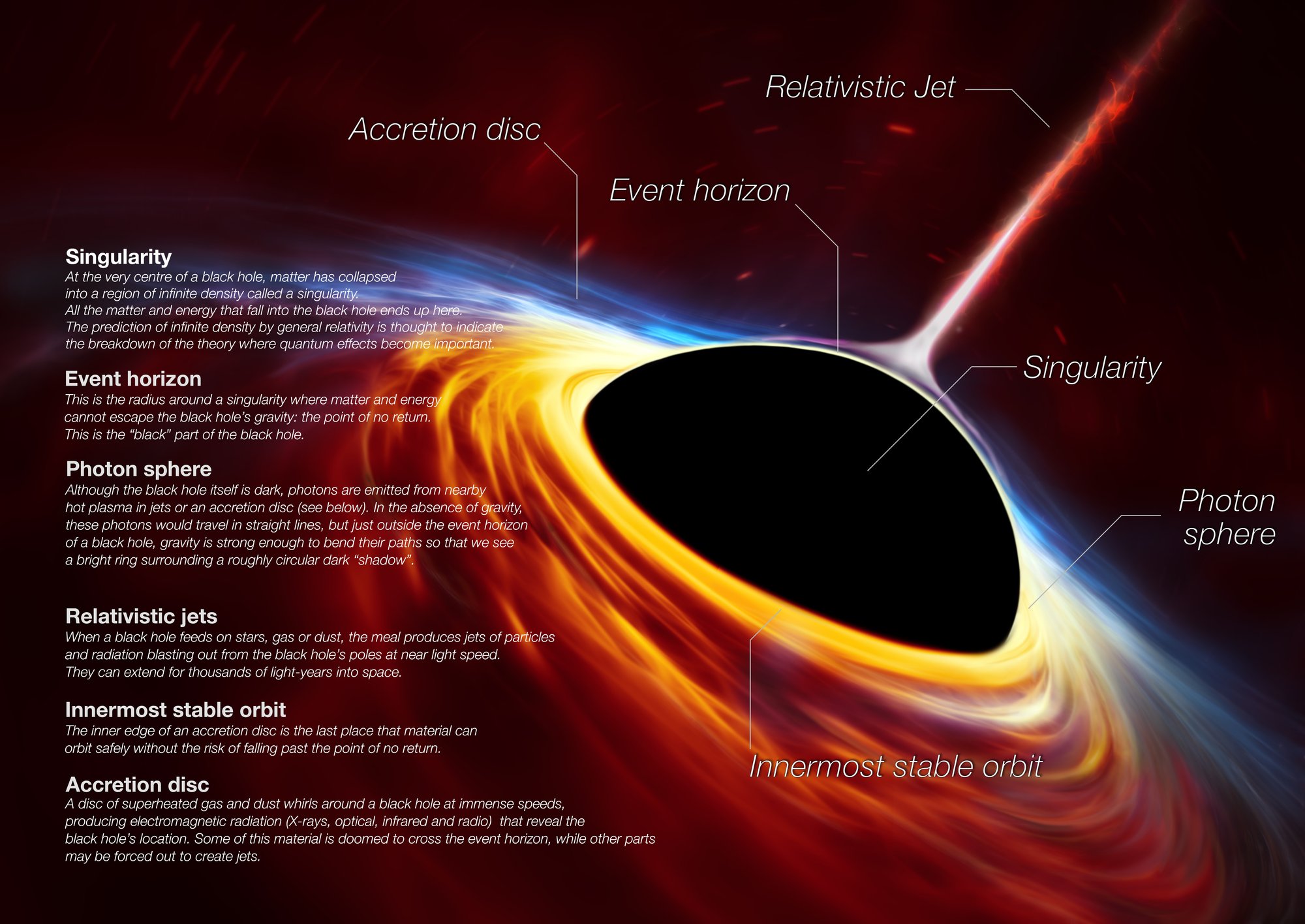
Spin, or angular momentum, measures how fast a black hole rotates. Black holes can spin very rapidly. The article notes that all black holes spin, often fast. Spin changes the geometry around the black hole, affecting features such as the innermost stable circular orbit and the ergosphere, where spacetime is dragged around by rotation.
Spin can be estimated from X-ray measurements of matter accreting near the black hole, from computer modelling of hot accreting gas, and in some cases from gravitational waves emitted during black hole mergers.
Charge
Electric charge is the third parameter, though most black holes are believed to be approximately neutral. A highly charged black hole would attract opposite charges and repel like charges, tending to neutralize itself. For that reason, charge is expected to be small in realistic astrophysical black holes.
The event horizon: where the outside story ends
The defining feature of a black hole is the event horizon, the boundary beyond which nothing can escape, not even light. It is the boundary of no return.
This is crucial to the no-hair idea. If information from inside the horizon cannot affect the outside world, then the external description can become much simpler than the complex story of what fell in.
General relativity predicts something even stranger: crossing the event horizon produces no locally detectable change for an infalling observer. A person falling in would not notice a dramatic boundary at the horizon itself. But for an outside observer, the object would appear to slow down, redden, and fade as it approached the horizon because of gravitational time dilation and gravitational redshift.
That contrast between outside appearance and local experience is one reason black holes are so conceptually challenging.
Black hole mechanics and the thermo-twist
One of the deepest surprises in black hole physics is that black holes obey laws that resemble thermodynamics, the branch of physics dealing with heat, energy, temperature, and entropy.
Black hole mechanics relates quantities such as:
- surface area
- surface gravity
- energy
- angular momentum
- charge
These laws were developed in the early 1970s by James Bardeen, Jacob Bekenstein, Carter, and Hawking.
Surface gravity is a measure tied to the gravitational pull at the event horizon. The surface area is the area of the horizon itself. The analogy with thermodynamics became especially powerful because these black hole properties behave in ways similar to temperature and entropy.
For example, the second law of black hole mechanics says the surface area of a black hole never decreases on its own. This parallels the thermodynamic idea that entropy, often described as a measure of disorder or the number of microscopic arrangements, does not spontaneously decrease in an isolated system.
At first, this was only an analogy. In classical general relativity alone, a black hole cannot emit radiation, so it would have zero temperature. But quantum mechanics changed that picture.
Hawking radiation: black holes are not perfectly black
In 1974, Hawking showed that quantum field theory implies black holes should radiate like a black body, with a temperature proportional to the surface gravity. This prediction is known as Hawking radiation.
That result transformed black hole thermodynamics from an elegant analogy into something much more literal. If a black hole has a temperature, then it can emit radiation. If it emits radiation, then it can slowly lose mass.
For astrophysical black holes, this effect is extremely weak. Stellar-mass black holes gain more mass from the cosmic microwave background than they lose through Hawking radiation. So the evaporation is not important for ordinary observed black holes right now. But conceptually, Hawking radiation is enormous: it means black holes are thermodynamic objects.
The information paradox
Here is where the no-hair theorem becomes more than a neat simplification. It turns into a profound problem.
A black hole is externally characterized only by mass, charge, and angular momentum. That seems to mean all the other information about what formed it is inaccessible from the outside. If black holes lasted forever, one could imagine that information still existed inside.
But Hawking radiation complicates that hope. The radiation appears thermal and featureless. It does not seem to carry the detailed information about the exact quantum state of the matter that fell in.
So if the black hole eventually evaporates, what happens to that information?
That is the black hole information paradox. It is one of the central open questions in theoretical physics because it sits at the clash point between general relativity and quantum mechanics.
The paradox matters because quantum mechanics strongly suggests that information should not simply vanish. Yet the black hole picture seems to threaten exactly that. The article notes that theoretical study of the paradox has generated further paradoxes and new ideas about the relationship between quantum mechanics and general relativity, but there is still no consensus resolution.
Why the paradox is tied to no hair
The no-hair theorem strips the black hole’s exterior down to three numbers. Hawking radiation then seems to come out with no memory of the infalling details. Put those together and it looks as though the universe may destroy information.
That is why the no-hair idea is not just a catchy slogan. It is a doorway into one of the deepest unsolved problems in modern physics.
Even the article’s discussion of alternatives and open questions shows how unsettled the deeper picture remains. Some hypothetical models avoid singularities or rethink the interior, and the exact truth of the no-hair conjecture itself remains an active issue. But within standard black hole physics, the triad of mass, charge, and spin remains the defining external summary.
A simple exterior hiding extreme physics
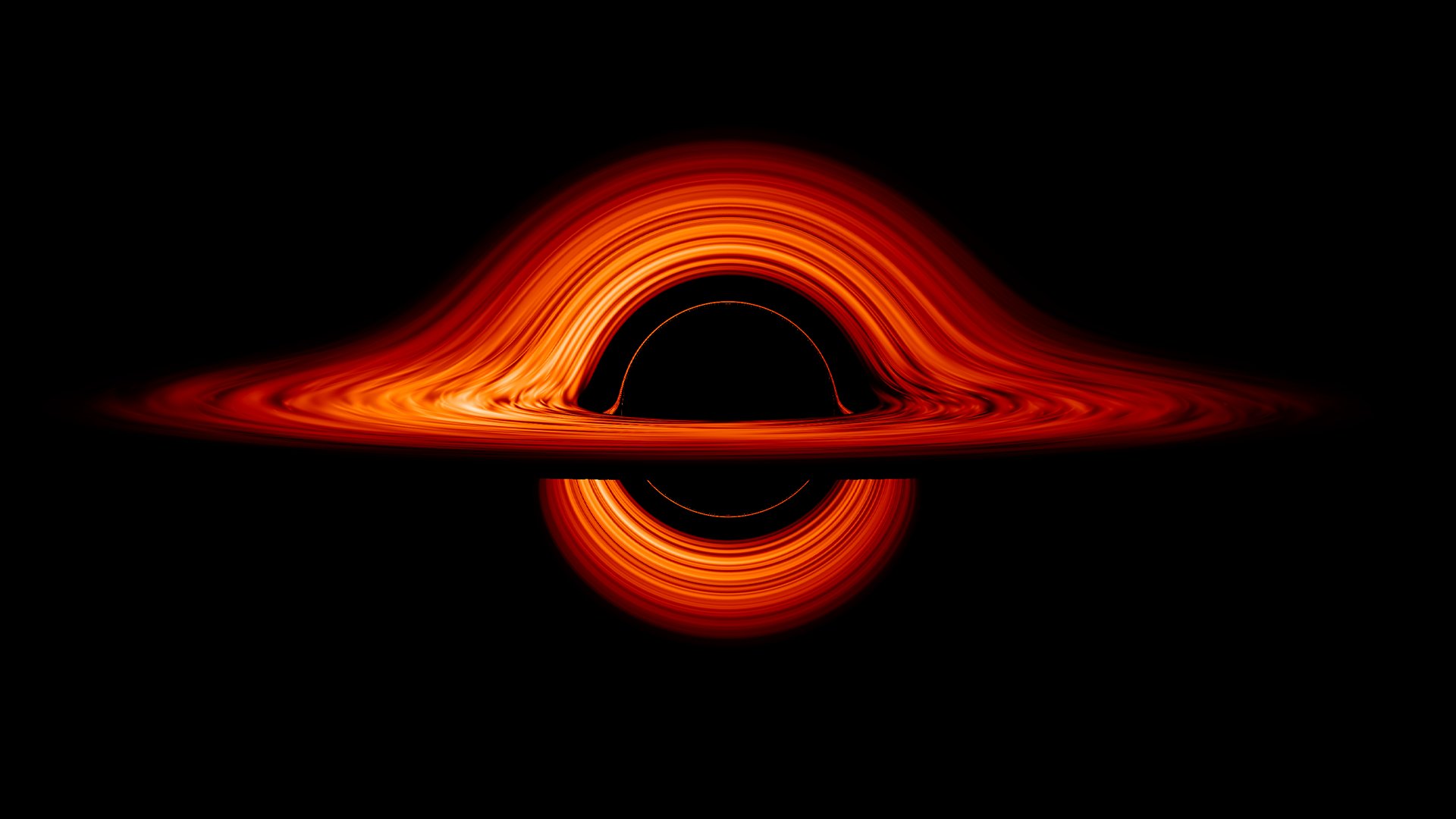
Black holes are among the most dramatic objects in the universe. They can power quasars, shape galactic centers, produce relativistic jets, merge to create detectable gravitational waves, and distort light through their gravity. Yet the settled black hole itself may be externally almost featureless.
That contrast is what makes the no-hair surprise so memorable. Nature seems to take an incredibly complicated history and compress it into three numbers.
And from that compression emerges a mystery that still has no accepted answer: if a black hole forgets almost everything, does the universe forget too?
Sources
Based on information from Black hole.
More like this
Lose yourself in cosmic mysteries, not in doomscrolling — download DeepSwipe and collect knowledge faster than a black hole collects mass.