Full article · 8 min read
Rosetta Stone and the Decoding of Egyptian Hieroglyphs
The stone that cracked an ancient code
For centuries, Egyptian hieroglyphs were visible everywhere on temple walls, monuments, and carved objects, yet nobody could truly read them. People could admire their beauty and recognize them as the writing of ancient Egypt, but the language behind the symbols had been lost. The Rosetta Stone changed that.
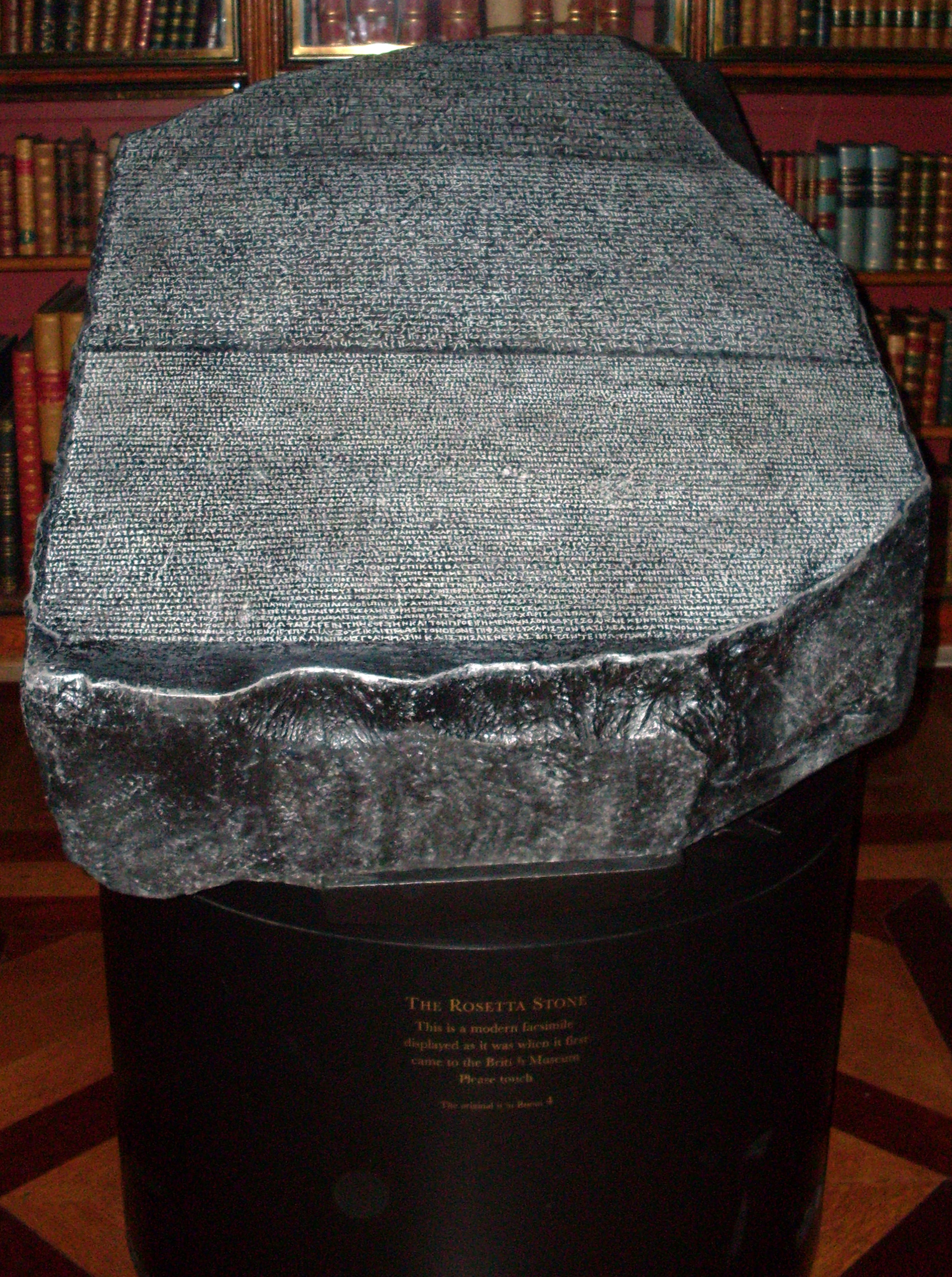
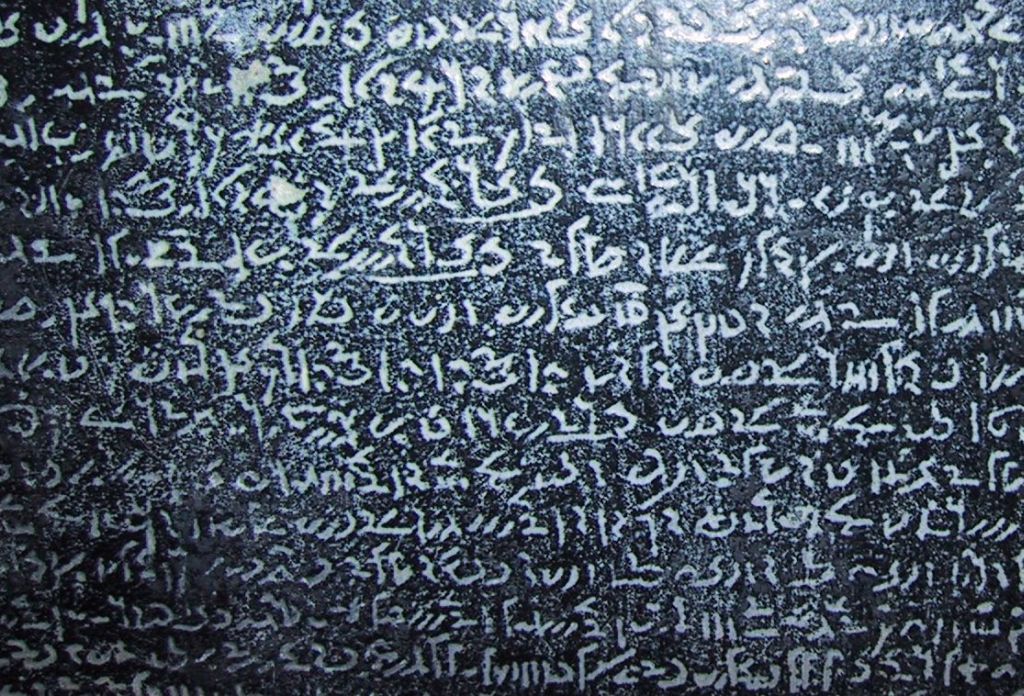
What made it so extraordinary was simple in principle and revolutionary in practice: it carried the same decree in three scripts. The top section used Egyptian hieroglyphs, the middle used Demotic, and the bottom used Ancient Greek. Because the versions differed only slightly, scholars could compare them and begin working out how the Egyptian scripts functioned.
This made the Rosetta Stone the essential key to the modern understanding of ancient Egyptian literature and civilisation. Its importance was so great that the phrase “Rosetta Stone” later came to mean any crucial clue that unlocks a difficult field of knowledge.
One decree, three scripts
The inscription records a decree issued in 196 BC during the Ptolemaic dynasty of Egypt on behalf of King Ptolemy V Epiphanes. A decree is an official public order or announcement. In this case, it was connected to the king’s coronation and the establishment of his divine cult.
The three writing systems on the stone were not there by accident. The decree itself instructed that copies should be placed in every temple in three forms: the “language of the gods,” the “language of documents,” and the “language of the Greeks.”
Those three forms were:
- Egyptian hieroglyphs, used for formal religious texts
- Demotic, a later Egyptian script used for documents and everyday written administration
- Ancient Greek, the language used by the Ptolemaic government
This combination made the stone unusually powerful as a tool for decipherment. Greek was already known to scholars, so it provided a readable anchor. From there, researchers could compare names, repeated phrases, and patterns across the other scripts.
Why Greek changed everything
Ancient Greek gave scholars a starting point that earlier generations had lacked. Once the Greek text could be translated, researchers knew the general meaning of the inscription. They were no longer staring at unknown symbols with no context at all. They were examining a message whose content could already be understood.
That mattered enormously. If a king’s name appeared in the Greek text, scholars could look for where that same name should appear in Demotic and hieroglyphs. If a title or place name repeated, they could search for matching patterns. This turned the problem from a mystery into a comparison exercise.
The first complete translation of the Greek text was published in 1803. Even that was not perfectly straightforward, because scholars still had to grapple with the specific administrative and religious language of Hellenistic Egypt. But Greek opened the door.
What exactly was Demotic?
Demotic was a script used for Egyptian writing that more closely represented the stage of Egyptian spoken in Ptolemaic times. Compared with hieroglyphs, it was more practical for documents and administration.
That distinction is important. Hieroglyphs are the famous picture-like symbols most people associate with ancient Egypt. But they were not simply decorative pictures. By the time of the Rosetta Stone, hieroglyphic writing was already a deliberately archaic form used in formal religious settings. The hieroglyphic text on the stone was written in Middle Egyptian, specifically a consciously old-fashioned form known as neo-Middle Egyptian.
Demotic, by contrast, belonged to the living documentary world. That made it a vital bridge between the ceremonial script of hieroglyphs and the known text in Greek.
The breakthrough was gradual, not magical
The Rosetta Stone is often treated like a single dramatic “aha” moment, but the real story was slower and more interesting. The decipherment of Egyptian writing happened step by step.
Several major advances were needed:
- recognition that the stone contained three versions of the same text
- recognition that Demotic used phonetic characters to spell foreign names
- recognition that hieroglyphs did this too and shared significant similarities with Demotic
- recognition that phonetic characters were also used to spell native Egyptian words
A phonetic character is a symbol that represents sound rather than a whole idea. That insight was crucial because many scholars had assumed hieroglyphs were purely symbolic or pictorial. Once researchers understood that some signs could stand for sounds, the script became far more accessible.
How scholars began matching names
One of the earliest and most productive strategies was to look for royal names. Since the Greek text identified rulers and other important figures, scholars tried to find their equivalents in the Egyptian scripts.
The Swedish scholar Johan David Åkerblad and the French scholar Antoine-Isaac Silvestre de Sacy worked on the middle text, the Demotic inscription. By comparing it with the Greek, they identified names such as Alexandros, Alexandreia, Ptolemaios, Arsinoe, and Epiphanes. Åkerblad even published an alphabet of 29 letters, more than half of which turned out to be correct.
This did not solve the script fully, but it proved that Demotic included phonetic writing.
The next critical leap came with hieroglyphs. Thomas Young identified phonetic characters used to write the Greek name Ptolemaios in the hieroglyphic text. He also noticed that many hieroglyphic signs had counterparts in Demotic. That was a major discovery because the two systems had often been treated as entirely different.
Then Jean-François Champollion pushed much further. Using copies of inscriptions and comparing names such as Ptolemaios and Kleopatra, he built an alphabet of phonetic hieroglyphic characters. In 1822 he announced his breakthrough in Paris. This became a turning point in the reading of ancient Egyptian texts.
Why hieroglyphs had become unreadable
The loss of the script had been a long historical process. Even in late ancient Egypt, knowledge of hieroglyphs had become increasingly specialized. By the 4th century AD, few Egyptians could still read them. Their monumental use ended as temple priesthoods disappeared and Egypt was converted to Christianity.
The last known hieroglyphic inscription is dated to 24 August 394 at Philae. The last known Demotic text, also from Philae, was written in 452.
After that, hieroglyphs remained visible but silent. Later writers often focused on their picture-like appearance and misunderstood how they worked. Attempts to decode them continued for centuries, but without the missing link that the Rosetta Stone eventually provided.
The decree behind the inscription
The text itself was not a poem or a myth but an official decree issued by a congress of priests at Memphis. Memphis was especially important because it was the place where the king was crowned and because the High Priests of Memphis had major religious influence across Egypt.
The decree praised Ptolemy V and recorded gifts of silver and grain to the temples. It also mentions especially high flooding of the Nile in the eighth year of his reign and says that the excess waters were dammed for the benefit of farmers. In return, the priesthood pledged annual celebrations for the king’s birthday and coronation, and ordered that copies of the decree be erected in temples.
This context matters because it explains why the text appeared in multiple scripts. The Ptolemaic government was Greek-speaking, but Egyptian religious institutions remained central to the kingdom’s legitimacy. A trilingual decree allowed the message to operate across those worlds.
Rediscovery in 1799
The stone was found in July 1799 during France’s invasion of Egypt. French soldiers were strengthening the defences of Fort Julien near Rashid, or Rosetta, in the Nile Delta when Lieutenant Pierre-François Bouchard noticed an inscribed slab uncovered during demolition work.
Its significance was quickly recognized. It was taken to Cairo for examination, and reports soon circulated suggesting that it might hold the key to deciphering hieroglyphs. Copies of the inscription were made and sent to scholars in Europe, allowing many researchers to work on it even before the original changed hands.
That circulation of copies was hugely important. The Rosetta Stone became not just an artefact, but a shared puzzle studied across Europe.
From Egypt to London
After the British defeated the French, the stone was taken to London under the terms of the Capitulation of Alexandria in 1801. Since 1802, it has been on public display at the British Museum almost continuously.
It became one of the museum’s most famous objects and is described as its most visited single object. During wartime in 1917 it was moved to safety underground, but otherwise it has remained remarkably visible to the public. Even conservation work in 1999 was carried out in the gallery so visitors could still see it.
More than a famous rock
The Rosetta Stone is a fragment of a larger stele, and it is not the only inscription of its kind. Other copies of the same decree were later discovered, and several similar bilingual or trilingual Egyptian inscriptions are now known.
Yet the Rosetta Stone remains uniquely famous because it arrived at exactly the right historical moment. It was the first Ancient Egyptian bilingual text recovered in modern times, it was rapidly copied and shared, and it gave scholars the evidence they needed to connect known Greek with unread Egyptian scripts.
Its true legacy is not just that it is old or beautiful. It is that it transformed mute symbols into readable language. Thanks to the Rosetta Stone and the painstaking work that followed, ancient Egyptian inscriptions and literature could once again be read with confidence.
The lasting meaning of the Rosetta Stone
Today, calling something a “Rosetta Stone” means it is the key that unlocks a mystery. That modern figurative meaning comes directly from this object’s role in decipherment.
The story is a reminder that great breakthroughs are often built from comparison, patience, and many partial discoveries. The Rosetta Stone did not instantly reveal everything. But it gave scholars what they had been missing: a bridge between the known and the unknown. Once that bridge existed, a lost written world could be entered again.
Sources
Based on information from Rosetta Stone.
More like this
More about culture
More about history
More about language
Unlock new ideas like the Rosetta Stone unlocked hieroglyphs — download DeepSwipe and decode something fascinating every day.


