Full article · 7 min read
Norman Conquest of England: How 1066 Remade Power, War, and Language
The Norman Conquest is often summed up in one famous date: 1066. But that single year was not just a battle or a change of king. It was a political crisis, an invasion, a military turning point, and the start of a deep transformation in England’s ruling class and culture.
When Edward the Confessor died, England did not smoothly pass to one unquestioned heir. Instead, the country was pulled into a fierce struggle over who had the right to rule. What followed was a dramatic chain of events: rival claims to the throne, a major invasion from the north, another from across the Channel, the death of Harold Godwinson at Hastings, and the rise of William of Normandy.
The conquest changed far more than the crown. Within about 20 years, the English ruling class had been almost entirely dispossessed and replaced by Norman landholders. Government, the Church, and even the language of courtly power were reshaped.
Why the throne was suddenly up for grabs
The crisis began with the death of Edward the Confessor in 1066. His failure to produce an heir triggered a bitter succession struggle. That means there was no clear, universally accepted next ruler, so several powerful men put forward competing claims.
Harold Godwinson became king, reportedly appointed by Edward on his deathbed and endorsed by the Witan. The Witan was an important political body in Anglo-Saxon England that could recognize or support a king.
But Harold was far from the only claimant. William of Normandy asserted his own right to the throne. Harald Hardråde of Norway also pressed a claim, aided by Harold Godwinson’s estranged brother Tostig. Sweyn II of Denmark also claimed England. Another figure, Edgar the Ætheling, had the strongest hereditary claim according to the account, but because he was young and lacked powerful backing, he played only a limited role in the struggle.
This made 1066 a genuine multi-sided contest. England was not simply invaded out of nowhere; it was caught in a high-stakes power struggle involving English, Norman, Norwegian, and Danish interests.
The first shock: Stamford Bridge
Before William of Normandy landed, Harold Godwinson had to deal with a major threat from the north. In September 1066, Harald III of Norway and Earl Tostig landed in northern England with a force of around 15,000 men and 300 longships.
Harold marched north and defeated them at the Battle of Stamford Bridge. Both Harald III of Norway and Tostig were killed. It was a major victory and showed Harold’s speed and military capability.
But that victory came at a cost. Armies in the 11th century moved, fought, and supplied themselves under punishing conditions. A king who had just rushed north to fight one invasion was in a far weaker position if another enemy suddenly appeared somewhere else. That is exactly what happened next.
Then William landed
On 28 September 1066, William of Normandy invaded England in what became known as the Norman Conquest. He landed while Harold’s army had already been strained by the northern campaign.
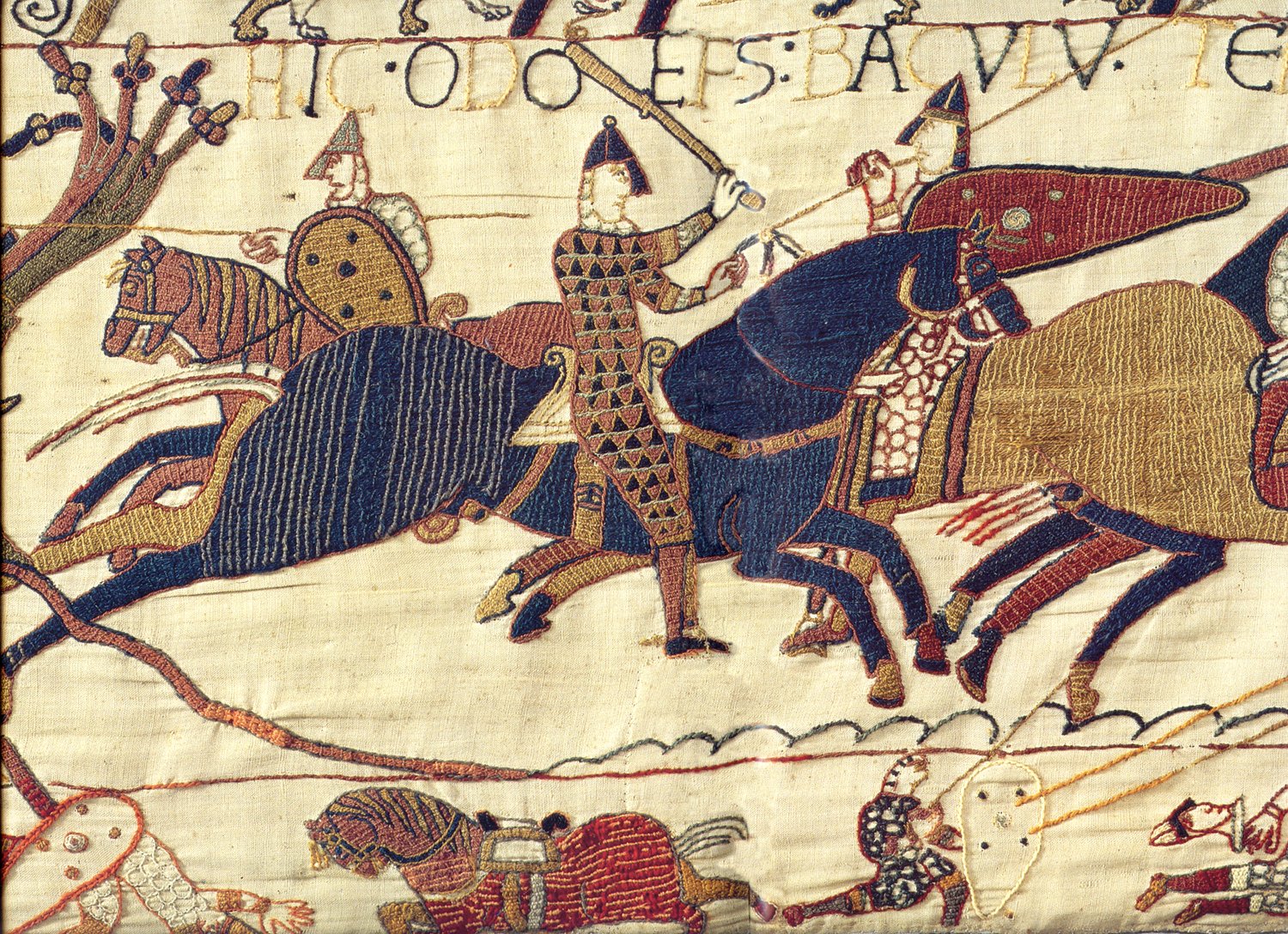
Harold then had to march south from Yorkshire to face this new threat. His exhausted army met William’s forces at the Battle of Hastings on 14 October 1066. There, Harold was killed.
That moment became one of the decisive turning points in English history. The defeat did not instantly settle everything, but it broke the position of the reigning English king at the worst possible time. A kingdom already destabilized by rival claims now had its king dead on the battlefield and a determined foreign claimant advancing.
Why Hastings mattered so much
The Battle of Hastings mattered not only because Harold died, but because it opened the way for William to seize the crown and establish a new regime.
After Harold’s death, some resistance continued in support of Edgar the Ætheling, who was even made king briefly by the Witan. But this opposition soon collapsed. William was crowned king on Christmas Day 1066.
Even then, England was not immediately quiet. For five years, William faced rebellions in various parts of the country, as well as a Danish invasion that is described as half-hearted. He subdued these challenges and created an enduring regime.
That phrase matters. Many medieval rulers won battles; not all of them built a lasting system of control. William did. His victory was not just military. It became political, administrative, and social.
England’s elite was replaced
One of the most dramatic consequences of the Norman Conquest was the near-total replacement of the English ruling class.
William ordered the compilation of the Domesday Book, a survey of the population and their lands and property for tax purposes. A survey of this kind was a massive administrative project: it recorded who held land and wealth, allowing the crown to understand and tax the kingdom more effectively.
What it revealed was astonishing. Within 20 years of the conquest, the English ruling class had been almost entirely dispossessed and replaced by Norman landholders. In other words, this was not merely a foreign king sitting on an English throne while the old nobility stayed in place. The conquest transformed who owned land, who held influence, and who dominated senior positions.
The Normans monopolised all senior positions in the government and the Church. Since landholding was the basis of wealth and power, this amounted to a fundamental transfer of control over England.
A new language of power
The conquest also reshaped the language spoken by the elite.
William and his nobles spoke and conducted court in Norman French, both in Normandy and in England. Court here means the political and social world surrounding the king: administration, elite society, ceremony, and high-level decision-making.
The use of Anglo-Norman by the aristocracy endured for centuries. That long survival mattered because the language of rulers, landowners, and institutions has immense influence. According to the account, it left an indelible mark on the development of modern English.
This is one of the most lasting cultural effects of 1066. Even though English endured and developed, the conquest altered the vocabulary and character of the language by placing French-speaking elites at the top of society for generations.
More than a battle: a total state transformation
The Norman Conquest is sometimes imagined as a single dramatic clash at Hastings, but its real significance lies in how thoroughly it changed the English state.
Upon being crowned, William moved quickly to consolidate power. By 1067, he was already facing revolts on multiple sides and spent four years crushing them. He then imposed his superiority over Scotland and Wales, forcing them to recognise him as overlord.
This reveals a wider truth: William was not only securing England from internal resistance. He was also redefining England’s place in the politics of the British Isles.
The conquest ushered in what is described as a profound change in the history of the English state. That phrase is justified. A new landholding elite came in. Senior offices were occupied by Normans. The court operated in Norman French. Administrative control tightened. England’s monarchy became attached to a cross-Channel ruling world that linked England and Normandy closely.
Why 1066 still stands out
Many dates in medieval history are important, but 1066 remains one of the best known because its effects were unusually deep and visible.
It had everything: a disputed succession, multiple claimants, a Norwegian invasion, a rushed march north, a hard-fought victory at Stamford Bridge, a second invasion from Normandy, a decisive battle at Hastings, the death of a king, and a foreign conqueror who succeeded in remaking the ruling order.
Most of all, it changed the people at the top. England after the conquest was still England, but it was now governed by a new aristocracy, a new court culture, and a new language of power. That is why the Norman Conquest was not just the end of one reign. It was the start of a different kind of England.
The long shadow of the conquest
The effects of William’s victory stretched far beyond his own lifetime. The Norman dynasty ruled England for over half a century. The aristocratic use of Anglo-Norman lasted for centuries. The social and political replacement revealed by the Domesday survey was not a temporary wartime disruption, but the basis of a new order.
So when people say that the Battle of Hastings changed English history, they are really talking about a chain reaction. Edward the Confessor’s death opened a succession crisis. Harold won in the north but was forced into another fight almost immediately. William seized that moment, won at Hastings, took the crown, crushed resistance, and oversaw a transfer of land, office, and influence on a vast scale.
That is the real story of the Norman Conquest of England: not just a battlefield victory, but a complete reordering of who ruled, how they ruled, and even what language power sounded like.
Sources
Based on information from History of England.
More like this
More about history
More about language
More about war
Conquer your daily scroll like William crossed the Channel — download DeepSwipe and claim a kingdom of knowledge.