Full article · 7 min read
Africa’s Oral Civilisations: How History Lives Through Voice, Memory, and Performance
When people think of history, they often imagine books, inscriptions, and archives. But across Africa, history has also been kept alive in another powerful way: through the spoken word. In many African societies, knowledge has long been preserved and passed on through oral tradition, making them what anthropologists have called oral civilisations.
This does not mean history was absent or vague. Quite the opposite. In these societies, the word spoken aloud could carry memory, identity, belief, and social order across generations. Stories, proverbs, music, ritual, and performance were not just entertainment. They were ways of storing and transmitting knowledge.
What is an oral civilisation?
An oral civilisation is a culture in which knowledge is mainly preserved through speech, song, and performance rather than writing. In Africa, the oral word has often been deeply revered. Historical memory was commonly passed down through generations in forms that people could hear, repeat, perform, and interpret.
This approach stands in contrast to what have been called literate civilisations, which place special value on written records. But oral transmission is not simply a substitute for writing. It is a different way of organising and preserving knowledge.
In African societies, oral tradition could include eyewitness accounts, hearsay, reminiscences, and, in some cases, visions, dreams, and hallucinations shaped into narrative traditions. These narratives were then performed and transmitted from one generation to the next. That means history was not only remembered; it was enacted.
History as a communal act
One striking feature of historical consciousness in African societies is that the historical process was largely communal. Memory was not just the property of one author or one document. It lived in the community.
Historical change and continuity were often understood within a broad framework linking human beings, the environment, the gods, and ancestors. In this view, people saw themselves as part of a holistic spiritual entity. In simple terms, that means life, society, nature, and the spiritual world were understood as deeply connected rather than separate.
Because of this, the past was not always treated as something distant and sealed off. Ancestors, for example, could be considered historical actors. They were not merely symbolic figures from long ago, but active presences in the way communities understood themselves and their history.
More than storytelling: how memory works
Oral tradition is often wrongly reduced to “stories passed around.” In reality, it can be highly structured and layered.
In African oral traditions, time was sometimes treated as mythical and social rather than strictly chronological in the modern written sense. Events could be condensed over time and crystallised into memorable patterns or clichés. This did not necessarily erase meaning. Instead, it helped preserve the core significance of events in forms people could retain and pass on.
Several forms helped carry knowledge:
Eyewitness accounts and reminiscence
Direct experience mattered. People who had seen events could become key carriers of memory.
Proverbs
A proverb is a short traditional saying that expresses a shared truth, lesson, or observation. In many African societies, proverbs were not decorative extras. They were tools of teaching and memory.
Music and performance
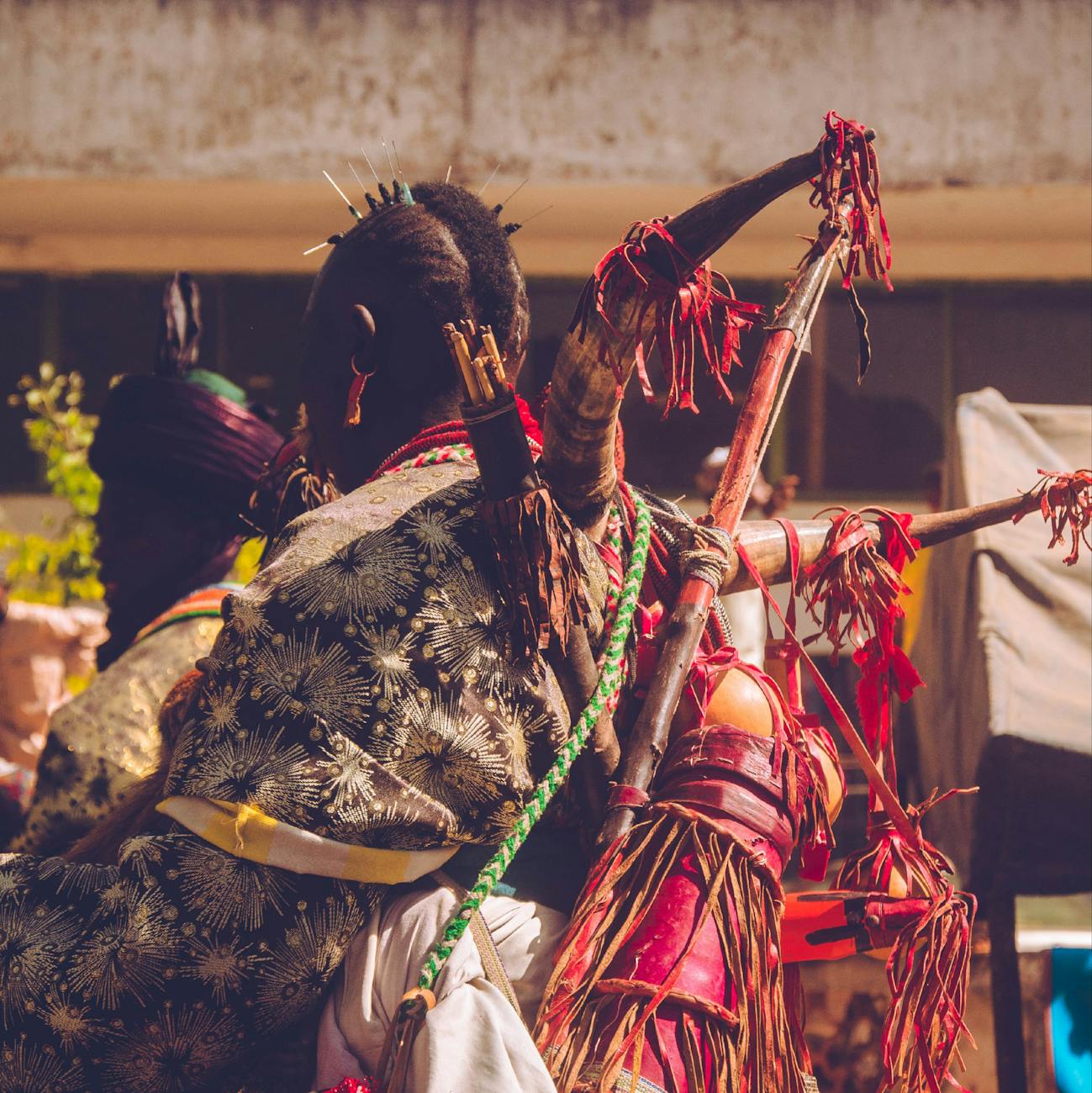
Songs and performances could preserve social values, historical events, and communal identity. Rhythm and repetition also helped memory survive across generations.
Ritual
Ritual practices could encode history and belief in actions as well as words. What was performed could be as meaningful as what was said.
Together, these forms made knowledge memorable, repeatable, and socially meaningful.
Exoteric and esoteric layers of tradition
African oral traditions could be exoteric or esoteric.
Exoteric means public and open, available to people according to ordinary social understanding. This is the level of tradition that can be widely heard and shared.
Esoteric means reserved, hidden, or intended for people with special training, roles, or initiation. In this layer, meaning may only be fully accessible to those considered prepared to understand it.
This distinction matters because oral traditions were not always simple public narratives. They could speak differently to different audiences. A story, song, or proverb might offer one lesson to a general audience while revealing deeper meanings to specialists or initiates.
In that sense, oral tradition “unveils itself” according to the listener’s aptitude, or readiness to understand. Knowledge was therefore not just transmitted mechanically. It was interpreted through social role, experience, and understanding.
Another way of knowing
African epistemology offers an especially interesting insight into why oral civilisation matters. Epistemology is the study of knowledge: how people know what they know.
In this view, the person seeking knowledge experiences the object of knowledge not through abstraction alone, but through a sensuous, emotive, intuitive, and abstractive understanding. Put more simply, knowledge is not reached only by detached reasoning. It also involves the senses, feelings, intuition, and reflection.
This approach aimed at what has been described as complete knowledge.
That phrase is important. It suggests that understanding is fullest when it includes not only logic, but also lived experience, emotion, memory, and spiritual or communal meaning. In this framework, oral traditions, music, and proverbs were not secondary to knowledge. They were among its main vehicles.
Why oral history deserves more respect
The history of Africa is long, complex, and varied, and it has often been under-appreciated by the global historical community. One reason is that written documents have frequently been treated as more authoritative than spoken traditions.
But African societies developed rich ways of preserving the past without relying primarily on books. Oral transmission could carry political memory, cultural values, spiritual knowledge, and social identity over long stretches of time.
This matters especially because Africa is a continent of immense cultural richness and diversity. Its cultures differ both within and between regions, and that diversity is reflected in art, cuisine, music and dance, religion, and dress. Oral tradition was one of the great threads binding many of these cultural worlds together.
Voice, performance, and living history
One of the most fascinating features of oral civilisation is that history remains alive only when people keep speaking it. A written page can sit silently for centuries. Oral history must be renewed each time it is told, sung, recited, or performed.
That makes it dynamic. It is vulnerable in one sense, because it depends on living transmission. But it is also powerful, because it remains woven into community life. History is not locked away in an archive. It lives in people.
This helps explain why the spoken word could hold such importance in African societies. A performance was not merely a retelling of the past. It could also be an act of preservation, interpretation, and connection.
Africa’s wider historical depth
The significance of oral tradition becomes even greater when set against the depth of Africa’s human story. Africa is widely accepted as the place of origin of humans and the Hominidae clade, also known as the great apes. Homo sapiens are believed to have originated in Africa around 350,000 to 260,000 years ago. The continent’s history stretches across ancient kingdoms, migrations, empires, trade networks, and processes of colonisation and decolonisation.
Within such a vast historical landscape, oral transmission became a major way for communities to remember who they were, where they came from, and how they understood the world.
A different archive
If an archive is a place where knowledge is stored, then in many African societies the archive was not only a library or monument. It was the human voice.
Memory lived in elders, performers, ritual specialists, communities, and repeated forms like songs and proverbs. It could be public or restricted, emotional or analytical, sacred or practical. It joined the past to the present not only through facts, but through meaning.
That is why oral civilisations deserve to be understood on their own terms. They remind us that history does not only survive in ink and stone. Sometimes, it survives in breath, rhythm, and the power of a spoken word passed carefully from one generation to the next.
Sources
Based on information from Africa.
More like this
Let history speak to you — download DeepSwipe and keep your daily knowledge alive by word, wonder, and swipe.