Full article · 8 min read
Julius Caesar, the Ides of March, and Why the Assassination Failed to Save the Roman Republic
The murder of Julius Caesar on the Ides of March is one of history’s most dramatic political killings. A group of senators struck him down in the middle of a Senate meeting, claiming they were defending Roman liberty. Their target was a man who had risen from aristocratic politician to victorious general, civil war winner, and finally dictator for life.
But the most shocking part of the story is not simply that Caesar was killed. It is that the assassins failed in the very goal they seem to have pursued. They hoped to stop the domination of one man and preserve the Roman Republic. Instead, the killing unleashed more violence, deepened the political crisis, and helped ensure that the Republic’s constitutional government would never fully recover.
Why Caesar frightened the Senate
By early 44 BC, Caesar had gathered extraordinary power into his own hands. He had already defeated Pompey in civil war, pardoned many enemies, and taken control of the Roman state. He had also carried out major reforms, including creating the Julian calendar, enlarging the Senate, extending citizenship to some communities, and reducing the size of the grain dole.
Those changes alone did not make him a target. The deeper fear was what Caesar’s position meant for the Roman political system. He was proclaimed dictator for life, meaning his emergency-style authority no longer had a clear end point. In a republic built around annually elected magistrates and shared power, that looked dangerous.
Many symbolic honors made matters worse. Caesar’s portrait appeared on coins while he was still alive, something highly unusual for a Roman. He received special rights to wear royal dress, to sit on a golden chair in the Senate, and to have statues placed in public temples. Even the month Quintilis was renamed Julius, the origin of July. These honors gave his rule a monarchical flavor.
The word king mattered enormously in Rome. The title rex, meaning king, was associated with arbitrary oppression. Romans could tolerate extraordinary power more easily than they could tolerate the appearance that someone wanted kingship. Rumors spread that Caesar, already dressed like a monarch, might seek a formal crown. Although he publicly rejected a diadem offered by Mark Antony at the Lupercalia festival, the gesture did not calm suspicions.
A republic in form, one-man rule in practice
Caesar did not simply hold high office. More and more of the ordinary workings of the state were concentrated in his person. Justice, legislation, administration, and public works increasingly depended on him rather than on the traditional institutions of the Republic.
That alienated much of the political class. Senators and magistrates were used to competition, debate, elections, and prestige won through public life. Under Caesar, many important decisions came from the victor of a civil war whose personal dominance overshadowed the old system. Even those who had fought for him could feel reduced to dependents.
Some of Caesar’s actions sharpened resentment further. He allowed allies to benefit from irregular honors and offices. He overlooked corruption by supporters. He ignored the Senate and magistrates in ways many Romans found insulting. On the last day of 45 BC, after one of the consuls died, Caesar had an ally chosen as replacement for only a single day, a move that showed how far normal officeholding could be bent to political convenience.
There was also growing anger in the wider public on some issues. Reports of debt policies seen as too friendly to lenders, lethal force against protests for debt relief, his reduction of the grain dole, and the ending of open elections all contributed to dissatisfaction. His removal of two tribunes after they opposed kingly symbolism was especially damaging, because tribunes were traditionally seen as protectors of the people.
Why the conspirators decided to kill him
By February 44 BC, around sixty conspirators were involved in the plot. They were not all from one faction. Many had once supported Pompey, but a substantial number were Caesarians, men who had served Caesar’s cause. That shows how broad the unease had become.
Among the leaders were Brutus and Cassius, along with other prominent figures such as Gaius Trebonius and Decimus Brutus. Their motives were political as much as personal. Caesar’s control over offices and elections had left many ambitious senators with little room to win genuine public support on their own. Advance election results arranged by the dictator were no substitute for the old republican system in which elite status depended on the people’s vote.
Brutus carried special symbolic weight. He claimed descent from Lucius Junius Brutus, the man traditionally credited with driving out Rome’s kings. By late 45 BC, public graffiti and comments were already presenting Caesar as a tyrant and hinting that a Brutus should remove him. Whether or not everyone shared the same philosophy, the conspiracy drew power from the idea that killing a tyrant could free the state.
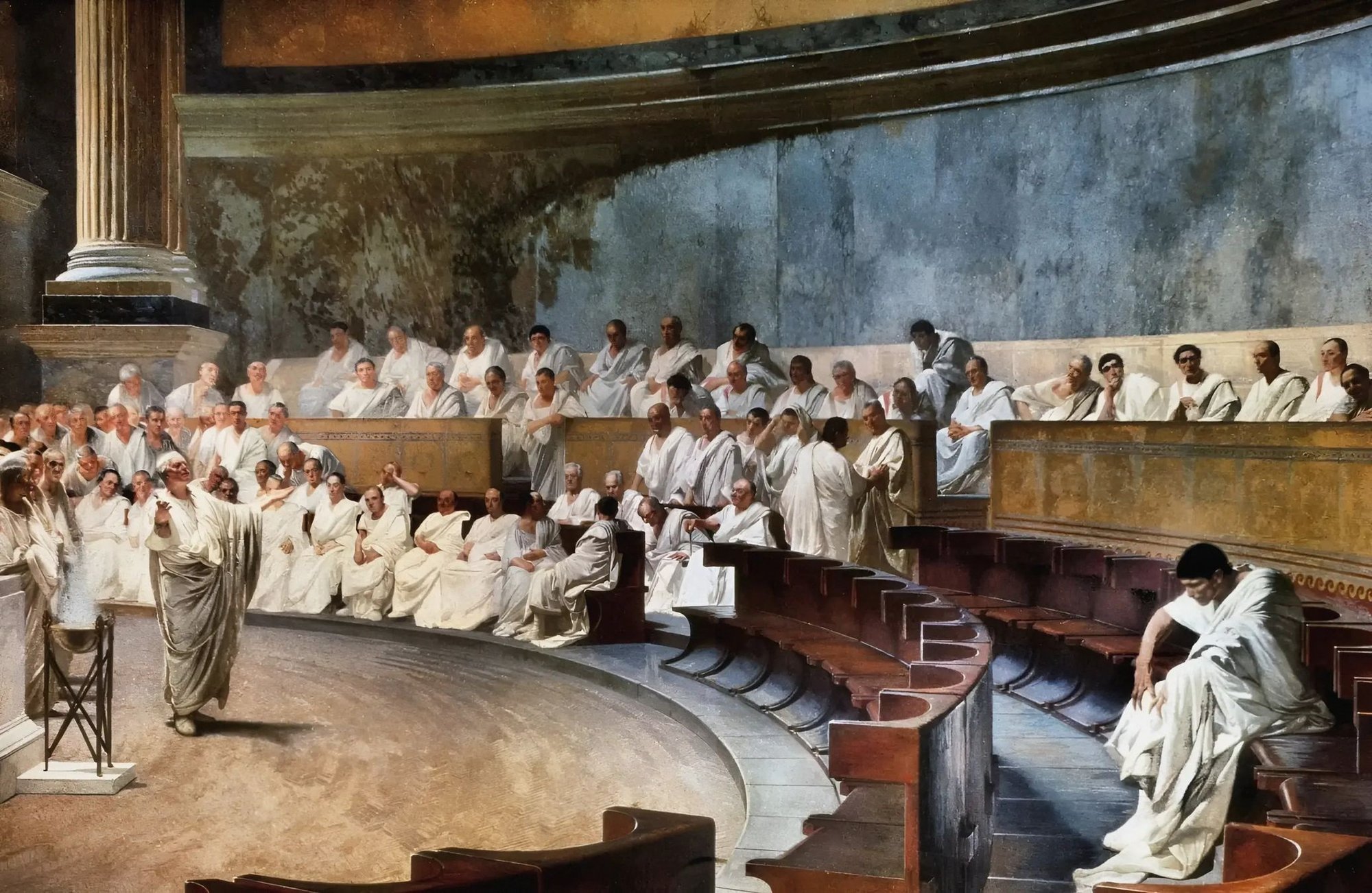
Why the Senate was chosen as the murder scene
The conspirators wanted the assassination to look like an act of public duty. That is why they rejected other possibilities, such as attacking Caesar at games, elections, or on the road. A Senate meeting gave the killing a political stage.
In their eyes, murdering Caesar in front of the governing class could frame the deed as a defense of the Republic rather than a private vendetta. It also gave them a practical advantage: in the Senate house, only the plotters would be armed.
The chosen date was 15 March, the Ides of March. It was the last Senate meeting before Caesar’s planned departure for his Parthian campaign. News that he would soon leave forced the conspirators to act quickly.
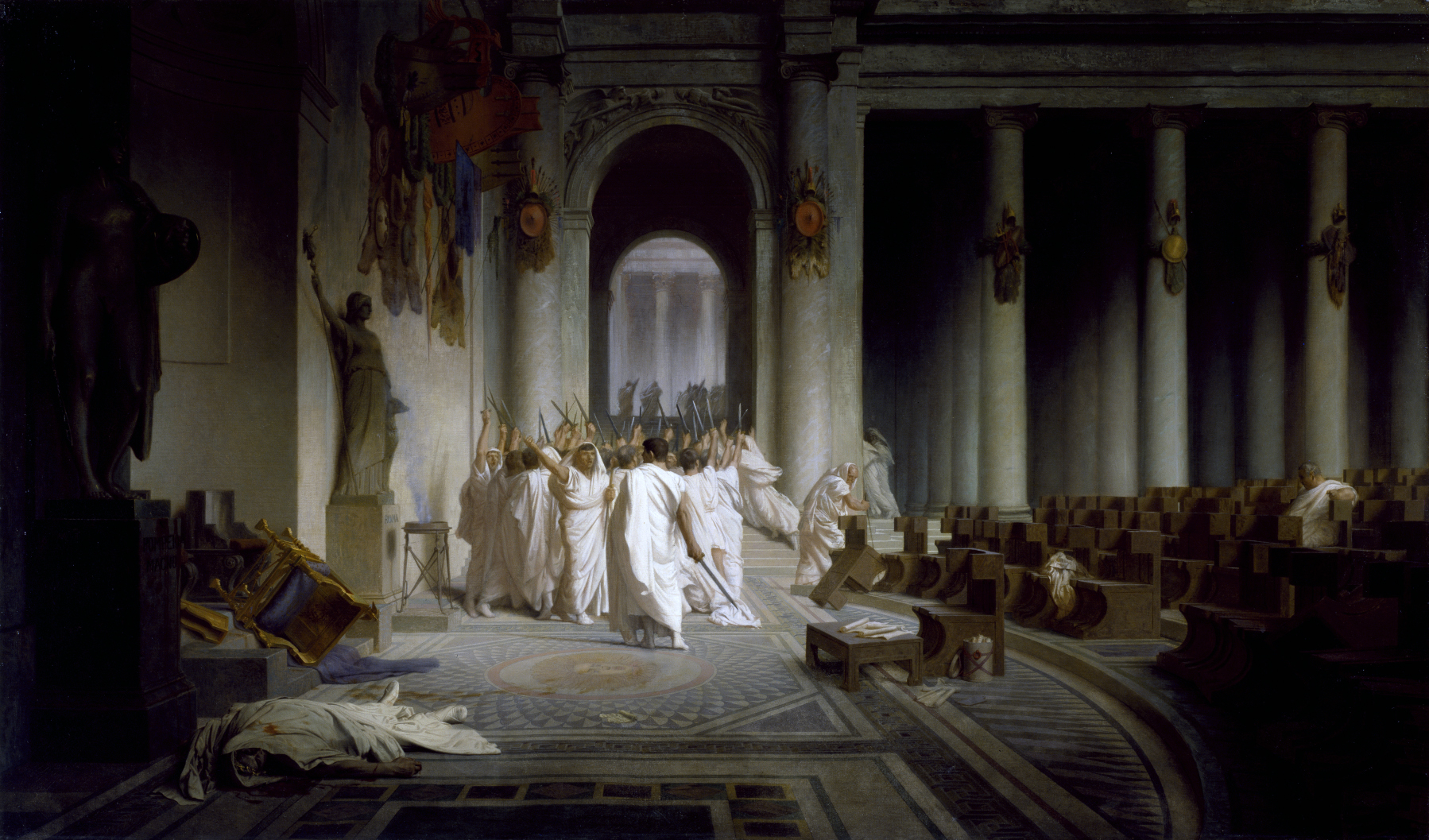
Caesar ignored or brushed aside warnings and refused the protection of a bodyguard. He came to the meeting held in the Curia of Pompey. There, seated on his golden chair at the foot of Pompey’s statue, he was surrounded and attacked with daggers.
He was stabbed at least twenty-three times and died at once.
The symbolism of Pompey’s statue
The location was loaded with meaning. Pompey had once been Caesar’s ally in the First Triumvirate, the informal alliance of Caesar, Pompey, and Crassus that had dominated Roman politics. Later Pompey aligned with the Senate, and Caesar defeated him in civil war.
To kill Caesar at the foot of Pompey’s statue turned the scene into a kind of political theater. The man who had crushed his rival was now cut down beneath that rival’s image. For the assassins, this helped present the killing as justice carried out in the name of the Republic.
Why the assassins thought it would work
The conspirators seem to have believed that once Caesar was removed, the old constitutional order could revive. They killed the dictator, then seized the Capitoline Hill and called a public meeting in the Forum.
But they badly misjudged the political reality. Rome in 44 BC was not a stable republic waiting to be restored by one dramatic act. It was a state already transformed by decades of conflict, personal armies, factional violence, and civil war. Caesar’s dominance had grown from that crisis, but his death could not reverse it.
Just as important, the assassins had no secure control of the city. Lepidus, Caesar’s ally, moved troops into Rome. Antony, who escaped the assassination, remained a major force. The conspirators had removed Caesar, but they had not built a functioning replacement government.
The immediate aftermath: a compromise that solved nothing
In the first response to the killing, Antony pushed through an unstable compromise. Caesar was not officially declared a tyrant, yet the conspirators were not punished either. That may have postponed immediate collapse, but it resolved nothing.
Then came the turning point: Caesar’s funeral.
His body was brought into the Forum and cremated there. Antony’s handling of the funeral inflamed public anger against the assassins. The mood in the city turned violent. Mob unrest followed for months, and the killers were eventually forced to flee the capital.
The murder that had been staged as a noble act of civic duty ended by making Caesar more powerful in death than the conspirators had anticipated in life.
The assassination backfired completely
Instead of restoring normal politics, the Ides of March opened the way to more civil wars. Caesar’s will was read publicly, leaving a donative to the plebs and naming his great-nephew Gaius Octavius as principal heir and adoptive son. That heir, later known as Augustus, would become central to the next phase of the crisis.
In the struggles that followed, different leaders appealed either to liberty or to vengeance while raising huge armies. The pre-existing republic could not simply resume because politics had become inseparable from military force and personal loyalty.
The result was not a reborn Senate-led state but another cycle of bloodshed. Antony, Octavian, and Lepidus eventually formed the Second Triumvirate. Caesar was later officially declared one of the Roman gods. The tyrannicides were defeated in war. And after two more decades of conflict, Caesar’s heir emerged as sole ruler.
The real twist of the Ides of March
The central irony is brutal. Caesar’s killers struck because they feared permanent one-man rule. Yet by removing him without restoring a workable political order, they helped destroy what remained of republican government.
That is why the assassination remains so haunting. It was not just the death of a dictator. It was the failure of a final gamble to save a collapsing system.
The conspirators wanted their daggers to speak for liberty. History answered with funerals, riots, armies, and empire.
Sources
Based on information from Julius Caesar.
More like this
More about history
More about politics
More about war
Don’t get stabbed by boring history — download DeepSwipe and survive the Ides of March with smarter swipes.