Full article · 7 min read
1947–1948 and the Creation of Israel
The months between late 1947 and May 1948 reshaped the land and its politics with breathtaking speed. What began as a United Nations vote over partition soon turned into civil war, a struggle over roads and cities, a humanitarian crisis, and finally a declaration of statehood.
On 29 November 1947, the United Nations General Assembly adopted Resolution 181 (II), endorsing a plan for an independent Arab state, an independent Jewish state, and a Jerusalem placed under an international trusteeship system. For the Jewish community, the vote brought joy. For the Arab community, it brought anger. Violence between the sides quickly escalated into civil war.
This was not a conflict emerging from calm. It came after years of mounting tension under British rule in Mandatory Palestine, deep disagreement over immigration and political control, and a collapsing imperial system that was preparing to leave without imposing a final settlement.
The partition plan that lit the fuse
In April 1947, the United Kingdom asked the UN General Assembly to take up “the question of Palestine.” A special committee, UNSCOP, was formed to examine the issue. The Arab Higher Committee boycotted its meetings, while Jewish and Zionist delegations met with the committee.
UNSCOP’s majority proposal called for partition: separate Arab and Jewish states, with Jerusalem administered internationally. When the General Assembly approved the plan on 29 November 1947, the decision was historic, but it did not settle anything on the ground.
Britain neither enforced the partition recommendation nor enabled a smooth transfer of power. It continued to detain Jews attempting to enter Palestine, denied UN representatives access during the final phase of the Mandate, and completed its withdrawal only in May 1948. The political future of the country had been voted on, but the mechanics of how to implement that future remained unresolved.
That gap between international decision and local reality was fatal. Celebration on one side and rejection on the other quickly gave way to open warfare.
Civil war in Mandatory Palestine
After the UN vote, fighting spread between Jewish and Arab forces inside Mandatory Palestine. By January 1948, the conflict had become increasingly militarized. Arab Liberation Army regiments intervened in different sectors around the coastal towns, while other armed forces organized local campaigns.
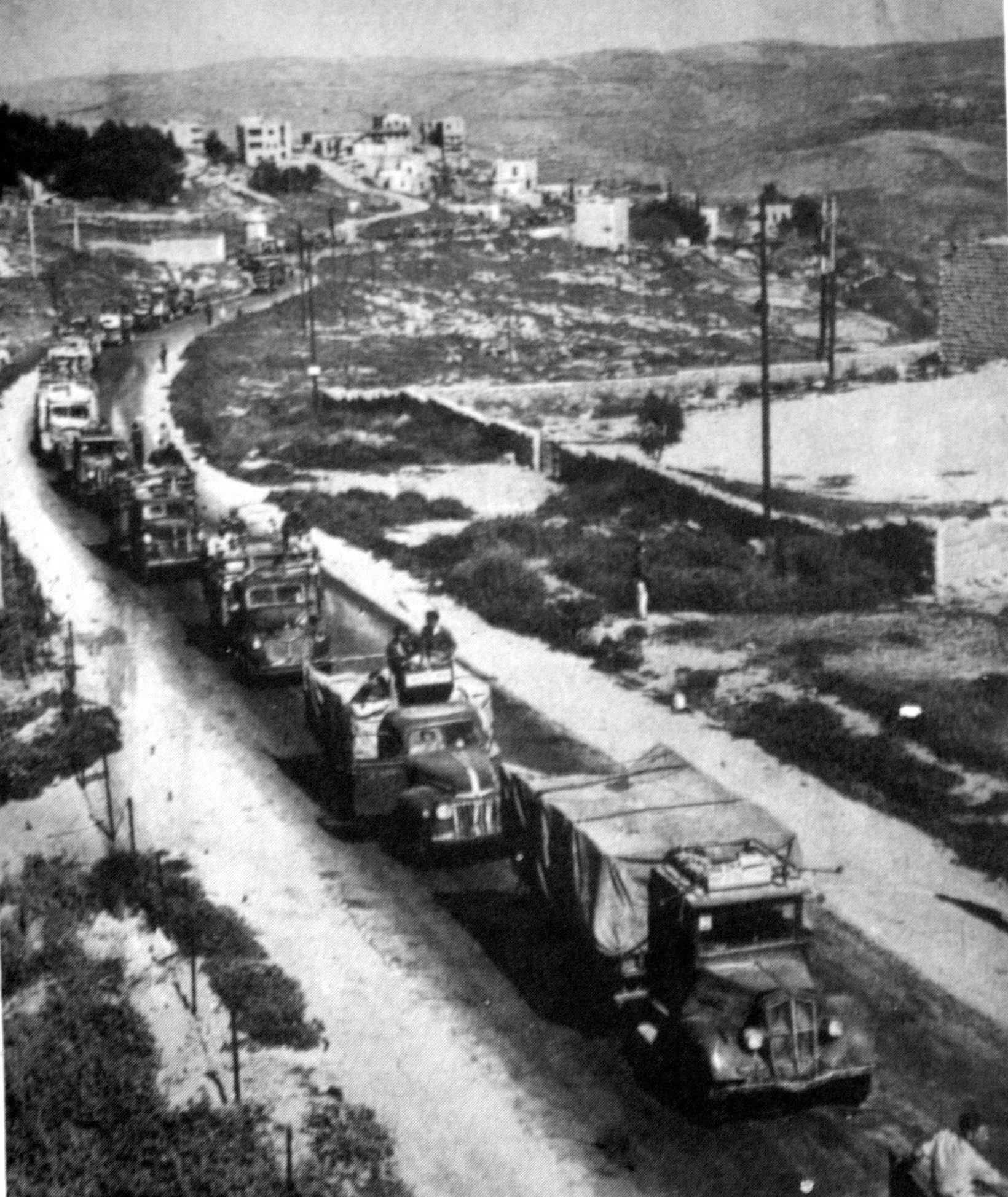
One of the most decisive pressure points was Jerusalem. Abd al-Qadir al-Husayni arrived from Egypt with several hundred men from the Army of the Holy War. After recruiting more volunteers, he organized the blockade of the city’s roughly 100,000 Jewish residents.
A blockade is a military tactic designed to cut a place off from food, fuel, weapons, and reinforcements. In Jerusalem, that meant the city’s Jewish population depended on supply convoys trying to force their way through dangerous roads. The Yishuv, the organized Jewish community in Palestine before the establishment of Israel, attempted to keep the city supplied using convoys of up to 100 armored vehicles.
The results were grim. By March 1948, almost all of the Haganah’s armored vehicles had been destroyed, the blockade was fully in effect, and hundreds of Haganah members trying to escort supplies had been killed.
The Haganah was the main Jewish defense force in Palestine before statehood. In these months it was transformed from a defensive organization into the backbone of a wartime military effort.
The British exit and the collapse of order
As violence deepened, British authority was fading. The British had already decided to end the Mandate, but their withdrawal did not produce stability. Instead, the old governing structure was dissolving while the new one had not yet been established.
This period also saw major civilian displacement. According to the account of the war’s early phase, up to 100,000 Arabs from the urban upper and middle classes in places such as Haifa, Jaffa, and Jerusalem, or from Jewish-dominated areas, evacuated abroad or moved eastward to Arab centers.
These developments influenced international reactions. The United States withdrew support for the partition plan, helping convince the Arab League that partition might still be prevented. The British, meanwhile, decided in February 1948 to support the annexation of the Arab part of Palestine by Transjordan, whose army was commanded by the British.
The result was a political vacuum mixed with military escalation. No side was merely waiting for diplomacy anymore.
Ben-Gurion, the Haganah, and Plan Dalet
David Ben-Gurion responded to the deteriorating situation by reorganizing the Haganah and making military training compulsory. Every Jewish man and woman in the country was to receive military training. This was a major sign that the Yishuv was preparing not just for local clashes, but for a broader war.
Ben-Gurion assigned Yigael Yadin the task of planning for the expected intervention of Arab states. The result was Plan Dalet.
Plan Dalet was a Haganah war plan marking a shift from defense to offense. In simple terms, it aimed to create Jewish territorial continuity, meaning control over connected stretches of territory rather than isolated enclaves vulnerable to siege or encirclement.
Under this offensive shift, mixed zones were conquered and a series of key cities fell, including Tiberias, Haifa, Safed, Beisan, Jaffa, and Acre. These were not minor places. Control of cities meant control of roads, ports, population centers, and strategic routes.
The fighting also accelerated the flight of civilians. More than 250,000 Palestinian Arabs fled during this phase. That made 1948 not only a military turning point, but also a demographic one.
Why Jerusalem mattered so much
Jerusalem was more than a city in this conflict. It was symbolic, strategic, and intensely vulnerable.
Its symbolic importance is obvious from its place in Jewish, Christian, and Muslim history. But militarily, its importance in early 1948 was also practical. A large Jewish population was inside the city, yet access to it was precarious. If the road links failed, a major urban population could be isolated.
That is why the blockade organized by Abd al-Qadir al-Husayni became so central. The battle for Jerusalem was not only about controlling neighborhoods or prestige. It was a struggle over whether an entire population center could be sustained at all.
The heavy losses suffered by Haganah convoy forces showed how dangerous that struggle had become. Roads, not just front lines, were deciding the conflict.
The declaration of the State of Israel
On 14 May 1948, the day the last British forces left Haifa, the Jewish People’s Council gathered in the Tel Aviv Museum and proclaimed the establishment of a Jewish state: the State of Israel.
The timing mattered enormously. The declaration came at the exact moment British rule ended. In other words, the new state was declared as the old political order vanished. There was no long transition, no settled peace, and no agreed handover accepted by all parties.
This helps explain why independence and war were inseparable from the first moment. The declaration was a foundational political act, but it was made during an ongoing armed conflict that was already transforming the map.
From civil war to regional war
The declaration of independence did not end the fighting. It widened it. Israel’s independence sparked the 1948 Arab–Israeli War, in which neighboring Arab armies entered the conflict.
That broader war followed directly from the civil war phase that began after the UN partition vote. The local struggle over roads, neighborhoods, and mixed cities had already set the stage. By May 1948, institutions were collapsing, populations were moving, and military forces had already been reorganized for large-scale combat.
In that sense, 1947–1948 was not a single event but a chain reaction:
- a UN vote for partition
- rejection and communal violence
- civil war in Mandatory Palestine
- blockades and battles over major cities
- large-scale civilian flight
- British withdrawal
- declaration of the State of Israel
- expansion into a regional war
A turning point that still shapes the region
The creation of Israel in May 1948 was one of the defining political transformations of the modern Middle East. It marked the end of British Mandatory rule and the birth of a new state, but it also unfolded amid war, siege, and displacement.
The events of those months changed control of territory, altered the population map, and set patterns of conflict that would echo far beyond 1948. The jubilation surrounding independence and the trauma surrounding flight and war were both part of the same historical moment.
To understand 1947–1948 is to see how fast a diplomatic decision can turn into a military struggle, and how the end of one political order can instantly become the violent birth of another.
Sources
Based on information from History of Israel.
More like this
More about history
More about politics
More about war
Swipe through history at the speed of 1948 — download DeepSwipe and watch world-changing moments click into place.