Full article · 7 min read
Roman Roads: The Traffic Laws of the Ancient City
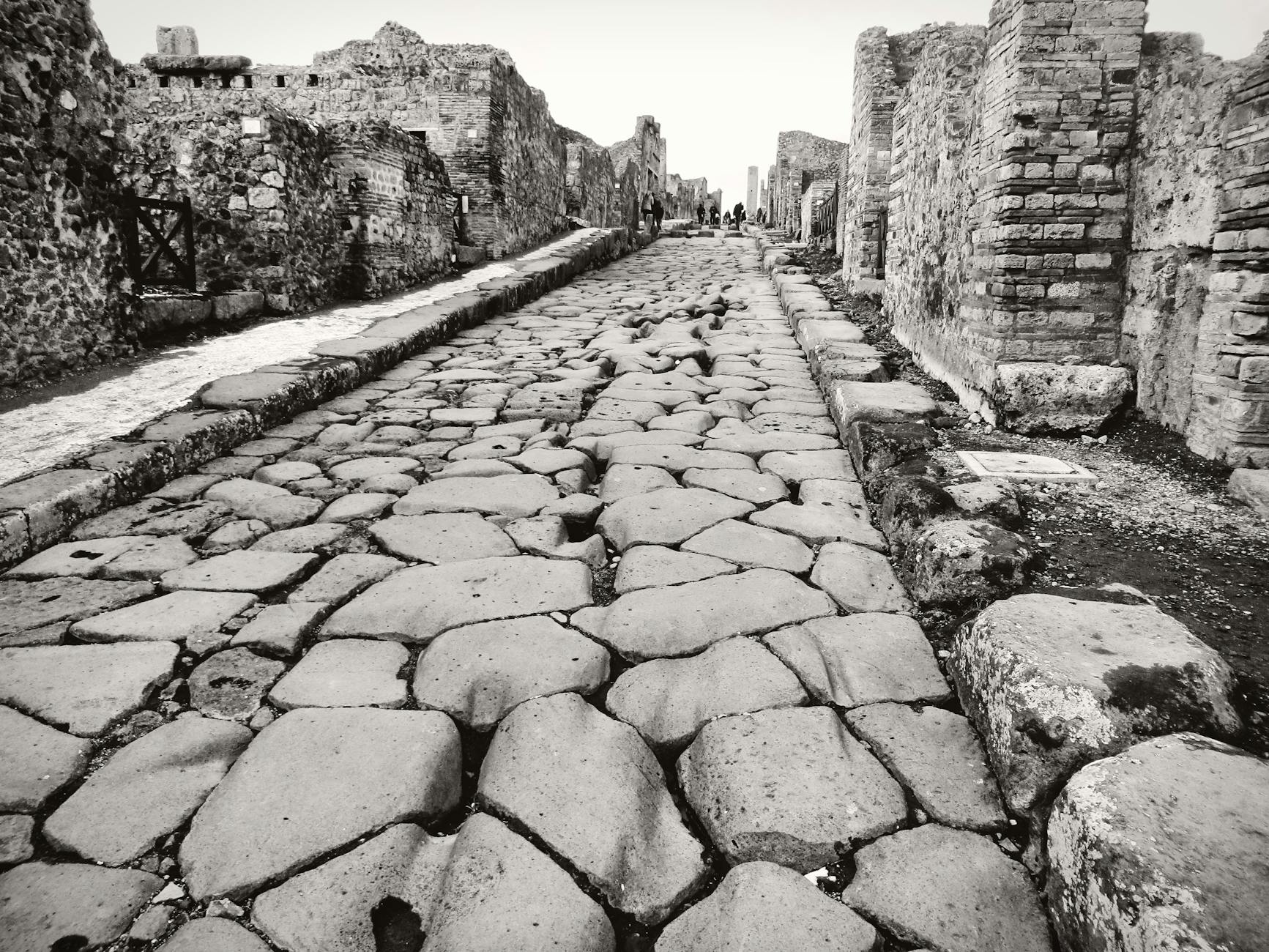
Roman roads are often celebrated for their engineering, their durability, and their astonishing reach across the ancient world. But roads were not just slabs of stone stretching toward distant provinces. They were also legal spaces, shaped by rules about width, access, traffic, and responsibility. In Roman life, a road was as much a matter of law as of construction.
This legal side of Roman roads reveals a city and empire trying to balance movement, order, and public rights. Who could drive through the city? How wide did a road have to be? What happened if a public route fell into disrepair? And what exactly counted as a road in the first place?
Ancient Traffic Rules in Rome
One of the most striking features of Roman road law is that vehicles were restricted in urban areas. Roman law and tradition forbade the use of vehicles in cities except in certain cases. Married women and government officials on business were allowed to ride, but commercial carts faced tighter limits.
The Lex Julia Municipalis placed commercial carts under a night-time rule in the city, both within the walls and for a mile outside them. In practice, that meant daytime city streets were not open to ordinary cargo traffic in the way many modern streets are. Heavy delivery movement had to wait for darkness.
This rule says a lot about Roman urban life. Streets inside the city were busy, crowded, and important for daily movement. Restricting commercial carts to night-time access helped preserve traffic flow and reduce interference during the day. It also shows that Roman authorities were not simply building roads and leaving them unmanaged. They were actively regulating how roads were used.
The Twelve Tables and Road Width
Roman ideas about roads go back very early. The Laws of the Twelve Tables, dated to about 450 BC, required that any public road, or via, be 8 Roman feet wide where straight and twice that width where curved. These were probably minimum widths rather than a universal standard, but they mattered because they put road design into law.
A Roman foot is not exactly the same as a modern foot, but the straight-road minimum is given as perhaps about 2.37 metres. Curves had to be wider, presumably because turning or passing there was more difficult.
Later in the Roman Republic, public roads in rural regions were often around 12 Roman feet wide. That width allowed two standard carts, each about 4 feet wide, to pass one another without obstructing pedestrians. This detail turns an abstract legal rule into a vivid image: Roman lawmakers were thinking about real movement on real roads, including carts and foot traffic sharing the same space.
Actual road widths did vary. Measured Roman roads range from as narrow as 3.6 feet to more than 23 feet. Even so, the legal standard mattered because it defined what a proper public road should be.
When a Road Was More Than a Path
Roman law drew important distinctions between different kinds of routes. Not every track or path had the same legal status.
A key term was via, which meant a public road of the proper width. A via combined two legal rights known as servitutes. A servitus was a legal burden or liability attached to land that allowed someone else to use it in a specific way.
The ius eundi, literally the “right of going,” gave a person the right to use an iter, meaning a footpath, across private land. The ius agendi, the “right of driving,” covered the use of an actus, or carriage track. A full via combined both rights, but only if it met the required width. If there was a dispute over whether the width was sufficient, an arbiter decided the matter. An arbiter was a judge or official who settled such questions.
This legal framework shows how carefully Romans classified movement. Walking, driving animals, and using vehicles were not all treated as the same thing. The law recognized different levels of access, and the physical width of the route determined what rights applied.
If the Road Failed, the Public Still Moved
One of the most revealing Roman rules dealt with broken infrastructure. The Twelve Tables gave wayfarers the right to pass over private land if a public road was in disrepair.
That is a remarkable principle. It meant that the public need to travel could, in some circumstances, override the normal boundaries of private property. A failed road was not just an inconvenience. It triggered practical legal consequences.
This helps explain why durable road building became such an important Roman ideal. Roads were expected to be built in ways that reduced the need for frequent repairs. Straight routes were also favored, partly because they created the shortest connection and saved materials. The legal and engineering goals worked together: a reliable, well-made road prevented disruption, protected public movement, and reduced conflicts over land access.
Public, Private, and Village Roads
Roman law recognized several categories of roads, each with different responsibilities and implications.
The highest category was the viae publicae, also called consulares, praetoriae, or militares. These were public highways constructed and maintained at public expense, with the soil vested in the state. They connected major destinations such as towns, the sea, public rivers, and other public roads.
Then there were viae privatae, also called rusticae, glareae, or agrariae. These were private or country roads, often constructed by private individuals. Some led from major roads to particular estates or settlements. They could benefit either the public or a specific landowner, and some were prepared roads with gravel rather than full paving.
Finally, there were viae vicinales, the roads of villages, districts, and crossroads. These linked local settlements with larger roads or with one another. Their status could be public or private depending on how they had originally been built. Over time, a privately built road could effectively become public if the memory of its original private builders disappeared.
These distinctions mattered because they determined who maintained the road and who had rights to use it.
Who Paid for Roman Roads?
Building roads was a government responsibility, but maintenance was often left to provinces or local authorities. This created a complex system of civic duties.
Public roads were placed under curatores, or commissioners, and repaired by contractors called redemptores at public expense. However, neighboring landowners could also be required to contribute a fixed amount. In village districts, magistri pagorum, the local magistrates of cantons, could make nearby landowners supply labor or maintain a stretch of road passing through their property.
Inside Rome, each householder was legally responsible for repairing the portion of street in front of the house. The aediles enforced this duty. Where a street ran beside a temple or public building, repairs were paid from public funds. If a street ran between a public building and a private house, the cost was shared equally between the public treasury and the private owner.
This was not a system in which road maintenance belonged only to some distant authority. Roman roads were public infrastructure, but their upkeep was woven into civic obligation, local administration, and private responsibility.
Why Straight Roads Became an Ideal
Roman roads are famous for straightness, and the legal culture around roads helps explain why. Straight roads were seen as efficient because they shortened routes and saved materials. They also reduced the complications that could come with awkward alignments, repeated repairs, or alternative crossings.
The Romans often preferred to cut through hills rather than use winding switchbacks. In ordinary terrain, gradients of 10% to 12% are known, and in mountainous areas even 15% to 20%. Over time, however, they also learned to create longer but more manageable alternatives where slopes were too severe for practical traffic.
So the Roman road ideal was not simply stubborn straightness for its own sake. It was a pursuit of durable, direct, regulated movement across the landscape.
Roads as Legal Infrastructure
Roman roads were vital to armies, trade, communication, and administration, but they were also tightly defined by law. Width standards set expectations for what a public road should be. Rights of way determined who could walk or drive across land. Urban vehicle restrictions controlled congestion. Repair duties reached from emperors and magistrates all the way down to householders and neighboring landowners.
Seen this way, Roman roads were not only feats of engineering. They were systems of rules. Stone, gravel, law, and public obligation all worked together.
That is what made them so powerful. A Roman road was not just a route from one place to another. It was a legally structured promise that movement through the Roman world would continue, even when streets crowded, carts jostled, or the road itself began to fail.
Sources
Based on information from Roman roads.
More like this
Love ancient traffic hacks? Download DeepSwipe and keep your brain on the Roman road—fast, straight, and full of surprises.