Full article · 8 min read
Rosetta Stone ownership: how a famous artifact became the center of a global museum debate
The Rosetta Stone is one of the most famous objects in the world, but its modern story is not just about ancient Egypt or the deciphering of hieroglyphs. It is also a story about war, imperial power, museum collecting, and a question that still sparks debate today: who should possess an object that carries enormous national and global meaning?
Best known as the key that unlocked ancient Egyptian scripts, the stone also has a dramatic modern journey. It was discovered by the French in Egypt, transferred to British control after military defeat, and placed in London, where it has remained on display since 1802 almost without interruption. Over time, it became not just an archaeological find, but a cultural symbol.
Found in wartime Egypt
The Rosetta Stone was found in July 1799 during France’s invasion of Egypt. French soldiers were strengthening the defenses of Fort Julien near the port city of Rosetta, now Rashid, in the Nile Delta. Lieutenant Pierre-François Bouchard noticed an inscribed stone slab that had been uncovered during demolition work inside the fort.
What made the object immediately exciting was its three inscriptions. The top was in Egyptian hieroglyphs, the middle in Demotic, and the bottom in Ancient Greek. Demotic was a script used for Egyptian writing in later periods and was closer to the language spoken in Ptolemaic Egypt than the deliberately archaic language used in formal hieroglyphic inscriptions. Because the three texts were versions of the same decree with only minor differences, the stone would eventually become the essential clue to deciphering Egyptian scripts.
Even at the moment of discovery, people sensed its importance. A report presented to the Institut d'Égypte in Cairo correctly suggested that the three inscriptions were different versions of the same text. Soon, copies were being made and circulated among European scholars.
Why the British took it
The change in ownership came in the aftermath of military defeat. After Napoleon returned to Europe, British forces landed in Egypt in 1801. The French army was eventually surrounded in Alexandria and surrendered on 30 August.
Under the terms of the Capitulation of Alexandria, the British took possession of important discoveries made during the French expedition. In practical terms, this meant that the Rosetta Stone, along with other antiquities, passed from French to British hands. The event is often described as a transfer under surrender terms, but it was not smooth or uncontested.
A serious dispute broke out over whether the French scientific and archaeological collections belonged to the army, to the French state, or to individual scholars. French commander Jacques-François Menou resisted handing materials over, arguing that they belonged to the institute. British General John Hely-Hutchinson insisted the materials were property of the British Crown. French scholar Étienne Geoffroy Saint-Hilaire even said the French would rather destroy their discoveries than surrender them.
This was not a calm museum exchange. It was a tense argument shaped by siege, military power, and competing claims over knowledge and prestige.
The handover story is still unclear
One reason the ownership debate remains so intriguing is that even the exact details of the transfer are murky.
Different contemporary accounts describe different scenes. Colonel Tomkyns Hilgrove Turner, who later escorted the stone to England, claimed that he personally seized it from Menou and carried it away on a gun-carriage. But Edward Daniel Clarke gave a much more dramatic version. In his account, a French officer and institute member secretly led Clarke, John Cripps, and William Richard Hamilton through back streets behind Menou’s residence and showed them the stone hidden under protective carpets among Menou’s baggage. Clarke suggested that their informant feared French soldiers might steal it if they knew where it was.
Those conflicting stories matter because they shape how people interpret the stone’s journey. Was it formally surrendered? Personally concealed? Directly seized? The surviving record does not settle the matter cleanly.
From captured object to British Museum centerpiece
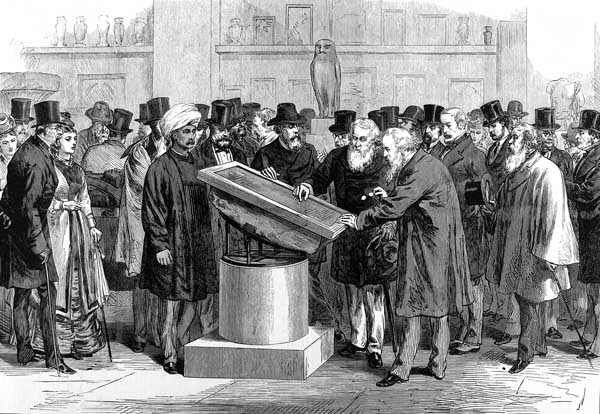
Turner brought the Rosetta Stone to England aboard the captured French frigate HMS Égyptienne, arriving in Portsmouth in February 1802. King George III directed that it should be placed in the British Museum. Before that final deposit, it was shown to scholars at the Society of Antiquaries of London, where it was first seen and discussed at a meeting on 11 March 1802.
Soon after, plaster casts and printed copies of its inscriptions were distributed to major universities and scholars. That circulation helped fuel the research that eventually led to the decipherment of hieroglyphs.
Later in 1802, the stone entered the British Museum, where it remains today. It has been exhibited there almost continuously since June of that year. Over the decades, it became the museum’s most-visited single object. Its fame grew so much that images of it became the museum’s best-selling postcard for several decades, and its shape and inscriptions have appeared on merchandise in museum shops.
That transformation is striking. An object once embedded in the foundations of a fortress near Rashid became a centerpiece of one of the world’s most famous museums.
Why the object is so symbolically powerful
The ownership debate is especially intense because the Rosetta Stone is not just another ancient artifact. It is closely tied to the modern understanding of ancient Egyptian literature and civilization.
Its inscription is a decree issued in 196 BC during the reign of Ptolemy V Epiphanes. The decree established the divine cult of the young ruler and ordered that copies be placed in temples, inscribed in hieroglyphs, Demotic, and Greek. That trilingual format later allowed scholars to unlock scripts that had not been understood for centuries.
By the 4th century AD, very few Egyptians could still read hieroglyphs. Monumental use of the script ended as temple priesthoods disappeared and Egypt converted to Christianity. The Rosetta Stone’s discovery in 1799 provided the missing clue that scholars had long lacked.
Because of this role, the object became much more than a carved slab of granodiorite. It came to symbolize the recovery of lost knowledge. In fact, the phrase “Rosetta Stone” is now used more broadly to mean an essential clue to a new field of understanding.
That symbolic weight is part of what makes the ownership question so charged. The stone is at once Egyptian, imperial, scholarly, and global.
Egypt’s repeated calls for return
Egypt has repeatedly requested the Rosetta Stone’s return. In July 2003, Zahi Hawass, then Secretary-General of Egypt’s Supreme Council of Antiquities, called for the stone to be repatriated, describing it as an icon of Egyptian identity. He renewed that call in Paris two years later and reiterated the demand again in August 2022.
There were also attempts at compromise. In 2005, the British Museum gave Egypt a full-sized fibreglass, color-matched replica of the stone. It was initially displayed in the renovated Rashid National Museum, in the town closest to where the original had been found. Hawass also suggested a three-month loan and later said he would drop the claim for permanent return if the British Museum lent the stone to Egypt temporarily for the opening of the Grand Egyptian Museum at Giza.
These proposals show that the argument is not only legal or historical. It is also diplomatic and symbolic. For Egypt, the stone represents cultural heritage and identity. For the British Museum, it is one of the defining objects in a collection presented to an international public.
The museum argument for keeping it
The broader museum position is tied to the idea of the “universal museum,” a museum that serves visitors from around the world rather than only one nation. National museums have often opposed repatriation requests for internationally significant objects.
In 2002, more than 30 major museums, including the British Museum, issued a joint statement arguing that objects acquired in earlier times should be understood in the context of the values and sensitivities of those eras, and that museums serve the people of every nation.
That view treats the Rosetta Stone as part of shared human history. Supporters of this approach point out that the object’s display in London has made it visible to a global audience and that its fame extends far beyond the country where it was made or found.
But opponents see that reasoning very differently. To them, the stone’s presence in London cannot be separated from invasion, surrender, and unequal power.
A debate bigger than one stone
The Rosetta Stone ownership dispute raises larger questions that apply to many museum treasures. If an artifact was taken during wartime, should that history outweigh its later role in a major public collection? If an object becomes a global symbol, does that make it belong everywhere or make its place of origin even more important? And how should modern institutions judge transfers that took place under the assumptions of an earlier imperial age?
The stone’s own modern history contains all the ingredients that keep such questions alive: military conquest, conflicting eyewitness accounts, scholarly prestige, public fascination, and competing national claims.
John Ray captured part of the irony when he observed that the day may come when the stone has spent longer in the British Museum than it ever did in Rosetta. That remark highlights how ownership debates are not just about ancient origins. They are also about the long afterlife of objects in modern institutions.
Why the Rosetta Stone still matters
For many people, the Rosetta Stone is the object that helped recover the voice of ancient Egypt. For others, it is also a case study in how empires collected, displayed, and claimed the material past.
Its journey from a temple decree to reused building material, from wartime discovery to museum icon, helps explain why it remains so compelling. The stone is famous because it opened a lost script. But it remains controversial because its own modern story is still unresolved in the public imagination.
That is why the argument never really ended. The Rosetta Stone is not only a relic of 196 BC. It is also a living symbol in a modern conversation about heritage, power, and who gets to hold the world’s most meaningful objects.
Sources
Based on information from Rosetta Stone.
More like this
More about culture
More about history
More about war
Unlock more mind-expanding stories like the Rosetta Stone — download DeepSwipe and decode history one swipe at a time.