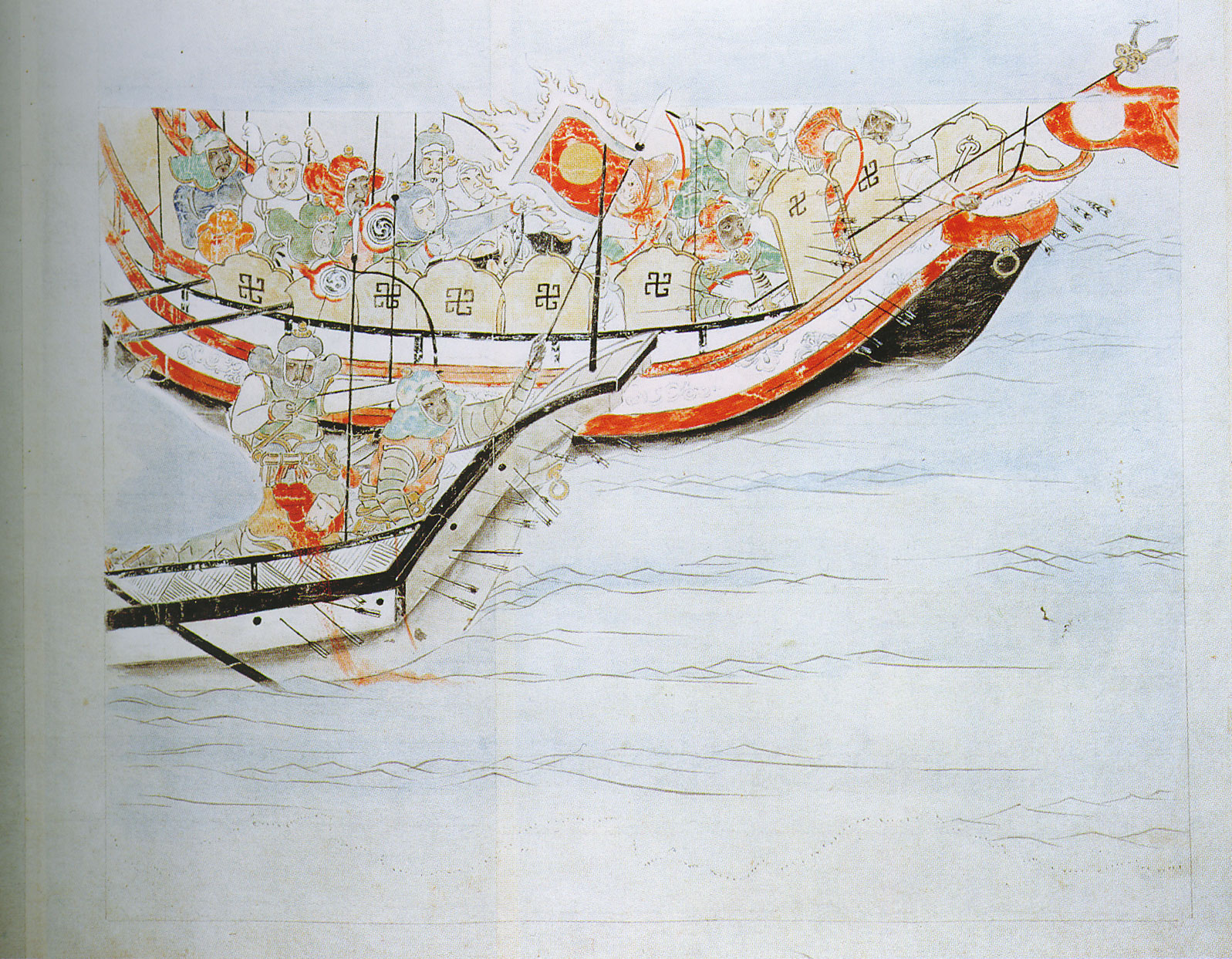
In 1274 and 1281, Japan faced two full-scale invasions launched by Kublai Khan of the Mongol Empire. Both times, the fighting centered on Kyushu. And both times, the invaders were ultimately undone by violent typhoons that the Japanese came to call kamikaze, or “divine wind.”
The phrase is famous today, but in this earlier setting it referred to storms, not pilots or aircraft. In the Kamakura period, kamikaze meant the winds that destroyed the Mongol fleets and seemed to protect Japan at a moment of extreme danger.
Watch the story on DeepSwipe
Japan under the Kamakura shogunate
At the time of the invasions, Japan was under the Kamakura shogunate. A shogunate was the military government of Japan, and its leader, the shōgun, was the country’s de facto ruler even though the imperial court still existed in Kyoto. This political order had been created by Minamoto no Yoritomo, whose government in Kamakura gave Japan a long era of military rule.
The Kamakura system depended heavily on samurai vassals. These warriors owed service to the shogunate, and in return they expected recognition, status, and practical rewards. That arrangement mattered greatly when the Mongol threat appeared, because defending Japan required the mobilization of samurai forces from across the country.

The first Mongol invasion, 1274
The first invasion came in 1274. The Kamakura shogunate had to confront a full-scale assault from a powerful enemy. The Japanese were outnumbered, and the invaders were equipped with superior weaponry. Even so, Japanese fighters held the Mongols to a standstill in Kyushu.
That detail is important. The victory was not simply handed to Japan by the weather. The samurai armies fought hard enough to prevent a quick collapse. Only after that did nature deliver the blow that changed everything. A typhoon struck and destroyed the Mongol fleet.
To later Japanese observers, this did not look like ordinary luck. The storm seemed almost providential: a force of nature intervening when the country was under severe pressure.
The second invasion, 1281
If the first invasion was terrifying, the second was even more dramatic. In 1281, Japan again had to mobilize against a major Mongol attack. Once more, the battles in Kyushu pushed Japanese defenders to the limit.
And once more, a typhoon shattered the invading fleet.
This second destruction fixed the idea of the kamikaze even more firmly in memory. Two invasions. Two storms. Twice the country appeared to be saved at the edge of disaster. That repetition gave the story enormous power in Japanese history.
What “kamikaze” meant
The word kamikaze literally means “divine wind.” In this medieval context, it referred specifically to the typhoons that wrecked the Mongol invasion fleets in 1274 and 1281.
The term combines a natural event with a religious interpretation. In a society where political power, military struggle, and religious life were closely connected, it was easy to see extraordinary weather as carrying deeper meaning. The storms became more than meteorology. They became symbols of protection and survival.
Why the storms mattered so much
It is tempting to reduce the story to a simple line: a storm came, Japan was saved. But the larger historical picture is more revealing.
The Japanese fought the Mongols to a standstill before the fleets were destroyed. That means the outcome depended on both resistance and weather. The samurai held the line in Kyushu, and the typhoons finished what the defenders had begun.
This is why the invasions became such a powerful historical turning point. They showed that Japan could survive an attack from one of the great powers of the age, but they also exposed the strain that such survival imposed.
The hidden cost of victory
On paper, the Kamakura shogunate had won. It had survived two invasions and preserved its rule. But the victory carried a serious price.
The defense of the country depleted the shogunate’s finances. Mobilizing warriors from across Japan, sustaining military readiness, and responding to repeated invasions put enormous pressure on the government’s treasury. After the victories, the shogunate was unable to provide compensation to its vassals for their role in the defense.
That failure had permanent negative consequences for the shogunate’s relations with the samurai class.
This was a crucial weakness. The Kamakura regime depended on its vassals, and loyalty in a feudal military order was not maintained by symbolism alone. Warriors who had risked their lives expected rewards. When the government could not satisfy them, frustration and discontent deepened.
Why vassal rewards mattered
A vassal was a subordinate warrior bound to a more powerful lord through service and obligation. In the Kamakura system, these ties were the framework of political power. If vassals believed the shogunate could no longer uphold its side of the relationship, the whole regime became more fragile.
That is what made the aftermath of the invasions so dangerous. The Mongols had failed, but the defense had been so expensive that the government alienated the very military class it relied on most.
In other words, the kamikaze saved Japan from invasion, but they did not save the Kamakura shogunate from the long-term consequences of war.
From triumph to instability
The article’s larger account of the Kamakura period makes this irony clear. The shogunate survived the invasions, yet the financial exhaustion caused by defense weakened its ties to the samurai. Discontent among the samurai later proved decisive in ending the Kamakura shogunate.
So the story of the divine wind is not just about rescue. It is also about unintended consequences. The storms tipped the military balance, but they could not repair the structural damage left behind.
That is what makes this episode so striking. A dramatic victory, remembered as almost miraculous, also helped set the stage for political decline.
Weather that changed history
Few moments show the force of contingency in history as clearly as the Mongol invasions. Armies, governments, and warriors all mattered. But so did the sea and sky.
Twice, typhoons destroyed invasion fleets at the moment they posed a grave threat to Japan. Those storms entered memory as kamikaze, the “divine wind.” They became one of the most famous examples of weather altering the course of a nation’s story.
Yet the deeper lesson is even more fascinating. Japan was not simply rescued by nature. Its samurai resisted fiercely in Kyushu, the storms completed the defense, and the cost of that defense permanently weakened the bond between the Kamakura shogunate and its vassals.
That is why the kamikaze remain such a compelling historical image. They were winds of survival, but also winds that left a political reckoning behind.