Full article · 8 min read
Nanjing Massacre: When the Battle Ended, the Horror Grew
The fall of Nanjing in December 1937 did not bring peace to the city. Instead, it opened the way to a sustained wave of murder, rape, looting, and arson that turned the former capital of the Republic of China into the scene of one of the worst wartime atrocities in history.
The Nanjing Massacre took place after the Battle of Nanjing, during the Second Sino-Japanese War. Japanese troops entered the city on December 13, 1937, after days of intense fighting. What followed was not a brief burst of violence but a period of unchecked brutality directed at Chinese civilians, prisoners of war, and countless men merely suspected of being soldiers.
When the battle ended, the danger intensified
It is easy to imagine that once a city falls, the worst of the fighting is over. In Nanjing, the opposite happened. The battle for the city ended with the collapse of organized Chinese defense, but the violence against people inside the city then surged.
Japanese forces had already committed atrocities on the march from Shanghai to Nanjing. Along that route, villages and urban areas were attacked, civilians were killed, homes were destroyed, and rape and torture were reported. By the time the army reached Nanjing, this pattern of terror was already established.
Once Japanese troops entered the city, the massacre escalated dramatically. The first weeks after December 13 were the most intense, but the violence did not immediately stop. Traditional accounts often describe the massacre as lasting six weeks, yet many historians also describe atrocities continuing in the Nanjing region into late March 1938. That means the horror extended well beyond the moment of military victory.
The victims were far more than combatants
One of the most important realities of the Nanjing Massacre is that the victims were not only soldiers.
Chinese prisoners of war were executed in large numbers. Under the laws of war, prisoners are supposed to be protected once captured. In Nanjing, many were instead rounded up and killed. Japanese troops also targeted men of military age, even when they were civilians. During so-called “mopping-up operations,” soldiers used arbitrary standards to decide who looked like a former fighter. Men with callouses, good posture, “sharp-looking eyes,” or even the wrong kind of physical condition could be seized.
This meant rickshaw pullers, laborers, carpenters, police officers, firefighters, street sweepers, and burial workers could be taken away on suspicion alone. In many cases, these men were marched off in groups and never returned.
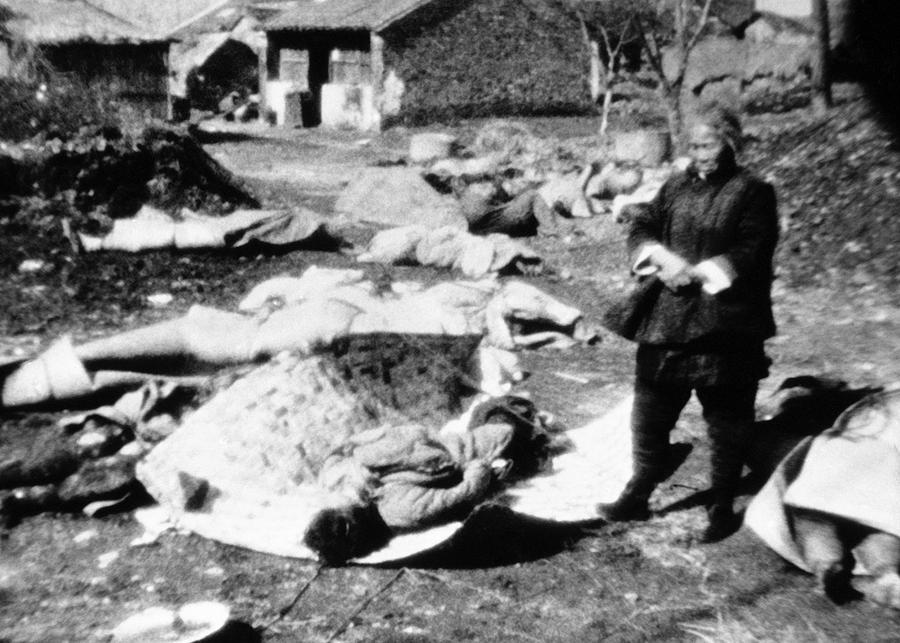
The massacre also consumed women, children, and the elderly. Civilians were murdered in homes, in refugee areas, on the streets, and in the countryside. Contemporary witnesses described bodies scattered across the city, and hospitals remained overwhelmed with gunshot and bayonet victims for weeks.
Mass executions on a huge scale
Many killings were not random acts by isolated soldiers. They were organized mass executions designed to kill large numbers of people quickly.
A major method was to bind prisoners, march them to the banks of the Yangtze River, and machine-gun them in rows. Survivors were often finished off with bayonets or revolvers. Bodies were burned, dumped into the river, or buried in mass graves, making later counting difficult.
Among the most notorious incidents was the massacre near Mufushan, where Japanese troops led 17,000 to 20,000 Chinese prisoners to the riverbank and killed them. Another major atrocity, the Straw String Gorge Massacre, involved prisoners whose hands were tied before they were divided into columns and shot. Elsewhere, victims were decapitated, used for bayonet practice, or burned alive.
There were also massacres in and around city gates. At Taiping Gate, 1,300 Chinese soldiers and civilians were gathered, murdered, and then burned. Witnesses reported mounds of corpses near Nanjing’s northern gates. In one account, machine-gun fire killed around two hundred Chinese in only ten minutes.
These were not simply battlefield deaths during active combat. Many of the victims had already surrendered, been captured, or were civilians accused without proof.
Sexual violence was central to the atrocity
Rape was one of the defining crimes of the Nanjing Massacre. It was widespread, systematic, and extraordinarily brutal.
The International Military Tribunal for the Far East estimated that in the first month of occupation there were approximately 20,000 cases of rape in the city. Other estimates go much higher. Women and girls of all ages were targeted, from infants to elderly women. Many were gang-raped. Many were killed afterward. Witnesses repeatedly described rape followed by murder, mutilation, or both.
Japanese soldiers went door to door searching for girls and women. Refugee camps and schools inside the Safety Zone were also penetrated. Minnie Vautrin, who sheltered thousands of women at Ginling Girls College, recorded the panic of refugees and the constant threat of assault. John Rabe wrote that one heard “nothing but rape.” Reverend James McCallum wrote of rape happening by day and night, estimating at least 1,000 cases a night at one point.
The violence was often sadistic. Victims were stabbed with bayonets or bamboo after rape. Pregnant women were attacked. Some mothers were assaulted after being forced to witness violence against their children. The article also records that some Chinese men and teenage boys were sexually assaulted.
Fire, looting, and destruction of the city
The killing was accompanied by large-scale looting and arson. Japanese soldiers entered buildings across the city and took what they wanted, often in full view of officers. Civilians were forced to carry stolen goods. Shops, homes, and newly built government buildings were pillaged.
About one third of the city was destroyed by fire. This destruction was not incidental. Witnesses described deliberate burning of civilian property, and survivors saw entire areas reduced to ruin. Arson added another layer of terror, leaving many who survived assault and robbery without shelter.
The destruction of bodies also complicates the historical record. Corpses were burned, thrown into the Yangtze River, or buried in mass graves, which is one reason the exact death toll remains contested.
The Nanking Safety Zone and those who tried to help
Amid the violence, a group of foreigners in the city attempted to protect civilians. The International Committee for the Nanking Safety Zone created a refugee area in the western quarter of Nanjing. John Rabe, a German businessman, led the committee.
The Safety Zone is credited with saving at least 200,000 lives. It worked because large numbers of civilians were concentrated in one area and its organizers tried to persuade military forces to keep troops out. Still, the zone was not fully secure. Japanese soldiers entered it repeatedly, carrying off men for execution and women for rape.
Several individuals stand out for their humanitarian efforts. Minnie Vautrin sheltered up to 10,000 women at Ginling Girls College. Bernhard Arp Sindberg and his German colleague Karl Gunther turned a cement factory into a refugee camp that gave refuge and medical help to roughly 6,000 to 10,000 civilians. John Magee documented atrocities with film and photographs, while other expatriates kept diaries, affidavits, and letters that became important evidence.
Why the death toll is debated
The numbers associated with the Nanjing Massacre remain debated, but the scale of the atrocity is not.
Many scholars support the estimate of the International Military Tribunal for the Far East that more than 200,000 people were killed. Newer estimates commonly place the death toll between 100,000 and 200,000. Other figures range from 40,000, if counting only the city itself, to more than 340,000, if a much wider region is included. Estimates of rape range from 4,000 to more than 80,000, with around 20,000 often cited.
Part of the difficulty comes from the deliberate destruction of records by Japanese authorities, the disposal of bodies, and disputes over how broadly to define the massacre in time and geography. Some calculations focus on the city walls and six weeks after the fall. Others include surrounding counties and violence from early December 1937 to late March 1938.
Despite these debates, a broad conclusion remains consistent: the massacre involved mass murder on a staggering scale.
Aftermath and memory
After the war, General Iwane Matsui and several other commanders were tried for war crimes and executed. Matsui was convicted because the tribunal ruled that he bore ultimate responsibility and did nothing effective to stop what it called an “orgy of crime.” Prince Yasuhiko Asaka, who had been installed as temporary commander and was associated with the order to “kill all captives,” was granted immunity and was never tried.
The massacre remains a deeply contentious issue in Sino-Japanese relations. Some Japanese nationalists and historical revisionists have denied or minimized it, while many scholars in Japan support the tribunal’s findings and accept that mass atrocities took place.
Nanjing is remembered not only because so many died, but because the violence continued after military victory had already been achieved. The city fell, but the killing kept going. That is what makes the event so haunting: the worst suffering came not in the battle itself, but in the days and weeks that followed.
Sources
Based on information from Nanjing Massacre.
More like this
More about history
More about war
History gets heavier when you know the details — download DeepSwipe and keep uncovering the stories behind the headlines of the past.


