Full article · 7 min read
Black Ships and the Opening of Japan
In 1853, four American warships entered Edo Bay and became one of the most shocking sights in Japanese history. Their arrival did more than alarm people on the shore. It marked the beginning of the end for Japan’s long period of isolation and pushed the country back into political dialogue with Western powers after more than two centuries.
These vessels became famous as the Black Ships, or kurofune. The name carried fear, disruption, and change. For many in Japan, they were not just foreign ships. They were a visible sign that the old order could no longer hold.
What were the Black Ships?
The term kurofune was used in Japan for Western vessels. Earlier, in the 16th century, it had referred to Portuguese merchant ships involved in trade with Japan. Those large ships, called carracks, had hulls painted black with pitch, a tar-like substance used to seal and protect wood. Because of that appearance, the label “black ships” came to be used more broadly.
By the 19th century, the phrase became strongly associated with the American warships led by Commodore Matthew C. Perry. Even though these ships did not actually have black-painted hulls, they produced thick black smoke from their coal-fired steam engines. That smoke made them appear ominous and unfamiliar, especially to observers used to sailing ships that depended on the wind.
Why the ships seemed so frightening
One of the most unsettling things about Perry’s fleet was that the ships could move without wind. Steam power made them seem unnatural and overwhelming to many Japanese viewers. The sight of four vessels entering Edo Bay, belching black smoke and advancing under their own power, deeply frightened people.
This was not simply fear of new technology. It was also fear of what that technology represented: military force. Perry’s expedition was a clear display of power. This kind of pressure is often called gunboat diplomacy, meaning the use of naval strength and the threat of violence to force political concessions.
The fear was intensified by Perry’s behavior. He refused official requests to move to Nagasaki, which was the licensed port for external trade. Instead, he insisted on coming closer and threatened to attack Edo and burn it to the ground if he was not allowed to land. In the end, he was permitted to land near Kurihama, where he delivered a letter before departing.
Japan’s “locked country” policy
To understand why the Black Ships had such an enormous impact, it helps to understand Sakoku. This was the Tokugawa shogunate’s policy of isolationism, often translated as “locked country.” Under this system, contact with most outside countries was forbidden or tightly restricted.
The Tokugawa shogunate adopted this policy after a period of earlier foreign contact. In the 16th century, Portuguese traders had initiated contact with Japan and established a trade route linking Goa, Malacca, and Nagasaki. This trade, known as the Nanban trade, brought in goods and inventions including refined sugar, optics, and firearms. Arquebuses, a type of firearm, became especially important during the Sengoku period, a time of intense internal warfare, because matchlock guns were copied and spread within Japan.
Christianity also entered Japan during this era. In 1549, the Spanish missionary Francis Xavier began a Jesuit mission there. The religion spread widely, gaining 300,000 converts among peasants and some daimyō, or regional warlords. But after the Shimabara Rebellion of 1637, which was blamed on Christian influence, the government cracked down. Portuguese traders and Jesuit missionaries faced tighter restrictions, were confined to Dejima, and were expelled in 1639.
After that, the Tokugawa shogunate retreated fully into Sakoku. For more than 200 years, only limited trade and diplomatic relations were maintained with China, Korea, the Ryukyu Islands, and the Dutch. Western contact was restricted to Dutch traders on Dejima island at Nagasaki.
The world had changed while Japan was closed
While Japan remained largely closed off, pressure from abroad did not disappear. In 1844, William II of the Netherlands urged Japan to open the mainland to trade, but Japan rejected the request.
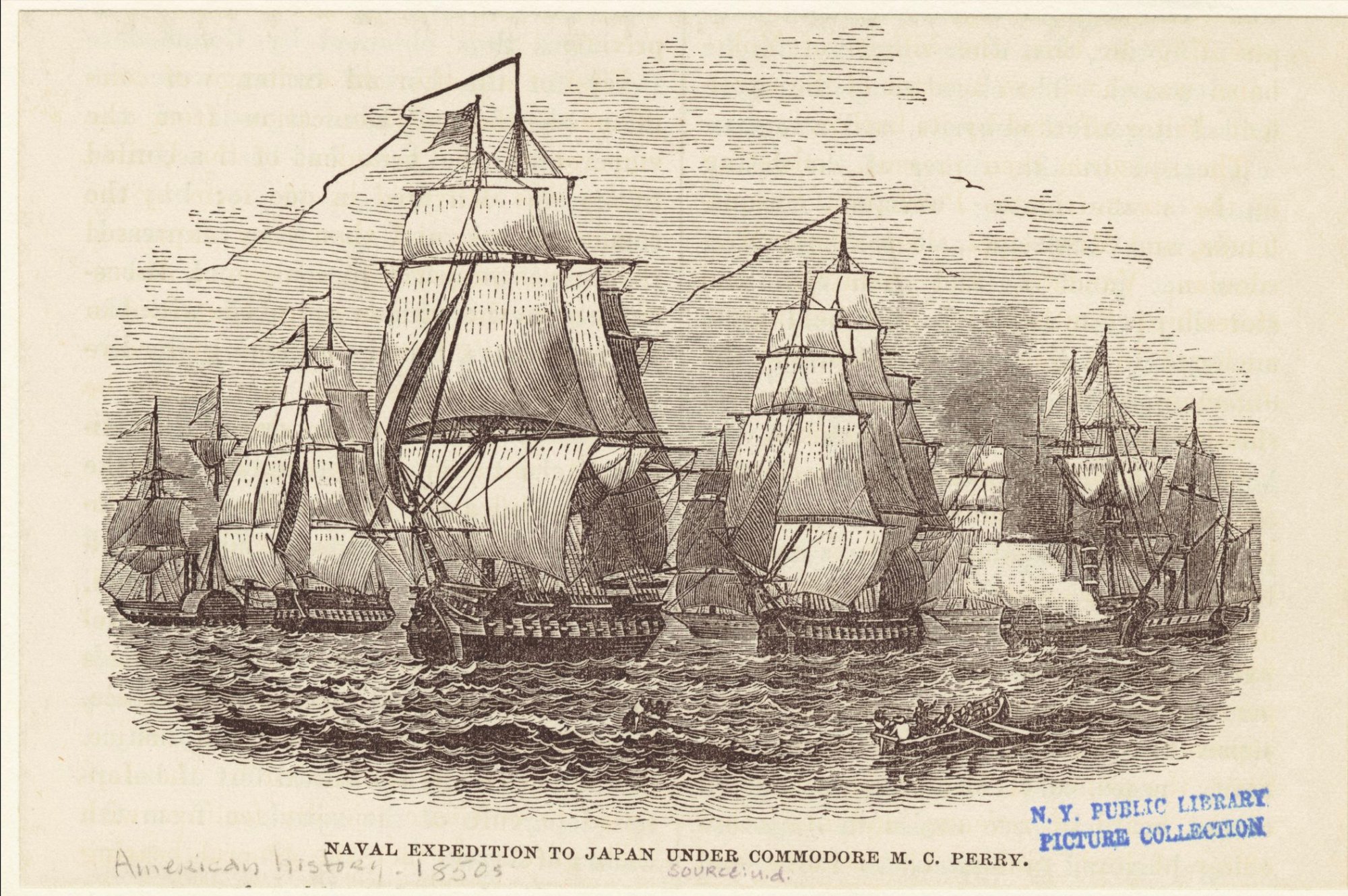
Then, on July 8, 1853, the United States Navy sent four warships into the bay at Edo. These ships were the Mississippi, Plymouth, Saratoga, and Susquehanna. They were part of the American expedition to open Japan under Commodore Perry. The expedition reached Uraga Harbor, in present-day Yokosuka in Kanagawa Prefecture, on July 14, 1853.
This was not a friendly visit in the ordinary sense. It was a forceful intervention designed to compel negotiations. Perry’s military display became the principal factor in securing a treaty allowing American trade with Japan, effectively ending the Sakoku era.
Perry returns with an even larger fleet
The first arrival was dramatic enough, but Perry did not stop there. The following year he returned with a fleet of eight Black Ships. The message was unmistakable: the United States Navy had the power to escalate, and Perry would not leave without results.
Inside Japan, officials debated how to respond. In the end, the government decided to avoid war and agree to a treaty with the United States. After about a month of negotiations, the shogun’s officials presented Perry with the Treaty of Peace and Amity.
Perry refused some of its conditions but agreed to put off those disagreements until later. Formal diplomatic relations between Japan and the United States were established, and when the fleet departed, a consul named Townsend Harris remained at Shimoda to negotiate a more permanent arrangement.
That longer-term agreement, the Harris Treaty, was signed with the United States on July 29, 1858. Within five years of the Treaty of Peace and Amity, Japan had also signed treaties with other Western countries. Trade with Western nations followed, and the Black Ships became a lasting symbol of the end of isolation.
Why the Black Ships mattered so much
The Black Ships were not important only because they were foreign. Japan had encountered Westerners before, especially through Portuguese trade and missionary activity in the 16th century. What made Perry’s arrival so consequential was timing, method, and effect.
First, the arrival came after more than two centuries of self-imposed isolation. That made the appearance of heavily armed steam-powered ships especially jarring. Second, Perry did not request dialogue from a distance; he backed demands with military threat. Third, the visit directly led to political agreements that reopened Japan to international relations and trade.
In that sense, the Black Ships were both real vessels and a powerful symbol. They represented technological shock, diplomatic coercion, and the collapse of an old boundary separating Japan from much of the outside world.
The Black Ships in Japanese culture
The shock of the Black Ships was so strong that it entered Japanese culture almost immediately. Their first visit inspired a famous kyōka, a humorous poem written in the 31-syllable waka form. The poem is built around puns known as kakekotoba, or “pivot words,” where the same sounds can carry multiple meanings.
Those layered meanings connect ideas such as peace, tea, steamships, and four vessels, turning the poem into a witty but uneasy reaction to the arrival of Perry’s fleet. That mixture of humor and alarm captures something essential about the moment: people were bewildered, frightened, and trying to make sense of a world that had suddenly changed.
The name Kurofune later appeared in major cultural works as well. It became the title of the first Japanese opera, composed by Kosaku Yamada and premiered in 1940. The story was based on Tojin Okichi, a geisha caught up in the turmoil of the final years of the Tokugawa shogunate. The Black Ships also echo in later works about Japan’s 19th-century transformation, including stories of westernization and uneasy encounters between Japan and the United States.
From black smoke to a turning point in history
Seen from shore, Perry’s ships were terrifying because they looked powerful, strange, and unstoppable. But their real significance lies in what followed. The Black Ships forced a government built on control and restricted contact to confront a new international reality.
For over 200 years, Sakoku had defined Japan’s relationship with the outside world. The arrival of the Black Ships did not merely interrupt that system. It helped bring it to an end. Through threat, negotiation, and treaty-making, the ships opened the way to diplomatic relations and trade with the West.
That is why the Black Ships remain such a potent historical image. They were four ships, then eight, but they came to symbolize something much larger: the moment Japan’s locked doors were forced open.
Sources
Based on information from Black Ships.
More like this
More about culture
More about history
More about war
Unlock your own “locked country” of curiosity — download DeepSwipe and let the Black Ships of knowledge sail in.