Full article · 8 min read
Pliny’s Day Under Ash: What the Eyewitness to Vesuvius Actually Saw
When Mount Vesuvius erupted in 79 AD, it destroyed towns, buried communities, and created one of history’s most famous natural disasters. But one of the most gripping parts of the story comes from a teenager: Pliny the Younger.
From Misenum, across the Bay of Naples and about 29 kilometres from the volcano, Pliny watched the disaster unfold. His two letters, written years later to the historian Tacitus, preserve the only surviving eyewitness account of the eruption. Through them, we get something rare in ancient history: not just the facts of a catastrophe, but the human experience of fear, confusion, escape, and loss.
The “pine-tree cloud” over Vesuvius
Pliny the Younger described seeing an extraordinarily dense cloud rising above the mountain. He compared it to a pine tree: a tall trunk shooting upward and then spreading out at the top like branches. That image has become one of the most famous descriptions of volcanic eruption in history.
This was no ordinary cloud. Vesuvius violently hurled hot tephra and gases high into the sky. Tephra is a general term for material blasted out by a volcano, including ash, pumice, and fragments of rock. The column rose so high that this eruption later gave its name to the Vesuvian type of eruption, known for towering columns of hot ash and gas reaching the stratosphere.
Pliny noted that the cloud sometimes looked bright and sometimes dark and spotted, depending on how heavily it was loaded with earth and cinders. Even from a distance, it was clear that something extraordinary and dangerous was happening.
A rescue mission begins
Pliny’s uncle, Pliny the Elder, was in command of the Roman fleet at Misenum. At first, he decided to investigate the phenomenon in a light vessel. Then the emergency became personal.
A messenger arrived from Rectina, the wife of Bassus, who lived on the coast near the foot of the volcano. Her party could only escape by sea, and she asked for rescue. Pliny the Elder responded immediately, ordering fleet galleys to launch for evacuation while continuing himself by ship.
During the crossing, conditions worsened fast. Thick showers of hot cinders, lumps of pumice, and pieces of rock fell around the vessels. Pumice is a foamy volcanic rock created when gas-rich lava cools quickly; it can be light enough to float. The helmsman advised turning back, but Pliny reportedly answered, “Fortune favors the brave,” and pressed on toward Stabiae.
At Stabiae, Pomponianus had already loaded a ship with belongings and was preparing to leave, but the same onshore wind that had brought Pliny there prevented departure. The rescue had turned into a trap.
Meanwhile at Misenum: a family under threat
While his uncle sailed toward danger, Pliny the Younger stayed behind. He tried to continue normal life, even studying and bathing, but the crisis soon overwhelmed any sense of routine.
That night, tremors woke him and his mother. They left the house for the courtyard, a decision that captures how unstable everything had become. Earthquakes had already shaken the region before the eruption. A major earthquake in 62 AD had caused widespread destruction around the Bay of Naples, especially at Pompeii, and some of that damage had still not been repaired by 79 AD. Smaller earthquakes followed in later years, and minor tremors were reported in the four days before the eruption. But because earthquakes were common in Campania, the warnings were not fully recognized.
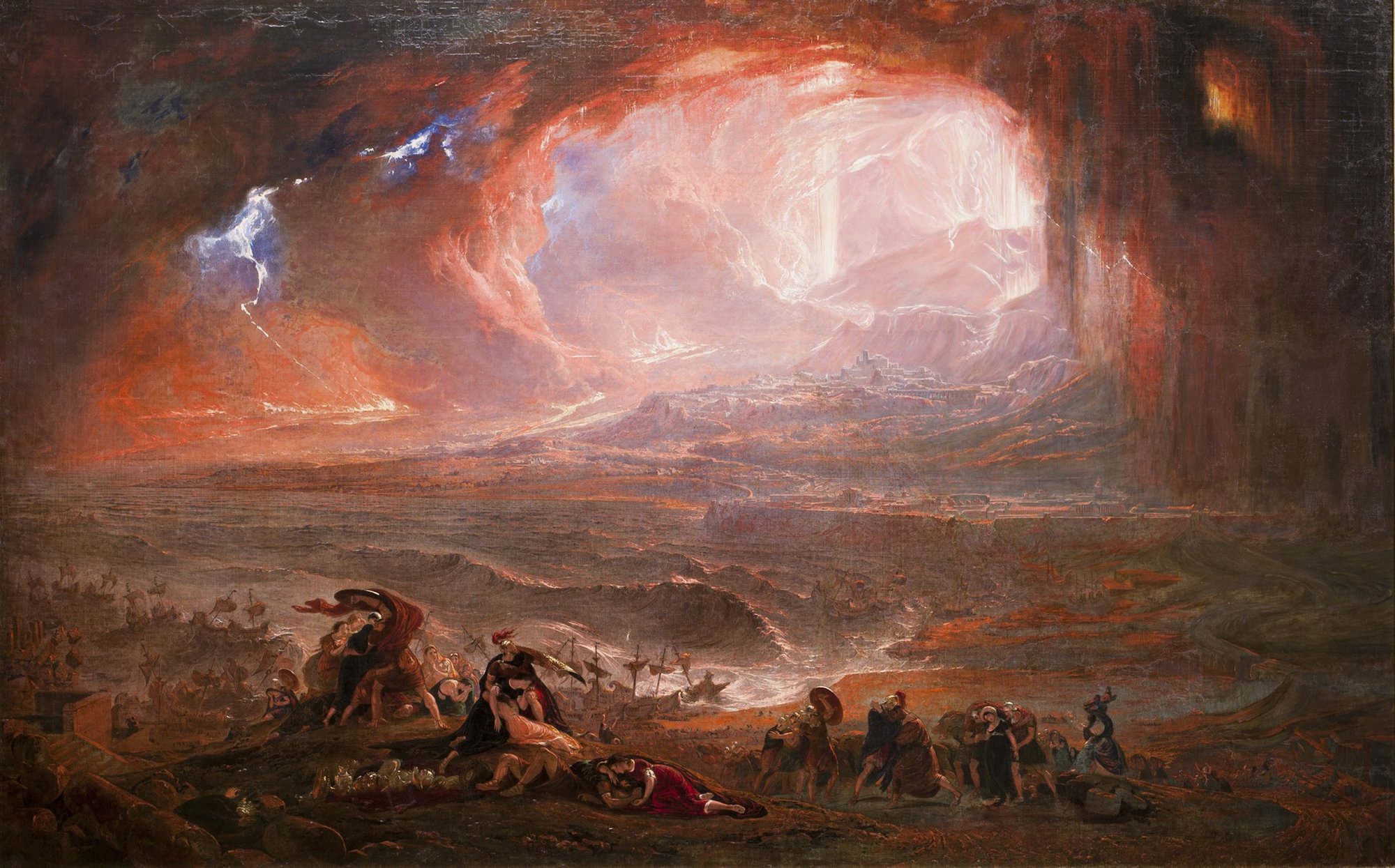
At dawn, another tremor struck, and people abandoned the village. Pliny records a haunting detail: after a third tremor, “the sea seemed to roll back upon itself, and to be driven from its banks.” This is taken as evidence of a mild tsunami in the Bay of Naples.
A tsunami is a large sea wave caused by a sudden movement of water. In this case, the disturbance was associated with the eruption and earthquakes. At Misenum, there was no evidence of extensive wave damage, but the effect added to the sense that the natural world itself was breaking apart.
Darkness at midday
As the event worsened, a black cloud blocked the light. Through it flashed bursts that Pliny compared to sheet lightning, only larger. Nearby landmarks vanished from sight, including Point Misenum and the island of Capraia across the bay.
Ash began to fall. Pliny said he had to shake it off repeatedly to avoid being buried. He compared the ashfall to a blanket of snow, an image that is striking because snow suggests softness and silence, while volcanic ash carries collapse, suffocation, and panic.
The wider eruption around Vesuvius was already producing devastation. In the early afternoon of the first day, ash and pumice began blanketing the region. Roofs collapsed under the weight. Escapes and rescues took place over the next several hours. One or more major earthquakes also occurred, bringing down walls and killing refugees.
For those farther away, like Pliny, the signs came as darkness, ash, fear, and flight. For those closer to the volcano, the danger would become far deadlier.
The mountain turns lethal
The eruption lasted two days. Stratigraphic studies, which examine layers of volcanic deposits, concluded that it unfolded in alternating phases. The first phase sent a towering column of debris and hot gases into the sky for 18 to 20 hours, raining pumice and ash over areas including Pompeii.
Later came pyroclastic surges and flows. These were among the deadliest parts of the eruption. A pyroclastic flow is a rapid-moving current of extremely hot gases, ash, and volcanic fragments. Rather than drifting gently downward like ashfall, it races across the ground, burning, suffocating, and smashing what lies in its path.
In the early morning of the second day, a rapid, dense, and very hot flow knocked down walls and killed many of those still alive near the volcano. Pompeii was engulfed and covered deeply. Herculaneum, Pompeii, and Oplontis were buried under fine pyroclastic deposits, pulverized pumice, and lava fragments.
Later studies estimated terrifying temperatures for some of these surges. In Pompeii, deposits connected to major surges were linked to temperatures ranging from about 180 °C to 260 °C, with some areas hotter still. Research suggested these temperatures were enough to kill people in a fraction of a second.
For readers of Pliny’s letters, this wider context matters. He was far enough away to survive and observe, but close enough to witness the edge of a disaster that annihilated entire communities.
Why Pliny’s account matters so much
Pliny the Younger’s letters are precious because so little direct testimony from ancient disasters survives. One letter records what he learned from witnesses about his uncle’s final journey. The other recounts his own experience at Misenum.
Together, they preserve vivid details: the strange cloud, the trembling ground, the sea drawing back, the blackness, the lightning-like flashes, the ash, and the terror of a population calling to each other as they retreated from the shore.
His writing also helps historians reconstruct timing. He says the morning before the eruption seemed normal. The main column rose in the early afternoon. The darkest panic at Misenum came through the night and into the following dawn. By the evening of the second day, the eruption no longer affected Misenum except for haze screening the sunlight.
Without Pliny, the eruption would still be known from archaeology, buried cities, and volcanic deposits. But with Pliny, it becomes immediate and human.
The final hours of Pliny the Elder
Pliny the Elder did not survive. At Stabiae, he and his companions spent the night in a building shaken by violent movement. Eventually they decided to move outside, tying pillows to their heads for protection against falling rock.
When they reached the beach, the wind still would not allow ships to leave. Pliny sat down on a sail laid out for him and could not get up again, even with help. His companions fled and later escaped by land.
His nephew later suggested that he died because his weak lungs reacted to a poisonous sulphurous cloud. But this remains debated. Stabiae was some distance from the volcanic vent, and the others with him were apparently not overcome by fumes. Other proposed causes include stroke, heart attack, or possibly an asthmatic attack. What is known is that his body was found the next day after the plume had dispersed, and it showed no apparent injuries.
That detail matters because it separates drama from certainty. The man who sailed toward the disaster to investigate and rescue others died there, but exactly how remains uncertain.
Ash, memory, and history
The eruption destroyed towns and killed many people, though the total death toll remains unknown. Pompeii and Herculaneum are the best-known places buried by the disaster, and excavations have revealed extraordinary traces of ancient life. More than 1,500 remains have been found across the two cities, but the overall number of victims is still not certain.
Pliny the Younger survived, returned home after the ashfall weakened, and eventually wrote the account that fixed the disaster in historical memory. His letters do more than describe a volcano. They show how people tried to make sense of chaos in real time: some studied, some fled, some prayed, some called to loved ones, and one Roman commander sailed into danger because someone had asked for help.
That is why Pliny’s day under ash still feels alive. It is not only the story of eruption columns, earthquakes, pumice, and pyroclastic surges. It is the story of what catastrophe looks like from the ground, through the eyes of someone who watched the sky turn black and lived to describe it.
Sources
Based on information from Eruption of Mount Vesuvius in 79 AD.
More like this
Step into history before the ash falls — download DeepSwipe and uncover more stories that hit like a pine-tree cloud of knowledge.