Full article · 8 min read
Why the Rosetta Stone Became a Universal Metaphor
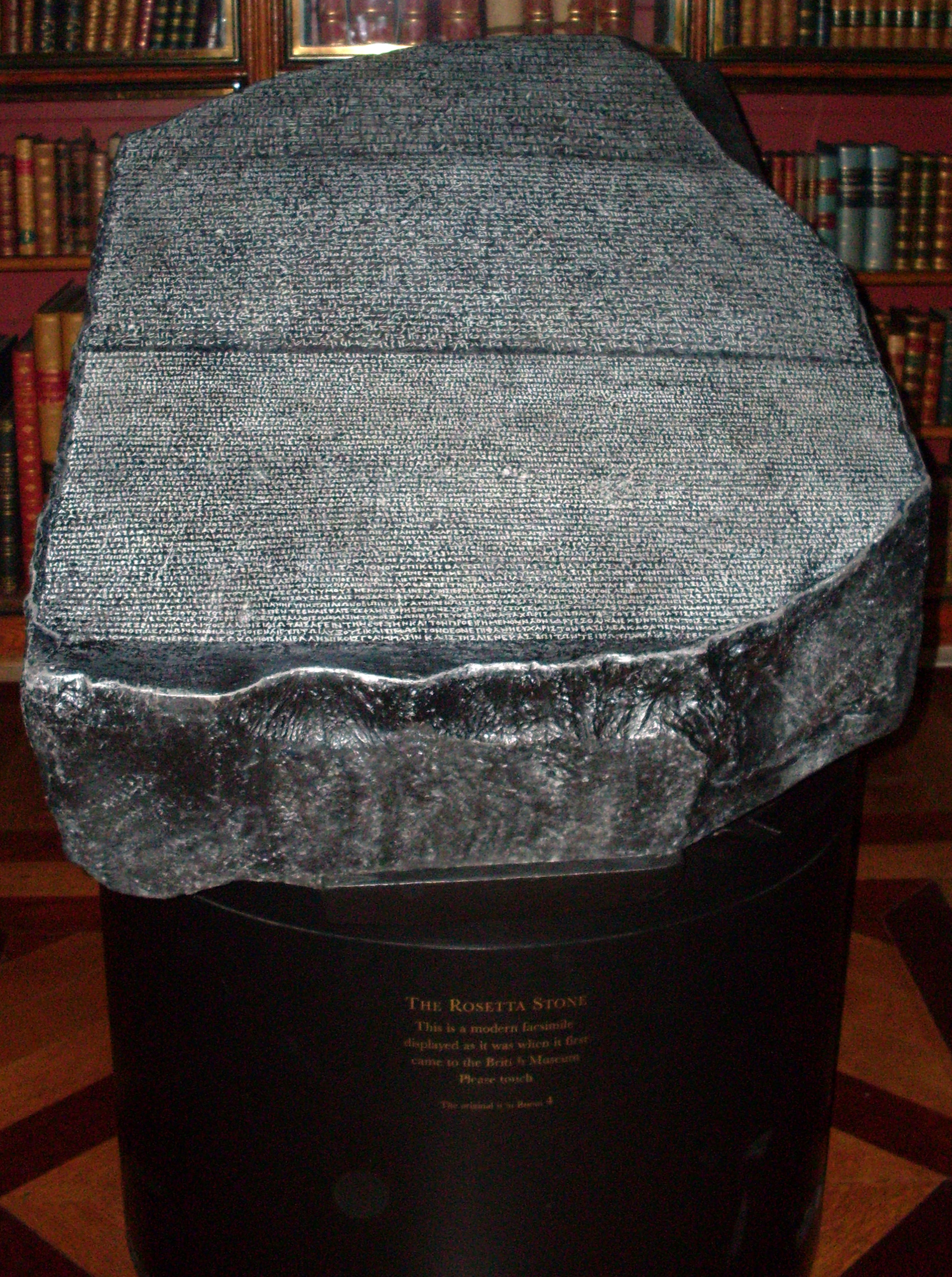
The phrase “Rosetta Stone” has escaped the museum label and entered everyday language. People now use it to mean the vital clue that unlocks a larger puzzle. That figurative meaning did not appear by accident. It grew out of the stone’s extraordinary role in opening up ancient Egyptian writing after it had gone unread for centuries.
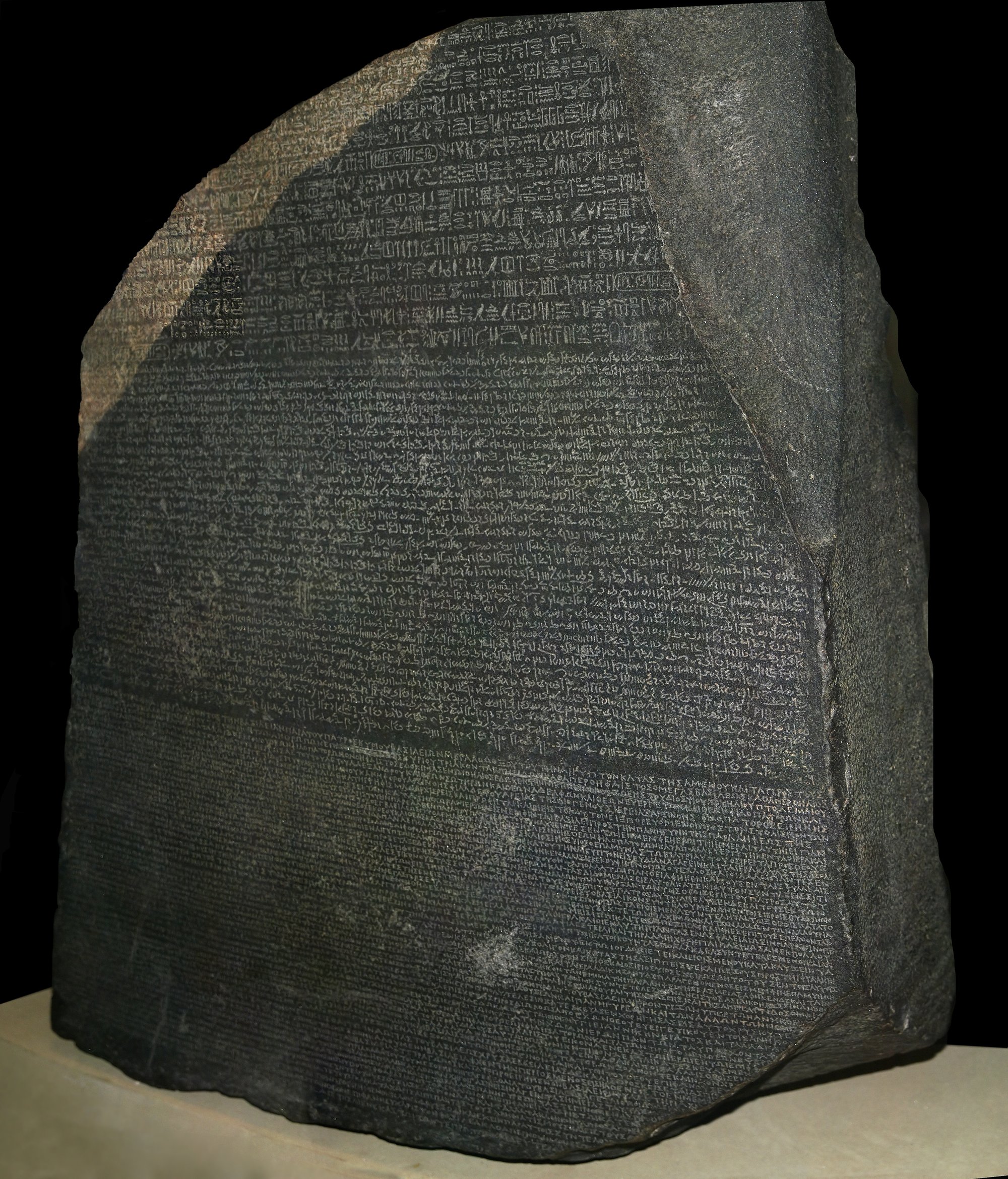
What made this object so powerful was not simply that it was old, rare, or beautiful. It was that it carried the same decree in three scripts: Egyptian hieroglyphs, Demotic, and Ancient Greek. Because the versions differed only slightly, scholars could compare them. That turned the stone into the essential key for deciphering Egyptian scripts, and eventually for recovering ancient Egyptian inscriptions and literature.
The stone that unlocked a lost world
The Rosetta Stone is a granodiorite stele inscribed with a decree issued in 196 BC during the Ptolemaic dynasty, on behalf of King Ptolemy V Epiphanes. A stele is an upright stone slab used for inscriptions, often erected in public or sacred places. In this case, the decree was originally displayed in a temple setting.
Its three texts were written for different audiences and functions. The top register used hieroglyphs, the formal script associated with religious and monumental use. The middle register used Demotic, a script closer to the Egyptian language of everyday administration and documents in Ptolemaic times. The bottom register was in Ancient Greek, the language used by the Ptolemaic government.
This combination mattered enormously. Ancient Greek was still readable to scholars, while the Egyptian scripts were not. Because the stone preserved parallel versions of the same decree, it gave researchers a way to compare known and unknown writing systems line by line. That is why the Rosetta Stone became so much more than an archaeological find: it became the practical bridge between silence and understanding.
Why the breakthrough was so dramatic
By the time the Rosetta Stone was discovered in 1799, hieroglyphs had not been understood since shortly before the fall of the Roman Empire. Their use had become increasingly specialised even in late Egyptian history. Monumental hieroglyphic writing ceased as temple priesthoods died out and Egypt was converted to Christianity. The last known hieroglyphic inscription is dated to 24 August 394, and the last known Demotic text was written in 452.
That means the scripts had been unread for well over a thousand years.
For centuries, attempts to decipher hieroglyphs had gone wrong. Their pictorial appearance encouraged the idea that they were purely symbolic. A work called Hieroglyphica by Horapollo, written in the 5th century, was long believed to be authoritative, but it was misleading in many respects and became a lasting obstacle to real understanding. Arab historians in medieval Egypt also studied hieroglyphs, comparing them with Coptic, and later European scholars tried repeatedly to solve the mystery. None could fully crack the system.
The Rosetta Stone changed that because it supplied the missing kind of evidence: a multilingual text that could be compared across scripts. Scholars slowly realized that the Egyptian writing on the stone did not work in some completely alien way. Parts of it represented sounds, especially in names. That insight was one of the decisive steps toward reading the language.
From a decree to a civilisation
The stone’s importance goes far beyond the contents of its decree. The decree itself was issued after the coronation of Ptolemy V and established the divine cult of the new ruler. It recorded honors granted to him by priests and referred to gifts of silver and grain to the temples. It also noted particularly high flooding of the Nile and measures taken for the benefit of farmers. Copies of the decree were to be placed in every temple and written in the “language of the gods,” the “language of documents,” and the “language of the Greeks.”
On its own, that might sound like a fairly specific political and religious text. But in practice, the stone became the gateway to something much larger. Once scholars could begin to understand how hieroglyphic and Demotic writing worked, they gained access to a vast body of inscriptions and texts that had long been closed off. That is why the Rosetta Stone came to symbolize more than translation. It represents recovered access to ancient Egyptian literature and civilisation.
The metaphor was earned because the stone did not just explain itself. It helped explain an entire written culture.
How scholars turned the clue into a solution
The process of decipherment was gradual, not a single eureka moment. The discovery first aroused public interest because scholars immediately understood its potential. Lithographic copies and plaster casts circulated among museums and researchers in Europe, allowing many people to study the inscriptions.
The Greek text provided the starting point, since scholars could read Greek even if they still struggled with some Hellenistic administrative and religious terminology. The first complete published translation of the Greek text appeared in 1803.
Attention then turned to the Demotic and hieroglyphic texts. In 1802, Johan David Åkerblad and Antoine-Isaac Silvestre de Sacy worked on identifying Greek names within the Demotic script by comparison with the Greek version. Åkerblad produced an alphabet of 29 letters, more than half of them correct, though the full nature of the script remained unclear because Demotic included not only phonetic signs but also other symbols.
A major advance came when Thomas Young studied the hieroglyphic text and identified phonetic characters used to write the Greek name Ptolemaios. He also noticed many similarities between hieroglyphic and Demotic signs, helping overturn the belief that the scripts were entirely separate in nature.
Jean-François Champollion then made the breakthrough that carried the decipherment much further. In 1822, using evidence from the Rosetta Stone and other inscriptions such as the Philae obelisk, he identified additional phonetic hieroglyphic characters and rapidly constructed an alphabet. He announced his findings in Paris that year. Between 1822 and 1824, it became clear that phonetic characters were used not only for foreign names but also for native Egyptian words.
This mattered because it showed that hieroglyphs were not merely symbolic pictures. They could encode sounds. That realization opened the way to reading ancient Egyptian confidently.
Why the name became a metaphor
The Rosetta Stone’s figurative power comes from this exact pattern: a relatively limited sample making a much larger system intelligible. One object provided the clue that unlocked an entire field of knowledge.
That is why the term “Rosetta Stone” came to mean the essential clue to a new field of understanding. It is now used not only for ancient inscriptions but also more broadly for encoded information, scientific puzzles, and any case where one key example reveals the structure of a bigger whole.
The term has been applied to other bilingual or trilingual inscriptions that helped decipher ancient scripts. It has also been used idiomatically for the first crucial key in the decryption of information. According to the Oxford English Dictionary, the first figurative use appeared in the 1902 edition of the Encyclopædia Britannica, in an entry on the chemical analysis of glucose.
From there, the phrase spread widely. It appeared in literature, including H. G. Wells’s 1933 novel The Shape of Things to Come, where a manuscript in shorthand helps make sense of scattered material. It was later used in scientific contexts too. The spectrum of hydrogen atoms was described as the Rosetta Stone of modern physics. The key set of genes in the human leucocyte antigen system has been called the Rosetta Stone of immunology. Arabidopsis thaliana has been called the Rosetta Stone of flowering time. A gamma-ray burst linked with a supernova has been described as a Rosetta Stone for understanding the origin of gamma-ray bursts. Doppler echocardiography has been called a Rosetta Stone for clinicians studying how the left ventricle fills in forms of diastolic dysfunction.
In each case, the idea is the same: one crucial sample, one breakthrough pattern, one gateway that suddenly makes a difficult landscape readable.
More than a museum object
Even though the Rosetta Stone is no longer unique in a strict sense, its symbolic status remains unmatched. Other fragmentary copies of the same decree were discovered later, and several other Egyptian bilingual or trilingual inscriptions are now known. Yet the Rosetta Stone still stands as the emblem of decipherment itself.
That is partly because it was the first Ancient Egyptian bilingual text recovered in modern times. It was also the object around which public fascination, scholarly effort, and intellectual rivalry all converged. Since 1802, it has been on public display at the British Museum almost continuously, and it remains the museum’s most visited object.
Its fame reflects something bigger than archaeology. The stone has come to represent a universal human hope: that even the most baffling mystery may yield if the right clue survives.
The lasting meaning of “Rosetta Stone”
When people call something a “Rosetta Stone,” they are invoking a very specific kind of breakthrough. Not just a discovery, and not just a translation, but the moment when a stubborn unknown begins to speak.
The original Rosetta Stone earned that role by making it possible to compare scripts, detect patterns, identify phonetic signs, and ultimately reopen access to ancient Egyptian writing. From that achievement grew a metaphor that now travels across history, literature, science, and technology.
A small inscription became the name for a big idea: that one well-placed clue can unlock an entire world.
Sources
Based on information from Rosetta Stone.
More like this
More about culture
More about history
More about language
Find your next Rosetta Stone moment — download DeepSwipe and unlock a bigger world, one swipe at a time.


