Full article · 7 min read
Paleolithic Prehistory and the First Human Breakthroughs

The Paleolithic is the deepest stretch of human prehistory that we can meaningfully explore through physical evidence. Its name means “Old Stone Age,” and it begins with the first known use of stone tools by hominins around 3.3 million years ago. That makes it not just ancient, but astonishingly ancient: these earliest tools are even older than the genus Homo itself.
This period is where some of the most important human breakthroughs first appear in the archaeological record. Stone tools, fire, burial, art, music, and increasingly sophisticated technology all emerge across the long arc of the Paleolithic. It is a time before written records, so everything we know comes from archaeological and anthropological evidence: tools, bones, charred remains, settlements, and other material traces left behind.
What “Paleolithic” actually means
The Paleolithic is the earliest part of the Stone Age. In Eurasia, prehistory is often divided using the three-age system: Stone Age, Bronze Age, and Iron Age. The Stone Age itself is further divided into the Paleolithic, Mesolithic, and Neolithic.
The Paleolithic stretches from the earliest known stone tools around 3.3 million years ago to the end of the Pleistocene around 11,650 BP. “BP” means “Before Present,” with “present” set at 1950 in archaeological dating. So when a site is dated to hundreds of thousands of years BP, it is being measured backward from that standard reference point.
The Paleolithic is usually broken into three broad phases:
- Lower Paleolithic
- Middle Paleolithic
- Upper Paleolithic
These labels are modern scholarly terms used to organize a very long and anonymous past. Since there are no written names for peoples or cultures from this era, prehistorians rely on material evidence and carefully defined categories to make sense of change over time.
The first breakthrough: stone tools before Homo
The opening act of the Paleolithic is the appearance of stone tools. The earliest known examples come from around 3.3 million years ago at the Lomekwi site in Kenya. These tools are so old that they predate the genus Homo and were probably used by Kenyanthropus.
That fact alone reshapes how human origins are imagined. Tool use is often thought of as a hallmark of “humanity,” yet the earliest known stone technology appears before humans in the strict biological sense had even emerged. In other words, the roots of technology run deeper than Homo.
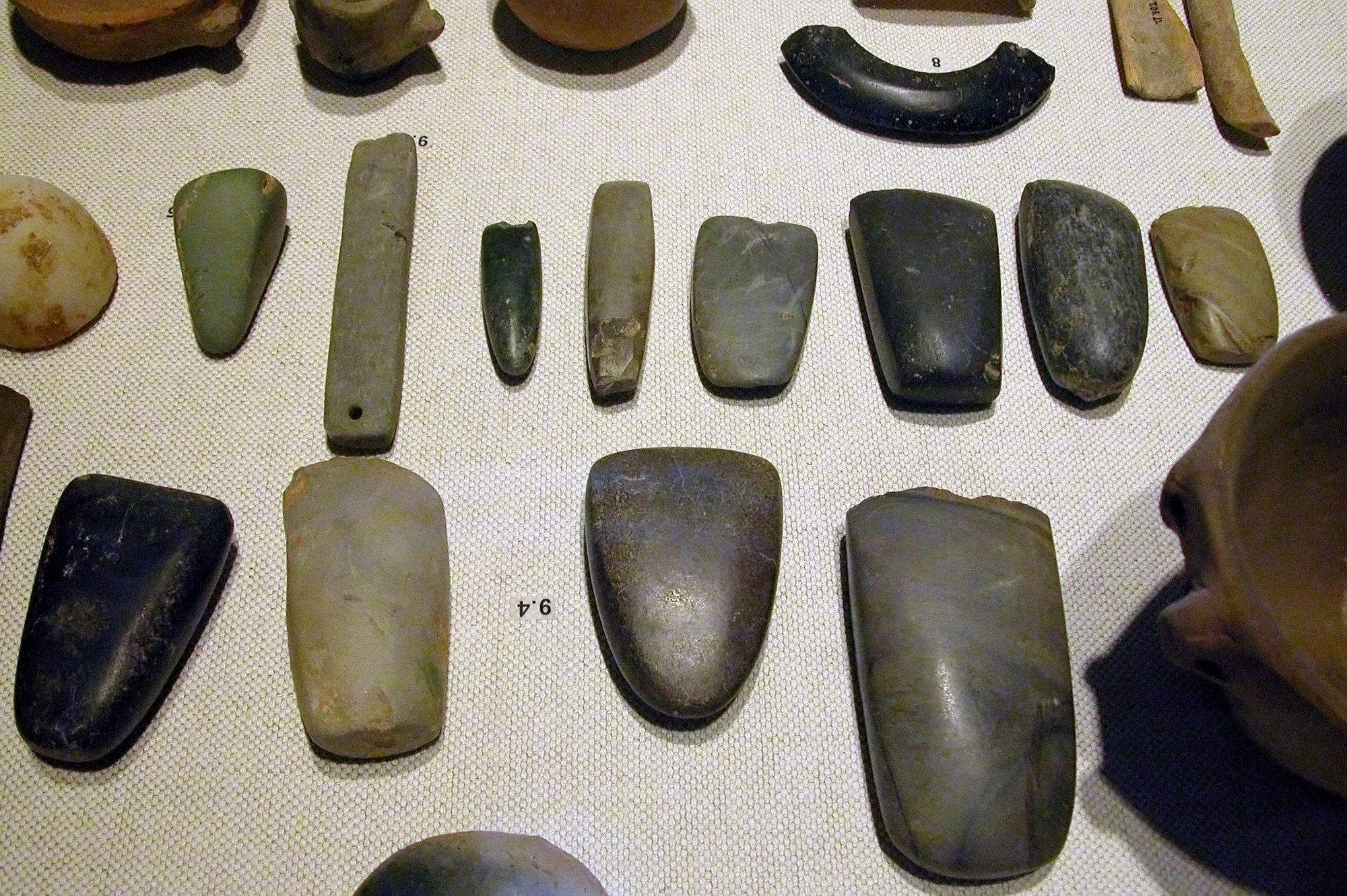
Stone tools matter because they survive. Unlike wood, plant fibers, or animal hides, stone can endure for immense spans of time. That durability is one reason archaeology can trace the Paleolithic at all. From these objects, researchers can study changing tool-making techniques and infer aspects of behavior, adaptation, and skill.
By around 600,000 BP, the timeline records hunting-gathering. Throughout the Paleolithic, humans generally lived as nomadic hunter-gatherers. These societies were often very small and egalitarian, though not always simple. Where resources were abundant or food storage was advanced, some hunter-gatherer groups could become more sedentary and develop complex social structures such as chiefdoms and social stratification.
Fire: the uncertain revolution that changed everything
Few discoveries feel more dramatic than the control of fire, but in the Lower Paleolithic the evidence is difficult and debated. Claims for very early fire use exist, yet the strongest scholarly support is limited. One widely accepted case places fire-making by H. erectus or H. ergaster between 790,000 and 690,000 BP at Bnot Ya'akov Bridge in Israel.
Even with uncertainty about the earliest dates, the significance of fire is clear. Fire could be used to cook food, provide warmth, create light, deter animals at night, and extend activity after dark. The archaeological record later shows definitive evidence of human use of fire in the Middle Paleolithic. Sites in Zambia preserve charred logs, charcoal, and carbonized plants dated to 180,000 BP.
This matters because fire is more than a tool. It changes the rhythm of life. It affects where people can live, what they can eat, and what they can do when the sun goes down. In a world without artificial light, flame turns nighttime from a threat into usable time.
The rise of Homo sapiens and modern capacities
Around 300,000 years ago, early Homo sapiens originated, ushering in the Middle Paleolithic. This phase is especially important because it includes anatomical changes indicating modern language capacity. The timeline also places anatomically modern humans in Africa around 300,000 BP.
The Middle Paleolithic is where the human mind begins to stand out more clearly in the material record. Archaeology preserves the first definitive signs not only of fire use, but also of systematic burial of the dead, music, prehistoric art, and increasingly sophisticated multi-part tools.
These finds do not give us written thoughts or spoken words, but they do reveal behavior that feels recognizably human in a deeper sense. Burial suggests ritual or social meaning surrounding death. Music hints at performance, rhythm, and shared culture. Art points to symbolism, imagination, or communication through images. Multi-part tools show planning and technical complexity.
The timeline also notes behavioral modernity by around 80,000–50,000 BP, including language and sophisticated cognition. That phrase refers to forms of behavior associated with complex thinking and symbolic culture. In prehistory, such capacities are not read from documents but from patterns in tools, artworks, habitation, and treatment of the dead.
Upper Paleolithic creativity and the first organized settlements
The Upper Paleolithic runs from about 50,000 to 12,000 years ago. This is the phase in which artistic work is said to blossom, and the record shows the first organized settlements.
Art becomes especially visible in this period. One example in the timeline is the cave paintings of Chauvet Cave in France, associated with the beginnings of Aurignacian culture around 32,000 BP. Another striking example is the clay sculpture of a wisent, or European bison, made deep inside Le Tuc d'Audoubert cave around 16,000 BP.
These creations matter because they were not necessary for basic survival in any narrow sense. They reveal a world in which human beings were making images, shaping materials, and expressing ideas in durable forms. Paleolithic life was not only about endurance. It also included symbolic and artistic activity.
The Upper Paleolithic record also includes technological advances. During the Gravettian period in Europe, between around 28,000 and 20,000 BP, harpoons, needles, and saws appear. By around 26,000 BP, people around the world were using fibers to make baby-carriers, clothes, bags, baskets, and nets. Such details remind us that prehistoric technology was not limited to rough stone objects. Much of daily life likely depended on organic materials that survive only rarely.
The archaeological record also captures increasingly settled life in some places. Around 23,000 BP, a settlement of huts built of rocks and mammoth bones was founded near what is now Dolní Věstonice in the Czech Republic. It is described as the oldest human permanent settlement found by archaeologists. Around 23,000 BP there is also evidence of small-scale trial cultivation of plants at Ohalo II, a sedentary hunter-gatherer camp on the shore of the Sea of Galilee.
These finds complicate any simple image of Paleolithic humans as constantly wandering from place to place. Nomadism was common, but some groups established more organized or lasting occupations, especially where conditions allowed it.
How we know any of this
Because the Paleolithic belongs to prehistory, there are no written records from the period itself. Knowledge comes from the archaeological record and from related fields such as anthropology, geology, genetics, paleontology, linguistics, and other sciences.
A key step in understanding prehistoric evidence is dating. One of the most common dating methods is radiocarbon dating. Researchers also use geologic and geographic surveys, excavation, forensic chemical analysis to identify how materials were used and where they came from, and genetic analysis of bones to study kinship and physical characteristics.
This means Paleolithic prehistory is reconstructed from fragments: a tool here, a hearth there, bones in one layer, pigments or carvings in another. It is a field built from evidence that is often incomplete, anonymous, and open to revision when new discoveries appear.
Why the Paleolithic still feels so powerful
The Paleolithic covers an enormous span of time, yet its major breakthroughs remain immediately compelling. The first stone tools mark the beginning of visible technological behavior on a deep timescale. Fire transforms survival and daily life. Burial, music, art, and composite tools reveal minds capable of symbolism, planning, and culture. Organized settlements show that even in the Old Stone Age, human communities were experimenting with new ways of living.
Prehistory can feel remote because it lacks named individuals and written voices. But the Paleolithic is where many of the foundations of human life first come into view. Long before cities, kingdoms, and writing systems, there were already makers, problem-solvers, artists, and communities shaping the world with stone, flame, and imagination.
In that sense, the Paleolithic is not just the beginning of prehistory. It is the first long record of human breakthrough after human breakthrough.
Sources
Based on information from Prehistory.
More like this
More about archaeology
More about history
Spark your curiosity like the first campfire — download DeepSwipe and light up your brain with bite-sized knowledge.


