Full article · 7 min read
The Arts: From Caves to Cinema
Why art seems to follow humanity everywhere
Human life and art are deeply entwined. Across history, people have used the arts for creative expression, storytelling, and cultural participation. Long before museums, concert halls, or movie theaters existed, humans were already making images, performing rituals, and shaping meaning through creative acts. That continuity is one of the most striking things about the arts: they change constantly in style and form, yet they remain a constant feature of human life.
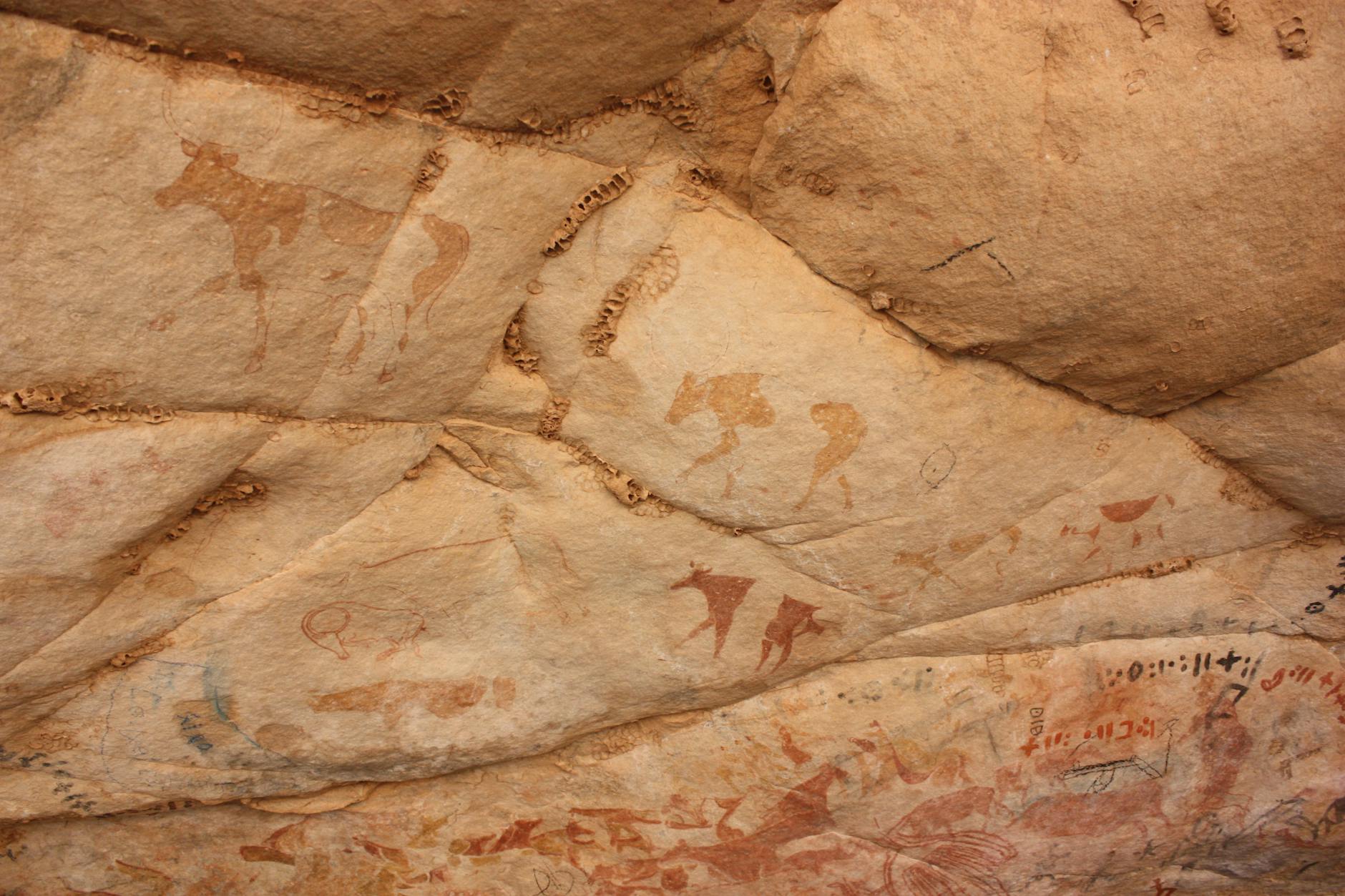
A vivid way to see this is to imagine the arc from prehistoric cave paintings in the Upper Palaeolithic to modern-day films. The Upper Palaeolithic refers to a late part of prehistory, and cave painting from that era shows that image-making is not a recent luxury. It is one of humanity’s oldest habits. Over time, those early marks and rituals developed into increasingly stylized and intricate forms through study, training, and tradition. What begins in caves eventually expands into painting, literature, dance, theatre, music, photography, filmmaking, and more.
The first galleries were not museums
When people think of art, they often picture framed paintings on white walls. But the history of the arts is much wider than that. Early human artistic practice included prehistoric cave paintings and ancient forms of ritual. In that sense, the first “galleries” were not carefully designed buildings but the spaces where people lived, gathered, and expressed shared meaning.
These early works matter because they show that the arts have long helped humans register and preserve their changing relationships with each other and the world. Art does not simply decorate life. It records how people see animals, nature, power, belief, beauty, fear, memory, and community. Even when styles differ wildly across time and place, the underlying impulse remains familiar: humans make art to express something that feels worth carrying forward.
What art records
One of the most powerful roles of the arts is that they preserve shifting relationships. That phrase includes a lot. It can mean how people understand themselves as individuals, how communities define shared values, and how societies interpret the natural or spiritual world.
The arts cultivate social, cultural, and individual identities. They also transmit values, impressions, judgments, ideas, visions, spiritual meanings, patterns of life, and experiences across time and space. In simple terms, art lets one group of people send emotional, intellectual, and cultural messages beyond the limits of the present moment.
A painting can preserve a way of seeing. A poem can preserve a voice. A dance can preserve a pattern of movement shaped by social or spiritual meaning. A film can combine image, sound, narrative, and performance into a time capsule of feeling and thought. The medium changes, but the function remains surprisingly stable: the arts help human experience travel.
Across time and space: how artistic messages move
The phrase “across time and space” captures why art matters so much. Most human experience disappears quickly. A performance ends. A conversation fades. A generation passes. The arts resist that vanishing.
Literature stores language in forms such as fiction, drama, poetry, and prose. Visual arts store images and forms through painting, sculpture, drawing, photography, architecture, and filmmaking. Performing arts store expression through repeatable works such as scripts and scores, or through practices that can be performed again even when each performance differs.
This is why art can outlive its makers. Through the arts, people in one era can encounter the values and visions of another. The arts carry stories, beliefs, and ways of feeling into new places and later times. They become a medium through which human beings share impressions and ideas far beyond the moment of creation.
Why humans make art
The arts are not only about preserving the past. They also shape what people become. Art helps humans develop capacities of attention and sensitivity. Attention means learning how to notice, while sensitivity means becoming more responsive to nuance, feeling, form, and meaning. In this sense, the arts can train perception as much as they produce objects or performances.
At the same time, the arts can be ends in themselves. This is often described as art for art’s sake, meaning art made simply because it is worthwhile in itself, not because it must serve some outside purpose. That idea highlights something important: art does not always need to justify itself as useful in a practical way. Sometimes creating, performing, or experiencing art is itself the point.
Yet even when art exists for its own sake, it can still transform human responses to the world. The arts can change what people consider worthwhile goals or pursuits. They can redirect attention, sharpen feeling, and invite reflection. In that sense, art is both a response to the world and a force that reshapes how the world is understood.
One idea, many forms
The arts are commonly divided into three main branches: visual arts, literature, and performing arts.
Visual arts include forms such as architecture, drawing, painting, photography, sculpture, ceramic art, and filmmaking. These are arts experienced primarily through sight, though some, like architecture or sculpture, also involve a strong sense of space and physical presence.
Literature includes fiction, drama, poetry, and prose. It uses language as its main medium. In many cultures, literary expression can also be oral, including legends, myths, ballads, folktales, and other forms of oral poetry.
Performing arts include dance, music, and theatre, as well as forms like opera and mime. What distinguishes the performing arts is that they unfold over time through human performance. They are not simply objects to look at; they are actions carried out before an audience.
These categories are useful, but they are not fixed walls. The arts often combine and interweave. Comics mix visual art and narrating literature. Theatre can combine speech, gesture, music, dance, sound, and spectacle. Opera brings together sets, costumes, acting, a libretto, singers, and an orchestra. Film is a particularly rich multidisciplinary form, merging visual composition, story, performance, sound, and editing into a singular experience.
From cave walls to cinema screens
Film makes a fitting endpoint for a journey that begins with cave paintings, because it shows how far the arts can evolve while still doing familiar human work. Like earlier visual forms, film creates images. Like literature, it can tell stories. Like theatre and music, it unfolds in time and can rely on performance and sound. Cinema is not a break from the history of art so much as a powerful continuation of it.
This helps explain the phrase “from caves to cinema.” It is not just a timeline. It is a reminder that human creativity keeps finding new media. The arts develop into more stylized and intricate forms, but they continue to carry values, ideas, visions, and experiences. Whether the surface is a cave wall, a page, a stage, or a screen, the impulse to express and preserve remains.
Art is always changing
Another reason the arts remain so compelling is that they are open to continual redefinition. New forms appear, old boundaries shift, and artists experiment with materials, methods, and purposes. Modern art is often seen as evidence of these changing boundaries, with its emphasis on experimentation, improvisation, self-criticism, and questioning.
This openness helps explain why debates about art never fully end. People dispute whether certain works or media should be classified as art at all. Such arguments have surrounded many forms, including movies, conceptual art, and video games. These debates are not signs of failure. They reveal that the arts are living practices, constantly testing their own possibilities.
More than beauty
Art is often associated with beauty, but its role is broader. The arts can convey insights and experiences, construct new environments and spaces, and provide responses to the world. They can be popular and everyday, or highly sophisticated and institutionalized. They can preserve spiritual meaning, support cultural identity, or become involved in politics and social change.
That range is part of what makes the arts so enduring. They are not limited to one function, one class of object, or one social setting. They include ordinary creative practices and major cultural achievements alike.
A human record that never stops growing
Seen across the long span of history, the arts form an ongoing human record. They show what people notice, what they fear, what they celebrate, and what they hope to preserve. They help create identity while also transmitting culture beyond the immediate moment.
From the prehistoric cave paintings of the Upper Palaeolithic to contemporary film, the arts register humanity’s ever-shifting relationships with one another and with the world. They carry messages across time and space. They shape attention and sensitivity. And sometimes, even without any practical goal beyond themselves, they remind us that making meaning is one of the most persistent things humans do.
Sources
Based on information from The arts.
More like this
From caves to cinema, curiosity never goes out of style — download DeepSwipe and keep the human story swiping forward.


