The Abydos boats offer a rare look at just how advanced early Egyptian boatbuilding already was around 5,000 years ago. These ancient ceremonial boats, found at Abydos in Egypt, are among the most remarkable discoveries from the Early Dynastic Period. One vessel in particular showed something extraordinary: it is the oldest planked boat yet discovered.
That matters because a planked boat is not just a floating raft or a hollowed-out log. It is a vessel made by joining separate wooden boards, or planks, into a complete hull. This kind of construction shows planning, precision, and a clear understanding of how to shape wood into a working craft.
A Discovery Hidden in the Sand
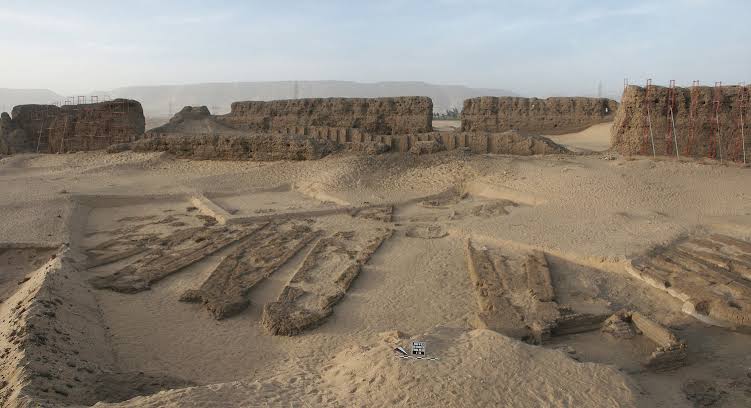
The boat burials were identified near the great mudbrick enclosure called Shunet El Zebib, a structure attributed to the 2nd Dynasty Pharaoh Khasekhemwy. The site lies nearly a mile from the royal cemetery of Umm El Qa'ab, where early pharaohs were buried.
The first clues appeared when lines of mudbrick were noticed after sand had blown away from the area. At first, these remains looked like ordinary walls. Later, it became clear that they marked out more than a dozen ship burials from an early dynasty. In total, fourteen boats were identified.
Each boat grave had its own brick boundary wall. The outline of each grave was shaped like a boat, and the surface was covered with mud plaster and whitewash. Small boulders placed at the prow or stern represented anchors. The prow is the front of a boat, while the stern is the rear. Even the graves themselves were designed to echo the form and symbolism of the vessels inside.
Because the remains were extremely fragile, archaeologists moved carefully. Much of the wood had deteriorated so badly that excavation had to wait until conservation could be properly planned.

The Boat That Changed What We Know
Of all the Abydos boats, one known as boat no. 10 became especially important. It was the first to be examined because soil erosion had slowly exposed part of it.
Over five days, archaeologists studied the boat’s midsection. They found wooden planks, disintegrated rope, and reed bundles. Much of the hull had been damaged by wood-eating ants, which reduced large parts of it to frass, meaning ant excrement. Strangely, even though the original wood had been destroyed, the frass preserved the shape of the hull. That allowed researchers to understand how the boat had originally been built.
What they found confirmed that this was the oldest known example of a planked boat.
Built From the Outside In
One of the most striking features of the Abydos boats is how they were assembled. The evidence showed that the boat was built from the outside in.
In simpler terms, the outer shell of the vessel was formed first. There was no internal frame, no rib-like skeleton of wood holding the shape together from within. Instead, the planks created the hull itself, and the seams between those planks were filled with reed bundles.
Reeds are tall grass-like plants that grow in wet areas, and in this case they served as packing material. Filling seams with reeds would have helped close gaps between planks. Reeds also covered the floor of each Abydos boat.
This outside-first method is very different from the way many later boats were built. It shows that early Egyptian shipwrights already had a standardized way of constructing plank-built vessels. In fact, this construction technology continued in Egypt for more than a thousand years.
That long survival suggests the design worked well enough to remain useful across many generations.
Long, Narrow, and Made for Water
The Abydos boats were large but shallow. On average, they measured about 75 feet long and 7 to 10 feet wide at their broadest point. Yet they were only about two feet deep.
They also had narrow prows and sterns, giving them a sleek, elongated shape. This tells us they were designed for movement through water rather than for stability on dry land.
That became especially obvious because boats without internal framing could twist once they were no longer supported by water. Some of the Abydos boats did exactly that. Without an internal skeleton, distortion was almost unavoidable after burial and long exposure out of the river.
In other words, these were vessels whose form depended on being afloat. Their shape made sense in the water, even if it looked awkward once they were resting on land.
Materials and Color in Early Egyptian Shipbuilding
The wood used for the Abydos boats was local Tamarix, also called tamarisk or salt cedar. This is notable because later Egyptian shipbuilding often favored cedar from Lebanon, including the famous Khufu ship.
The Abydos boats show that early builders were working primarily with local material for the hulls. At the same time, Lebanon cedar was already being imported for poles and beams used in the tombs at Umm el-Qa'ab. That means long-distance timber use was already known, even if these boats themselves were not built from that imported wood.
The vessels were not plain, unfinished structures either. Several were covered in white plaster, matching the treatment seen on Abydos tombs. Boat no. 10 was painted yellow, and pigment traces suggest bright colors were used. Traces of white pigment were also found.
There is even evidence from part of the mudbrick casing that supports may have existed for poles or pennants above the boats. A pennant is a narrow flag or banner, often used as a visible marker or symbol. If so, these boats may have been visually striking as well as technically sophisticated.
More Than Boats: Royal Meaning and the Afterlife
The Abydos boats were not ordinary working craft left behind by chance. They were found in formal boat graves, with their prows pointed toward the Nile. Experts interpret them as royal boats meant for the pharaoh in the afterlife.
This ritual significance helps explain why they were buried so carefully and placed near major royal funerary structures. They seem to have been linked to beliefs about the king’s journey after death.
These vessels are considered predecessors of the great solar boats of later dynasties. In later Egyptian belief, the pharaoh joined the sun god Ra and journeyed along the sacred Nile during the day. The Abydos boats appear to belong to an earlier version of that tradition, carrying many of the same symbolic meanings that would later be associated with solar barques.
A solar barque is a ritual boat tied to the sun and divine travel. The much later Khufu ship is usually identified as the earliest solar barque, but the Abydos boats show that the idea of royal funerary boats was already well established much earlier.
A Glimpse of Early Egyptian Engineering
The Abydos boats reveal a world in which early Egyptian builders had already mastered large-scale wooden construction, developed a repeatable building system, and created vessels with both practical and ritual importance.
They were long, narrow, shell-built boats made from joined planks, sealed with reeds, and shaped for river travel. They could be painted, plastered, and perhaps even adorned with poles or pennants. Most importantly, their design was not an experiment that vanished. It endured for more than a millennium.
That is what makes the Abydos boats so fascinating. They are not just ancient objects buried beside royal monuments. They are proof that sophisticated shipbuilding in Egypt began astonishingly early, with techniques advanced enough to influence construction for centuries to come.