Abydos Boats: Egypt’s Buried Fleet for the Afterlife

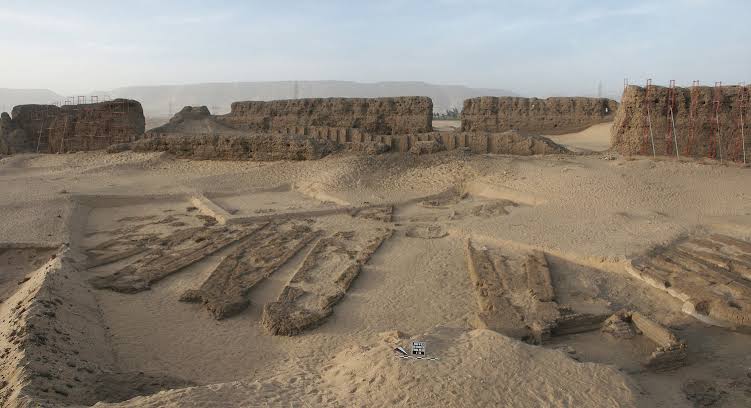
At Abydos in Egypt, what first looked like simple lines of mudbrick turned out to be something far more dramatic: the outlines of ancient ship graves. More than a dozen ceremonial boats were buried there, forming a royal fleet hidden beneath the desert surface for thousands of years.

These finds are known as the Abydos boats, and they open a striking window into how early Egyptian rulers imagined death, royalty, and the journey beyond the grave. Long before the most famous royal boats of ancient Egypt, kings were already being linked with vessels meant for eternity.

The boat burials were discovered at an archaeological site in Abydos, near the huge mudbrick structure called Shunet El Zebib, which is attributed to the 2nd Dynasty pharaoh Khasekhemwy. This enclosure is one of several major wall constructions from the Early Dynastic Period, and it stands nearly one mile from Umm el-Qa'ab, the royal cemetery where early pharaohs were buried.

In 1988, blowing sand revealed lines of mudbrick at a site about a mile from the royal tombs. At first, these remains were thought to be ordinary walls. Later, archaeologists realized the brick features were actually the boundary walls of ship burials from an early dynasty. Excavation work by the University of Pennsylvania Museum and Yale University Expedition eventually identified fourteen boats.

Each grave had its own mudbrick boundary. Even more intriguing, each grave was shaped like a boat. The surface was finished with mud plaster and whitewash, turning the burials into carefully designed monuments rather than rough pits in the ground.

DeepSwipe app banner

Boat Graves Designed Like Real Vessels

The details of the graves make the ritual purpose hard to miss. Small boulders placed at either the prow or stern represented anchors. The prow is the front of a boat, while the stern is the rear. These touches gave each burial the appearance of a vessel ready for use, even though it lay sealed in the desert.

The boats were positioned with their prows pointed toward the Nile. Experts interpret this as a sign that they were royal boats intended for the pharaoh in the afterlife. In ancient Egyptian belief, the afterlife journey was not imagined as stillness. It was movement, passage, and continuation. A boat was not just transport. It was a symbol of power, sacred travel, and the king’s ability to continue beyond death.

Because these graves stood beside an important funerary enclosure and not far from a royal necropolis, the setting strongly reinforced their ceremonial role. A necropolis is a large burial area, essentially a city of the dead. Umm el-Qa'ab served as such a royal necropolis for Egypt’s earliest rulers.

The “Ghost Ship” Clue

When the Abydos boats were first studied, their fragility created a major challenge. Archaeologists avoided immediate large-scale excavation because the remains had to be carefully assessed for conservation. Ancient wood does not survive easily, especially after thousands of years underground.

One boat, known as boat no. 10, had begun to appear because of soil erosion and was the first to be investigated closely. For five days, archaeologists examined its midsection and uncovered wooden planks, disintegrated rope, and reed bundles.

Much of the hull had been eaten by wood-eating ants and reduced to frass, which is the powdery material left behind by insects after chewing wood. Yet this destruction produced an astonishing benefit: the frass still preserved the shape of the original hull. Even where the wood itself had largely vanished, the boat’s form survived like a ghostly imprint.

That preserved outline helped researchers understand the vessel’s size and construction. These boats averaged about 75 feet long and 7 to 10 feet wide at their widest point, though they were only about two feet deep. They had narrow prows and sterns, giving them a long, slim profile.

How the Abydos Boats Were Built

The Abydos boats are especially important because they revealed very early plank-built boat construction. Boat no. 10 confirmed the oldest planked constructed boat yet discovered. In simple terms, a planked boat is built from fitted wooden boards rather than being a simple raft or a hollowed log.

The construction method was unusual and revealing. The boats were built from the outside in, with no internal frame. An internal frame is the skeleton-like structure inside many boats that helps support the hull. Without that support, some of the Abydos boats twisted after burial, which was apparently unavoidable once they were out of the water.

The seams between the planks were filled with reed bundles, and reeds also covered the floor of each boat. This detail shows how plant materials worked together with wood in early Egyptian boatbuilding.

The main wood used for the hulls was local Tamarix, also called tamarisk or salt cedar. This is different from the cedar from Lebanon that later became favored for Egyptian shipbuilding and was used for Khufu’s Solar Barque. Lebanon cedar had already been imported earlier for poles and beams in the tombs at Umm el-Qa'ab, showing that different woods were selected for different purposes.

Painted Boats and Possible Pennants

These were not plain utility craft. Several of the Abydos boats were white-plastered, matching the treatment seen on Abydos tombs. Boat no. 10 was painted yellow, and pigment traces suggest the wooden planks had bright colors on their outer surfaces. Traces of white pigment were also found.

There is also evidence that some sort of support may have stood above the boats, perhaps for poles or pennants. A pennant is a narrow flag or banner. This possibility links the boats to imagery seen elsewhere in early Egyptian art, where boats could appear as important ceremonial symbols rather than just practical machines.

The level of standardization in these early boats is striking. Their building technology continued in Egypt for more than a thousand years, showing that this was not an isolated experiment but part of a lasting tradition.

Older Than the Famous Solar Boats

The Abydos boats are often discussed as predecessors to the great solar boats of later dynasties. In later Egyptian royal ideology, the pharaoh joined the sun god Ra and journeyed in a sacred boat. A solar barque, or solar boat, is a ceremonial vessel associated with the sun’s divine passage.

That means the Abydos fleet may represent an earlier version of the same core idea: the ruler traveling after death in a sacred craft. In that sense, these vessels may already have carried the metaphors later attached to the better-known solar boats.

Khufu’s famous ship at Giza, built around 2500 BC and buried beside the Great Pyramid, is usually identified as the earliest solar barque. But the Abydos boats are older, suggesting that the connection between kingship, boats, and the afterlife had deep roots well before the pyramid age.

Which Kings Were They For?

Although the boat graves lie next to the funerary enclosure of Khasekhemwy, they appear to have been established earlier than his reign late in Dynasty II. Some scholars think they may have been intended for the afterlife journeys of Hor-Aha, the first king of Egypt’s First Dynasty, or of Pharaoh Djer, another ruler of Dynasty I.

Two later mortuary discoveries have been identified as those of King Aha, who may have been the son of King Narmer, the ruler often associated with the first unification of Upper and Lower Egypt. These connections place the Abydos boats near the very beginning of Egyptian kingship.

Part of a Wider First Dynasty Tradition

Abydos was not the only place where First Dynasty boat burials have been found. Nineteen boat burials were discovered at Helwan, though only four were published. Six boat graves were found at Saqqara, with four of those published. Two full-sized model boats made of clay are also known from Abu Roash Hill.

Even so, the Abydos fleet remains one of the most vivid examples of these early royal boat burials. Its combination of preserved layout, construction evidence, and ceremonial context makes it one of the clearest glimpses into how early Egyptian rulers prepared for eternity.

The image is unforgettable: a fleet of long, narrow boats buried in the desert, still pointing toward the Nile, waiting for a king’s final voyage.

Stories About Abydos boats

Abydos Boats: How Egypt Built Ships 5,000 Years Ago

Abydos Boats: How Egypt Built Ships 5,000 Years Ago

Otehr Stories like this

Human History: Polynesians—Masters of the Open Ocean

Human History: Polynesians—Masters of the Open Ocean

Apotropaic Magic: Why Scary Faces Protected People

Apotropaic Magic: Why Scary Faces Protected People

Mount Vesuvius 79 AD: Pliny’s Day Under Ash

Mount Vesuvius 79 AD: Pliny’s Day Under Ash

Black Ships and the Opening of Japan

Black Ships and the Opening of Japan

Persian Destruction of Athens

Persian Destruction of Athens

Mount St. Helens: The Eruption That Blew Sideways

Mount St. Helens: The Eruption That Blew Sideways

Set sail into history’s strangest mysteries — download DeepSwipe and take your own afterlife journey through knowledge.