World War II ended in 1945. Hiroo Onoda surrendered on March 10, 1974.
For nearly 29 years after Japan’s surrender, the Japanese army officer continued his mission on Lubang Island in the Philippines. He rejected surrender announcements, distrusted letters from his family, and ultimately insisted that a former commanding officer personally relieve him of duty.
It is an extraordinary survival story—but not a harmless adventure. For people on Lubang, Onoda’s long holdout involved stolen food, destroyed harvests, armed encounters, and allegations of civilian killings. Understanding his story means looking beyond the soldier who refused to surrender to the communities that lived with the consequences.
Watch the story on DeepSwipe
The Orders That Sent Onoda Into the Mountains
Hiroo Onoda was born in Japan in 1922 and was conscripted into the Imperial Japanese Army in 1942. He trained as an intelligence officer at the Futamata branch of the army’s Nakano School, where he learned guerrilla warfare: fighting through small-scale raids and other operations rather than conventional battles between large armies.
On December 26, 1944, he was sent to Lubang in the Japanese-occupied Philippines. His mission included destroying the island’s airstrip and harbor pier before an Allied invasion, along with enemy aircraft or boats attempting to land.
His orders explicitly forbade surrender or suicide.
However, higher-ranking officers on Lubang prevented him from carrying out his planned destruction. American and Philippine resistance forces landed on February 28, 1945, and captured the island. Eventually, Onoda withdrew into the mountains with three other soldiers: Yuichi Akatsu, Shōichi Shimada, and Kinshichi Kozuka.

Why Didn’t He Believe the War Was Over?
Onoda’s group encountered a surrender announcement in October 1945. A note left by islanders declared: “The war ended on 15 August. Come down from the mountains!”
The men dismissed it as Allied propaganda—information they believed was intended to deceive them. They reasoned that they would not still have been fired upon if the conflict had really ended.
Later that year, aircraft dropped leaflets carrying a surrender order from General Tomoyuki Yamashita. The group examined them and again decided they were not genuine.
The attempts continued. Japanese authorities used search missions, leaflets, and radio broadcasts to persuade Onoda to stop fighting. In February 1952, family letters and photographs were dropped onto the island. Even these were rejected as a trick.
Yet the familiar explanation that Onoda simply never knew the war had ended is disputed. Japan scholar Beatrice Trefalt has questioned that claim, pointing out that he had access to newspapers and carried a transistor radio. His circumstances were not those of someone entirely cut off from outside information.
Survival Came at a Cost to Lubang
Onoda and his companions survived on foods including bananas, coconuts, stolen rice, and cattle. They also exchanged gunfire with local residents and police.
The group gradually dwindled. Akatsu left in September 1949 and surrendered to Philippine forces in March 1950. The remaining men regarded his departure as betrayal and became more cautious.
Shimada was wounded during a shootout with local fishers in 1953. Onoda cared for him, but in May 1954 Shimada was killed after a Philippine Army mountain unit encountered the soldiers while training.
Kozuka remained with Onoda until October 19, 1972, when police killed him during a raid. The two men had been burning piles of villagers’ harvested rice—something they intended as a signal to Japanese forces that they were still carrying out their duties. After Kozuka’s death, Onoda was alone.
Villagers later alleged that Onoda and his men had killed up to 30 civilians. Those allegations are essential to understanding why his story could inspire celebration in Japan while leaving painful memories on Lubang.
The Adventurer Who Found Him
On February 20, 1974, Japanese adventurer Norio Suzuki met Onoda after four days of searching on Lubang.
Suzuki had told friends he was looking for “Lieutenant Onoda, a panda, and the abominable snowman, in that order.” His encounter with the soldier produced a friendship, but not an immediate surrender.
Onoda insisted that he needed orders from Major Yoshimi Taniguchi, the officer who had given him his final instructions.
Suzuki returned to Japan with photographs proving the meeting. The government located Taniguchi, who had become a bookseller after the war. He then traveled to Lubang with Suzuki and met Onoda in the jungle on March 9, 1974, formally relieving him of duty.
The Surrender That Finally Ended His Mission
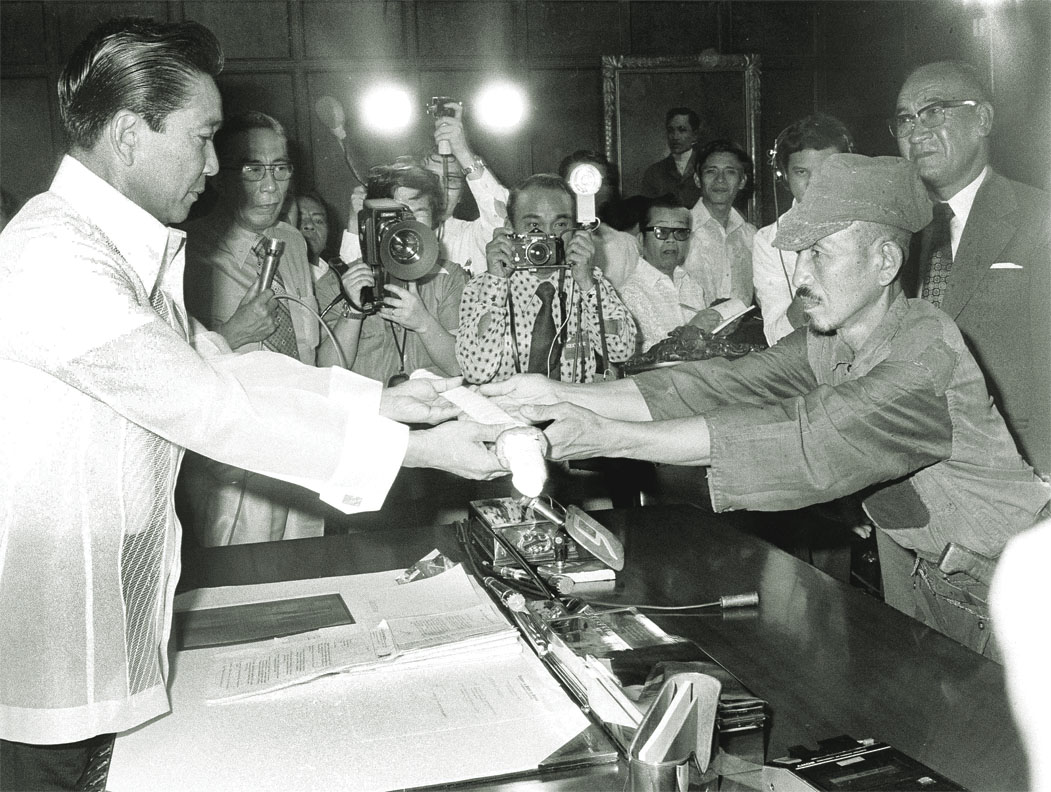
Onoda surrendered to Philippine forces on March 10, 1974. A formal ceremony followed the next day at Malacañang Palace in Manila, where Philippine President Ferdinand Marcos granted him a full pardon for crimes committed while in hiding.
Onoda handed over a sword, a functioning Type 99 rifle, 500 rounds of ammunition, and several hand grenades.
His holdout had lasted 28 years, six months, and eight days after Japan’s surrender: 10,416 days. He was one of the last Japanese holdouts, but not the last. Teruo Nakamura remained at large in Indonesia until December 1974.
A Hero’s Welcome—and an Unresolved Legacy
Onoda returned to a hero’s welcome in Japan and published his autobiography, No Surrender: My Thirty-Year War, in 1974. He later became a cattle farmer in Brazil and established an educational camp in Japan after returning in 1984.
But his account did not go unchallenged. In 1976, the autobiography’s ghostwriter, Tsuda Shin, described it as a carefully constructed narrative rather than a purely personal account. He also alleged that Onoda had known the war was over.
When Onoda visited Lubang in 1996, his wife had arranged a $10,000 scholarship donation on his behalf. The visit nevertheless drew protests from about fifty relatives of alleged victims. The town council asked him to compensate the families of seven people he had allegedly killed.
Onoda died in 2014 at age 91. His story remains striking not simply because he fought until 1974, but because the same decades could be remembered so differently: as remarkable endurance by some, and as a prolonged history of violence and loss by others.