Full article · 8 min read
Dutch East India Company: The Dark Side of the Spice Empire

The Dutch East India Company, usually known as the VOC, is often remembered as a giant of global trade. It was one of the first joint-stock companies, its shares were traded openly, and it became enormously rich from Asian commerce. But behind that image of innovation stood a much darker reality. In the spice trade, especially in places like the Banda Islands, the VOC did not simply compete in the marketplace. It used war, coercion, monopoly, and terror to control who could grow, sell, and transport valuable goods such as nutmeg, mace, and cloves.
To understand the VOC’s darker side, it helps to begin with the basic attraction: spices were extraordinarily profitable. The company was able, for a time, to monopolise the trade in nutmeg, mace, and cloves and sell them across Europe and into the Mughal Empire at 14 to 17 times the price it paid in Indonesia. That difference created immense profits. But those profits were not just the result of efficient business. They were also built on forcing down the prices paid to local producers and using armed power to eliminate rivals.
Why spices mattered so much
In the late 16th and early 17th centuries, demand for spices was strong, especially for pepper and the prized spices of the Maluku region and nearby islands. When supply lagged, prices could rise sharply. Dutch merchants saw an opportunity, especially after they were increasingly cut out of Portuguese trade networks. Early Dutch expeditions reached the Indonesian archipelago and quickly discovered that direct access to spice-producing regions could be wildly profitable.
That promise of profit was one of the main reasons the VOC was established in 1602. The Dutch government granted it a 21-year monopoly over Asian trade. A monopoly means exclusive control over a market: one company gets to dominate trade and block competitors. In practice, this meant the VOC did not merely aim to buy spices. It aimed to become the only buyer and the only effective seller in key areas.
A company with the powers of a state
One reason the VOC became so dangerous was that it was not an ordinary merchant business. It had quasi-governmental powers. It could wage war, negotiate treaties, build forts, maintain armies, imprison and execute convicts, strike coins, and establish colonies. Those powers made it something more than a corporation and less than a state, but often just as forceful as either.
This structure gave the company the tools to turn trade into conquest. Its leaders did not need to rely only on bargaining or shipping contracts. They could send fleets, storm ports, seize ships, and punish communities that resisted their commercial demands. The logic was brutal but simple: if military force increased control over spices, force would be used.
A revealing summary of this mindset came from within the company itself: trade in Asia was to be driven and maintained under the protection of weapons, and those weapons were to be paid for by the profits of trade. In other words, war and commerce were tightly linked.
The Banda Islands and the nutmeg monopoly
No place shows the dark side of the VOC more clearly than the Banda Islands. These islands were central to the nutmeg trade, and the company became determined to control them completely. Nutmeg and mace were not just luxury goods; they were the foundation of a monopoly system the VOC believed had to be defended at any cost.
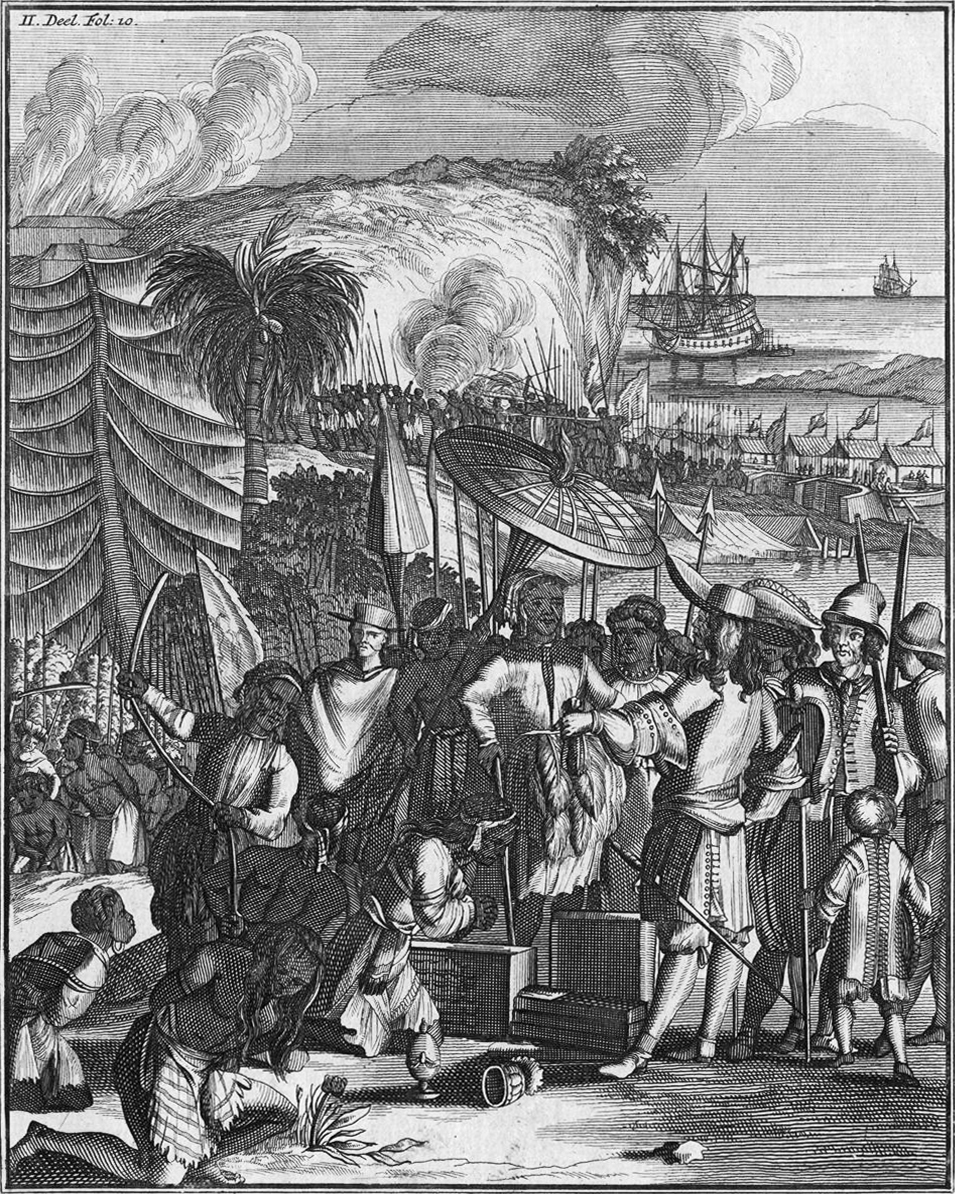
Between 1609 and 1621, after the islands resisted Dutch control, the VOC carried out punitive expeditions. A punitive expedition is a military attack meant not just to defeat an enemy, but to punish and intimidate a population. In the Banda case, the results were catastrophic.
The Dutch conquest of the Banda Islands led to the near-destruction of Bandanese society. In 1621, the VOC invaded Lontor, the main Bandanese island. During the attack, 2,800 Bandanese were killed, mostly from famine, and 1,700 were enslaved. Before the conquest, the islands’ total population was estimated at 15,000. Although the exact numbers remain uncertain, it is estimated that around 14,000 people were killed, enslaved, or fled elsewhere. Only about 1,000 Bandanese survived on the islands, and they were spread through the nutmeg groves as forced labourers.
That is what the spice monopoly looked like on the ground. It was not an abstract business policy. It was the destruction of a society in order to secure control over a high-value export.
Violence, extortion, and forced scarcity
The VOC maintained its control through a range of coercive methods. It used extortion, violent suppression, and direct military force. It also used a particularly striking tactic: burning spice trees. This was done to force indigenous populations to grow other crops and to cut the supply of spices such as nutmeg and cloves. Reducing supply helped the company preserve high prices.
This strategy reveals the logic of monopoly in its harshest form. Rather than allowing production to expand naturally, the company deliberately restricted output. In modern terms, it was manipulating supply to protect margins. But in human terms, that meant imposing hardship on local communities, controlling land use, and punishing people whose livelihoods depended on those crops.
The treatment of enslaved people in the Banda system was harsh. The native Bandanese population fell to 1,000 by 1681. To sustain the labour force, about 200 slaves were imported annually, helping maintain a slave population of 4,000. The spice empire was therefore not just commercial and military. It was also tied directly to slavery and forced labour.
Batavia and the machinery of control
The VOC’s headquarters eventually moved to Batavia, now Jakarta, after Jan Pieterszoon Coen stormed Jayakarta in 1619 with nineteen ships and established the city from its ruins. Batavia became the administrative centre of the company’s Asian operations.
From there, the VOC coordinated a vast network of trade, forts, treaties, and military operations. It was a hub where goods, information, and commands flowed across the Indian Ocean and Southeast Asia. But it was also a colonial capital marked by hierarchy and segregation. The company’s rule was not egalitarian. Its commercial empire depended on rigid social ordering and the ability to command labor and territory.
The violence associated with VOC rule was not limited to Banda. In 1623 on Ambon, VOC officials arrested, tortured, and executed ten English East India Company employees, along with Japanese and Portuguese auxiliaries, in what became known as the Amboyna massacre. In 1636, VOC forces mounted a punitive expedition on Lamey Island off Taiwan after shipwreck incidents; most inhabitants were killed or deported and the island was effectively depopulated. In 1740, during a severe downturn in Batavia’s sugar economy, VOC troops and allied militias killed thousands of ethnic Chinese residents in the Batavia massacre, with estimates ranging from about 5,000 to over 10,000 deaths.
These events were not side notes. They show a consistent pattern: commercial power backed by organized violence.
Profit for investors, pressure for producers
From the perspective of shareholders, the VOC could appear dazzlingly successful. It paid annual dividends that averaged about 18% of capital for almost 200 years. By 1669 it was described as the richest private company the world had ever seen, with more than 150 merchant ships, 40 warships, 50,000 employees, and a private army of 10,000 soldiers.
But that success came with a hidden cost carried by others. In the Spice Islands, the local economy was damaged because the VOC, as a monopoly buyer, forced prices paid to local producers down to low levels. This is one of the clearest examples of how colonial monopoly worked: wealth flowed to investors and European markets, while producers at the source were squeezed, displaced, or destroyed.
The company’s ability to buy low and sell high was not simply clever market timing. It depended on controlling ports, defeating rivals, dictating terms to local rulers, and suppressing anyone who threatened its grip on trade.
Why the VOC still matters
The VOC is sometimes admired for corporate innovation, global scale, and business sophistication. It had one of the earliest widely recognised corporate logos, sold shares on open markets, and built an international trading network of enormous reach. Yet the spice empire that made it famous was inseparable from colonialism, exploitation, slave labour, violence, and monopoly.
Its history is a reminder that economic innovation and brutality can exist side by side. The same company that helped shape modern finance also destroyed communities in pursuit of nutmeg profits. The same enterprise that became a model of global commerce also showed how trade can be militarised when profit is treated as the only goal.
That is why the VOC remains such a powerful historical example. Its spice empire was not merely about exotic goods moving across oceans. It was about what happened when a corporation gained the power to wage war, control supply, and treat entire populations as obstacles to profit.
The legacy of a spice empire built on force
What people remember about the VOC depends on what they choose to look at. One version highlights entrepreneurship, shipping, and commercial success. The fuller picture includes famine, enslavement, massacres, forced labour, and deliberate destruction used to uphold monopoly.
In the Banda Islands especially, the truth is stark: the spice trade turned deadly because the VOC was willing to destroy local society to dominate nutmeg. That is the dark side of the Dutch East India Company’s empire, and it is central, not incidental, to its story.
Sources
Based on information from Dutch East India Company.
More like this
More about culture
More about history
More about war
Spice up your brain without the colonial monopoly — download DeepSwipe and explore history one powerful swipe at a time.


