Before World War II erupted across Europe and the Pacific, Spain became a brutal preview of what was coming. The Spanish Civil War, fought from 1936 to 1939, drew in foreign powers, showcased ideological rivalries, and gave major states a chance to test weapons and tactics in real combat. That is why it is so often remembered as a kind of rehearsal for the far larger war that followed.
The conflict inside Spain did not stay purely Spanish for long. It became a proxy war, meaning a conflict in which outside powers support local sides instead of immediately fighting each other directly. In Spain, Adolf Hitler's Germany and Benito Mussolini's Italy backed the Nationalist rebels led by General Francisco Franco. The Soviet Union supported the government of the Spanish Republic. More than 30,000 foreign volunteers, known as the International Brigades, also joined the fight against the Nationalists.
Watch the story on DeepSwipe
A civil war with global meaning
The Spanish Civil War broke out in 1936, just as Europe was sliding into deeper instability. Germany had already remilitarised the Rhineland that same year, while Germany and Italy were becoming more aggressive abroad. In this tense atmosphere, Spain became more than a domestic struggle. It turned into a stage where competing political systems and military ambitions could collide.
For Hitler and Mussolini, backing Franco was a chance to support a friendly force and expand their influence. For the Soviet Union, helping the Republic was a way to support the existing Spanish government. For volunteers arriving from abroad, Spain looked like the frontline in a larger fight over Europe's future.
That wider significance helps explain why the war drew so much outside attention. It was not yet World War II, but it foreshadowed many of its patterns: foreign intervention, ideological polarization, air power, mechanised warfare, and the use of local battlefields to settle international rivalries.

Germany, Italy, and the Soviet Union all got involved
One of the clearest reasons the Spanish Civil War is seen as a rehearsal is the direct involvement of future World War II powers.
Hitler and Mussolini lent military support to Franco's Nationalists. Italy supported the Nationalists even more extensively than Germany did. Mussolini sent more than 70,000 ground troops, 6,000 aviation personnel, and 720 aircraft to Spain. That is an enormous foreign commitment for a war that was, on paper, an internal Spanish conflict.
The Soviet Union backed the Spanish Republic, the existing government that was fighting to survive. This meant that three major powers who would play central roles in the coming world war were already shaping events on the battlefield in Spain.
The result was a conflict that doubled as an international proving ground. Spain became a place where foreign governments could measure not just their allies, but also their own military readiness.
Spain as a laboratory for weapons and tactics
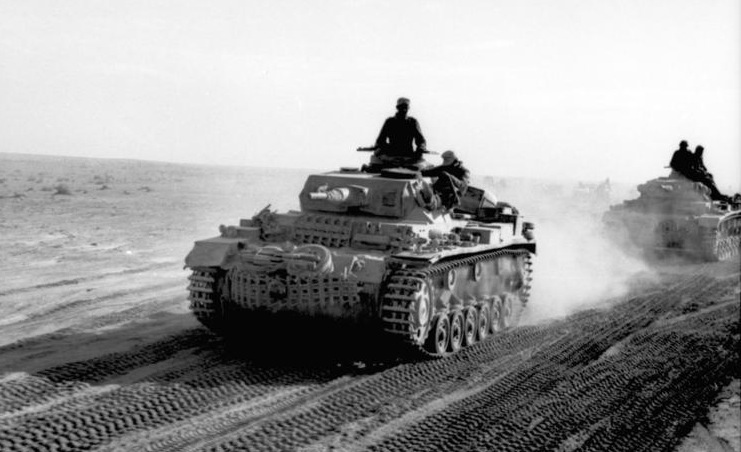
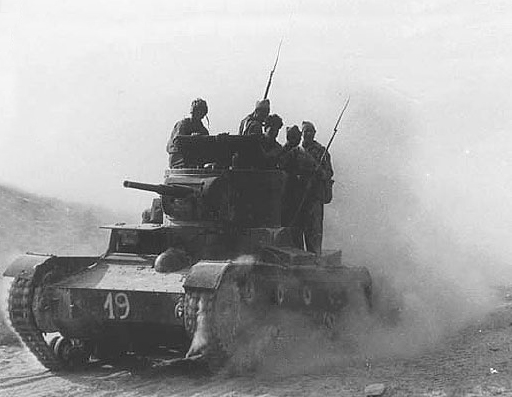
The war in Spain offered something military planners rarely admit wanting but often seek: real combat conditions. Germany and the Soviet Union used the conflict as an opportunity to test their most advanced weapons and tactics in battle.
That phrase matters. A tactic is a method used to fight and win engagements on the battlefield. In peacetime, armies can train and run exercises, but exercises cannot fully reproduce the confusion, fear, and unpredictability of war. Spain provided exactly that harsh environment.
This is what makes the "rehearsal" label so powerful. The war was not only political. It was practical. It allowed foreign powers to see how men, machines, and methods performed under fire.
Italy's intervention also showed how heavily an outside state could commit air and ground forces to influence another country's war. Sending tens of thousands of troops and hundreds of aircraft was not symbolic support. It was a major military operation.
The International Brigades and the internationalisation of the war
Spain also previewed World War II in another sense: people from many countries believed the fighting there mattered far beyond Spain's borders.
More than 30,000 foreign volunteers joined the International Brigades to fight against the Nationalists. Their presence showed how the conflict was already being understood as part of a larger ideological struggle. Spain was becoming a magnet for those who believed Europe's future was being contested there.
This kind of internationalisation would become a defining feature of World War II itself, which involved nearly all of the world's countries. In Spain, that process appeared in concentrated form: foreign troops, foreign aircraft, foreign political causes, and foreign volunteers all converged before the wider war officially began.
Franco's victory and what came next
The Nationalists won the Spanish Civil War in April 1939. Franco emerged as dictator of Spain.
When World War II began later that year with Germany's invasion of Poland on 1 September 1939, Spain did not formally enter the conflict. Franco remained officially neutral during World War II. That neutrality, however, did not mean total distance from the Axis powers.
Franco generally favoured the Axis, and his greatest collaboration with Germany was the sending of volunteers to fight on the Eastern Front. The Eastern Front was the vast battlefield opened in June 1941 when Germany invaded the Soviet Union. It became the biggest and deadliest land theatre of the war, stretching across enormous areas of Eastern Europe and the western Soviet Union.
So even after staying officially out of the war, Franco's regime remained connected to the wider struggle that Spain had helped foreshadow.
Why historians see a preview of World War II
Calling the Spanish Civil War a rehearsal does not mean it was minor. It was devastating in its own right. But the phrase captures how clearly the conflict anticipated the next catastrophe.
Several themes stand out:
Foreign powers intervened before openly fighting each other
Germany and Italy backed Franco. The Soviet Union backed the Republic. Rather than clashing first in a declared world war, these states were already confronting each other indirectly on Spanish soil.
Military innovation was tested in combat
Germany and the Soviet Union used the war to test advanced weapons and tactics. Italy committed large numbers of troops and aircraft. Spain became a trial by fire rather than a mere diplomatic crisis.
Ideology shaped the battlefield
The war drew support not just from governments but from volunteers motivated by political conviction. That ideological intensity would define much of the violence of the 1930s and 1940s.
The outcome connected directly to World War II
Franco stayed officially neutral, but still leaned toward the Axis and sent volunteers to the Eastern Front. Spain's civil war therefore cast a shadow well into the global conflict that followed.
A warning before the storm
Seen in hindsight, the Spanish Civil War was a warning Europe did not fully stop. While major powers still maneuvered diplomatically, armies and air forces were already gaining deadly experience. Spain showed that the age of limited crises was ending. External intervention, ideological warfare, and battlefield experimentation were already here.
By the time World War II officially began in September 1939, some of its future participants had already learned hard lessons in Spain. That is why the Spanish Civil War remains one of the clearest previews of the wider disaster to come: a smaller war that revealed the shape of a much larger one.