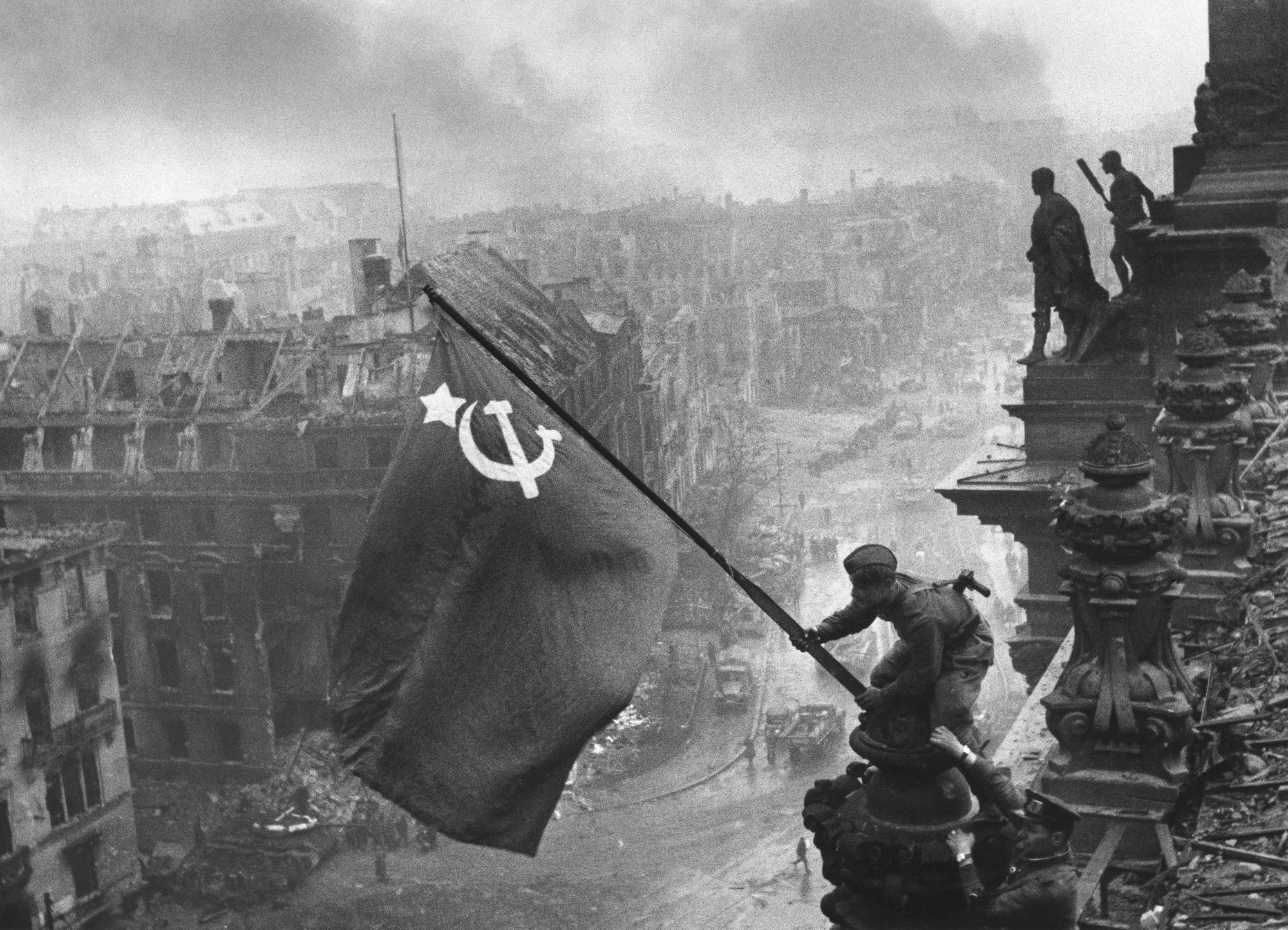
Few images from World War II are as instantly recognizable as the photograph of Soviet soldiers raising a flag over Berlin’s Reichstag. It looks like the perfect final scene: the enemy capital fallen, the victorious troops on the roof, and the banner of triumph flying above the city.
But the famous image has an important twist. The well-known rooftop photograph was not taken at the exact moment the building was first captured. It was a re-enactment made the day after the Reichstag had already been taken. That detail does not make the event less important. If anything, it reveals something even more interesting about the final battle for Berlin: the photo became powerful not because it was spontaneous, but because it captured what the battle meant.
Watch the story on DeepSwipe
Why the Reichstag was such a potent symbol
By the time Soviet troops fought their way to the Reichstag in late April 1945, the building was not functioning as Germany’s parliament. It had burned in February 1933 and had been left in ruins ever since. In a purely practical military sense, it was not the most essential building in Berlin.
Yet symbols matter in war, and the Reichstag was one of the biggest symbols available. To the Soviets, its capture represented the defeat of Nazi Germany in the heart of Berlin. The building stood for German state power in a broad, historical sense, even if it was no longer being used as the center of government. Raising a victory banner above it sent a message far beyond the battlefield.
That is why Soviet forces placed such importance on taking it. The image of a flag over the Reichstag turned the fall of Berlin into a visual story of final victory.

Berlin was already collapsing when the assault began
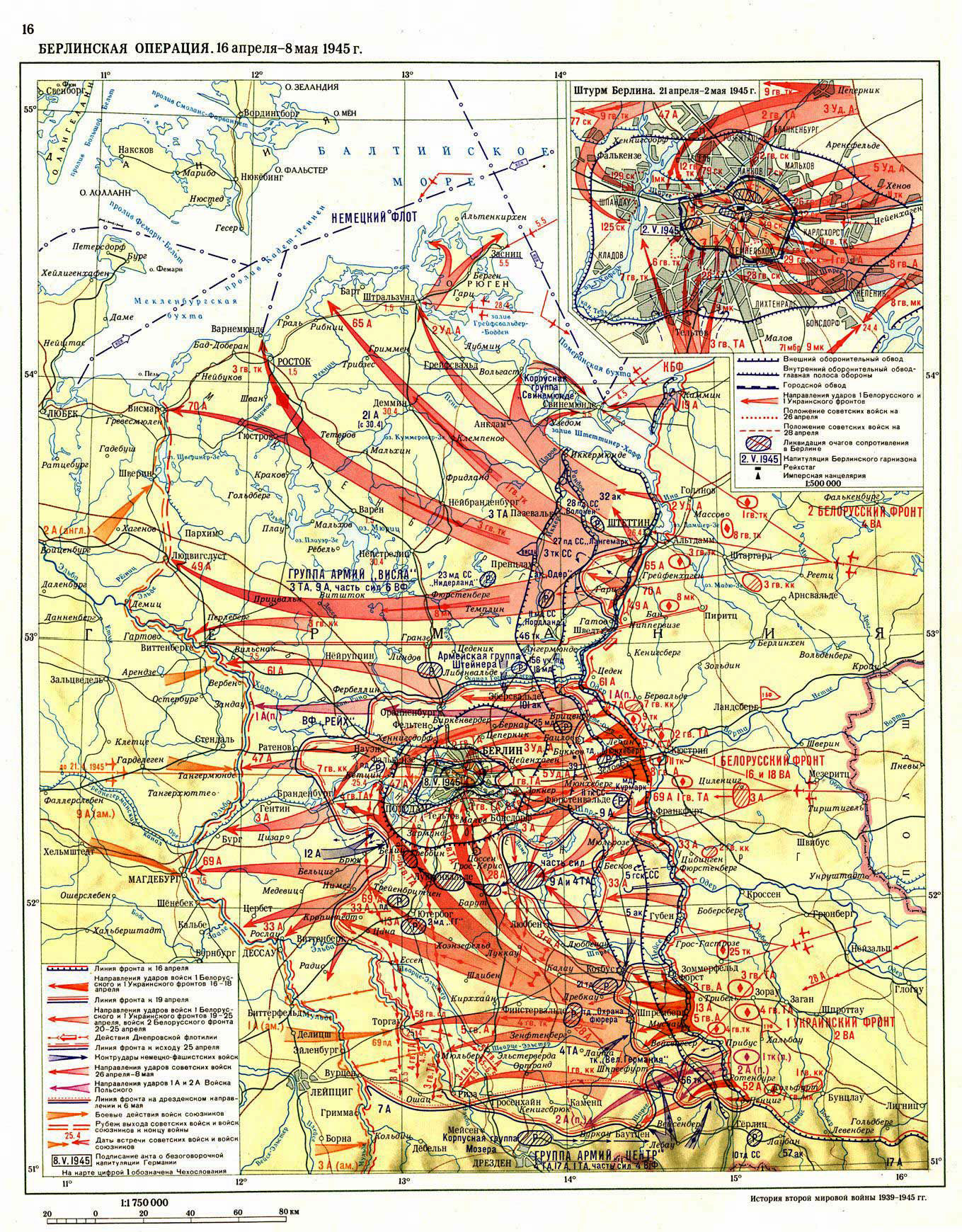
The attack on the Reichstag happened during the closing days of the Battle of Berlin, one of the last major offensives in the European theatre of World War II. After earlier Soviet advances had pushed deep into Germany, Berlin was eventually encircled by Soviet forces. On 20 April 1945, Soviet artillery from Marshal Georgy Zhukov’s 1st Belorussian Front began shelling the city and continued until Berlin surrendered.
The German defenders inside Berlin were in terrible shape. The city’s garrison included depleted Army and Waffen-SS divisions, the Volkssturm, and members of the Hitler Youth. The Volkssturm was a militia made up largely of men who were too old or otherwise outside normal military service, and many had little effective training for the kind of brutal urban combat now unfolding. The Hitler Youth members were boys pressed into the defense as the regime tried to fight on despite the hopeless situation.
General Helmuth Weidling took command of the city’s defense on 23 April. He organized Berlin into defensive sectors, but the larger picture was grim. Soviet forces had already broken through key German defenses outside the capital, and by the time the inner fight began, Germany had largely lost the decisive stages of the battle.
The road to the Reichstag was savage
Urban warfare is among the most destructive forms of combat, and the fighting around central Berlin was no exception. The Soviet advance toward the city center came along several major routes, and the heaviest fighting centered on places such as the Reichstag, the Moltke Bridge, Alexanderplatz, and the Havel bridges at Spandau.
Accounts describe house-to-house and hand-to-hand combat. Those phrases are not just dramatic language. House-to-house combat means soldiers had to clear one building after another, often with defenders waiting behind walls, stairwells, and barricades. Hand-to-hand combat means the fighting became so close that firearms alone were not the whole story. In such conditions, every room, hallway, and doorway could become a battlefield.
The defenders around the Reichstag were deeply entrenched. To be entrenched means being dug in or heavily protected in defensive positions, often with barriers, firing points, and layers of cover that make attackers pay a terrible price. Even a damaged building could become a fortress when held by determined troops.
Crossing into the government district
In the early hours of 29 April, the Soviet 3rd Shock Army crossed the Moltke Bridge and spread into the surrounding streets and buildings. Their first assaults were slowed by a major problem: a lack of supporting artillery.
Artillery refers to heavy guns used to bombard enemy positions from a distance. In battles like Berlin, artillery was often crucial because it could smash fortified positions before infantry moved in. But damaged bridges made it difficult to bring that firepower close enough to support the assault. Only after the bridges were repaired could artillery be moved up effectively.
At the same time, fighting raged across central Berlin. To the southwest, the Soviet 8th Guards Army attacked across the Landwehr canal into the Tiergarten, the large park area near the center of the city. The battle was closing in from multiple directions.
The assault on the Reichstag
On 30 April, with artillery support finally in place, the Soviets launched their major attack on the Reichstag at 06:00. Even then, progress was slow. German defenders were heavily dug in, and they were backed by 12.8 cm FlaK 40 guns positioned about 2 km away on the roof of the Zoo flak tower near Berlin Zoo.
A flak tower was a heavily fortified anti-aircraft gun tower. Though designed primarily for air defense, such structures could also support fighting on the ground because their guns were powerful and their positions were difficult to destroy. This made the assault on the Reichstag even more punishing.
It was not until that evening that Soviet troops were able to enter the building. And entry did not mean the battle was over. The German soldiers inside had prepared for a fierce defense, and room-to-room fighting followed. That kind of fighting is exactly what it sounds like: soldiers battling through individual chambers, corridors, staircases, and strongpoints inside the same structure.
Even after Soviet troops got inside, a large group of German defenders in the basement kept launching counter-attacks. A counter-attack is an attempt by defenders to strike back and regain ground after being attacked. In the Reichstag, this meant the building remained contested even after Soviet forces had breached it.
When the photograph was taken
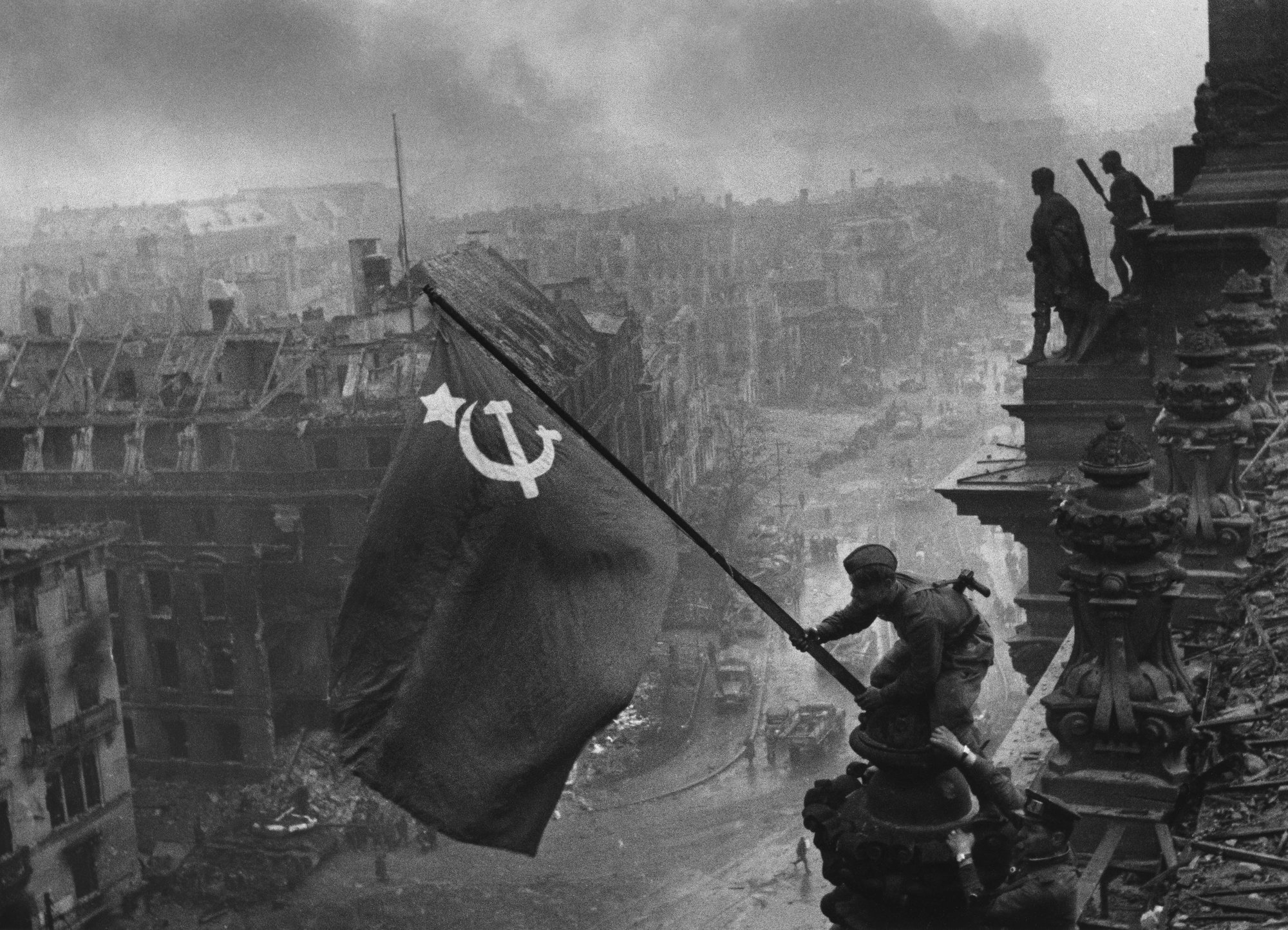
By 2 May 1945, the Red Army had full control of the Reichstag. The famous photo of two soldiers planting the flag on the roof was then taken as a re-enactment on the following day.
That fact surprises many people because the image feels like a candid snapshot of history happening in real time. But wartime photography often aimed not only to document events, but to present them in a clear and memorable form. The re-enacted flag-raising distilled the meaning of the battle into a single unforgettable picture.
For the Soviet Union, the image quickly became symbolic of victory not just in Berlin, but across the wider Eastern Front. It visually declared that Nazi Germany had been defeated in its own capital.
A staged image, but a real victory
Calling the photo staged can be misleading if people take that to mean false. The battle was real. The deaths were real. The struggle inside the Reichstag was real. The capture of the building was real. What was staged was the photographic moment that came to represent all of it.
That distinction matters. The image was not valuable because it perfectly froze the exact first second of triumph. It was valuable because it became the chosen symbol of total victory in Berlin.
In that sense, the famous Reichstag flag photo tells two truths at once. One is historical: the well-known picture was a re-enactment taken after the building had been captured. The other is emotional and political: to the Soviets, no other image better expressed the defeat of Nazi Germany at the end of the war in Europe.
The rooftop scene may have been recreated, but the meaning attached to it was forged in one of the fiercest urban battles of World War II.