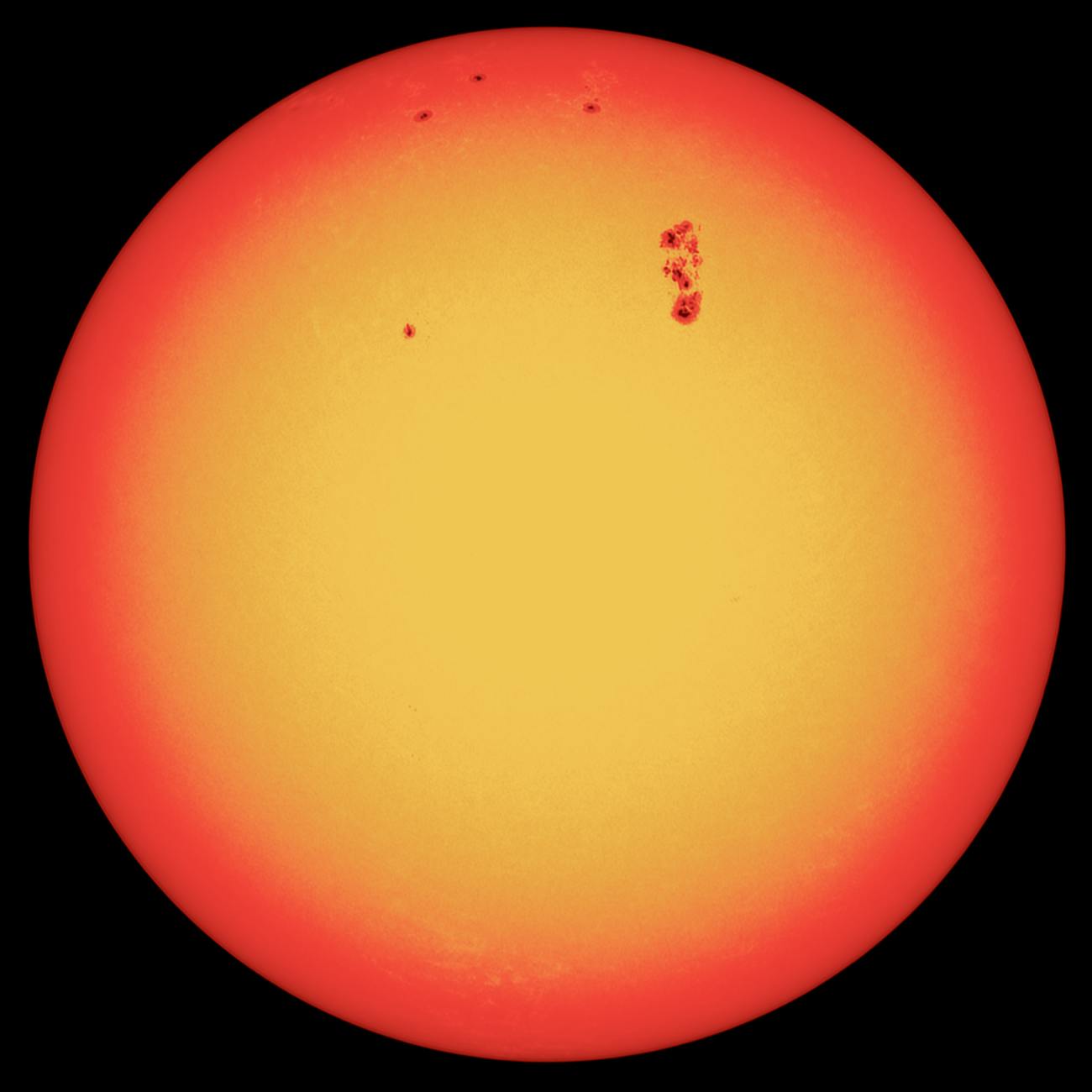
The Sun may look like a smooth, steady disk in the sky, but its surface tells a far more dramatic story. One of the clearest signs of that hidden activity is the appearance of sunspots: dark-looking patches on the Sun’s visible surface that reveal where magnetism is reshaping the flow of heat.
These spots are not holes, burns, or clouds. They are regions on the photosphere, the Sun’s apparent visible surface, where magnetic fields become especially concentrated. That intense magnetism interferes with convection, the process by which hot material rises and cooler material sinks to transport heat outward. Because less heat reaches the surface in those regions, sunspots are slightly cooler than the surrounding photosphere and therefore appear dark by contrast.
Sunspots are only one part of a much bigger pattern. Their number and size rise and fall in a repeating solar rhythm, and that rhythm is tied to a deeper magnetic cycle that changes the Sun on a global scale. Those changes matter to Earth, too, because solar activity can trigger auroras and interfere with radio communication and electric power.
Watch the story on DeepSwipe
Why sunspots look dark
To understand sunspots, it helps to know a little about the outer layers of the Sun. The visible surface is called the photosphere. Below it lies the convection zone, where the solar plasma is not dense or hot enough to move energy outward mainly by radiation. Instead, heat is transported by convective currents: hot material rises, cools near the surface, and sinks again.
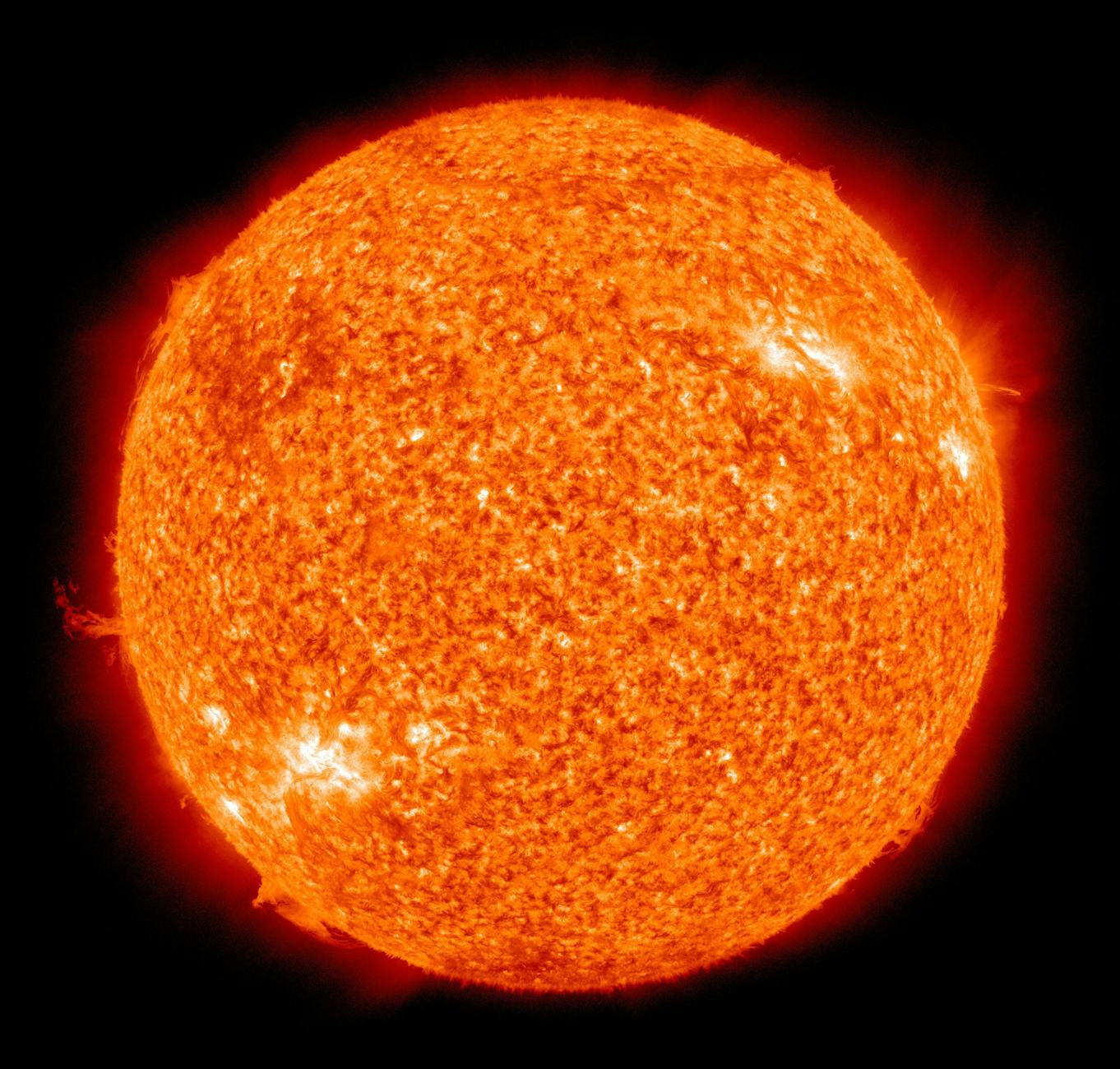
This rising and sinking motion leaves a visible signature called solar granulation, a grainy texture on the Sun’s surface. In normal regions, convection is constantly carrying heat up from below. But in sunspots, strong magnetic fields inhibit that convective transport of heat from the solar interior to the surface.
That is why sunspots appear darker than the rest of the photosphere. They are still extremely hot, but they are slightly cooler than nearby areas, so they stand out as dark patches against the brighter solar surface.

A surface sign of magnetic power
Sunspots are not random blemishes. They are visible markers of powerful magnetic concentrations on the Sun. The Sun has a stellar magnetic field that varies over its surface and changes over time. In ordinary terms, a magnetic field is the invisible region where magnetic forces act. On the Sun, that field can become especially strong in sunspots.
The Sun’s magnetism is not static. It extends far beyond the Sun itself. The solar wind, a continuous outward flow of plasma, carries the Sun’s magnetic field into space and helps shape what is called the interplanetary magnetic field. In other words, the Sun’s magnetic influence does not stop at the photosphere. It reaches across the Solar System.
Sunspots offer one of the easiest ways to see that magnetic activity in action. They show where the usual upward transport of heat has been disrupted by magnetism, making the invisible structure of the Sun’s field partly visible.
The 11-year sunspot rhythm
Sunspots follow a quasi-periodic 11-year cycle. That means the pattern repeats roughly every 11 years, but not with perfect clockwork precision. During solar minimum, few sunspots may be visible, and sometimes none at all can be seen. During solar maximum, the number and size of sunspots increase.
The changing position of sunspots is part of the pattern too. At solar minimum, the sunspots that do appear are found at relatively high solar latitudes, meaning farther from the Sun’s equator. As the cycle progresses toward maximum, sunspots tend to form closer and closer to the equator. This equatorward drift is known as Spörer’s law.
Some sunspots can be enormous, with the largest spanning tens of thousands of kilometres. So even though they look like tiny freckles from Earth, they can be vast structures on the solar surface.
The hidden 22-year magnetic cycle
The familiar 11-year sunspot cycle is only half the story. It is part of a 22-year magnetic cycle, called the Babcock–Leighton dynamo cycle. In simple terms, the visible rise and fall of sunspots is tied to a longer magnetic pattern in which the Sun’s large-scale magnetic polarity changes.
Magnetic polarity refers to the orientation of a magnetic field, similar in idea to north and south poles in an ordinary magnet. On the Sun, the overall large-scale magnetic field does not stay fixed. Each 11-year sunspot cycle corresponds to a change in that polarity, so it takes about 22 years for the magnetic pattern to return to its earlier orientation.
This cycle involves an exchange of energy between two magnetic configurations: toroidal and poloidal fields. The details are complex, but the main point is that the Sun’s magnetism is constantly being reorganized. Differential rotation, meaning the Sun rotates faster at its equator than at its poles, plays an important role in this process.
The transition layer called the tachocline, between the radiative zone and the convection zone, is thought to be especially important. It is a region of sharp shear, where layers slide past one another because one region rotates more uniformly and the other rotates differentially. It is hypothesised that a magnetic dynamo within this layer generates the Sun’s magnetic field.
How sunspots emerge during the cycle
At solar-cycle maximum, an internal toroidal magnetic field is near maximum strength. Buoyant upwelling within the convective zone then forces parts of this magnetic field through the photosphere. This produces pairs of sunspots that are roughly aligned east to west and have opposite magnetic polarities.
Those polarities do not stay the same from one cycle to the next. The magnetic polarity of sunspot pairs alternates every solar cycle, a pattern described by Hale’s law. As the cycle declines, sunspots become fewer and smaller. At solar minimum, the toroidal field is at minimum strength and sunspots are relatively rare, while the external poloidal field is at maximum strength.
Then the cycle begins again. Magnetic energy shifts back, the sunspot count rises, and the Sun enters another active phase.
Why Earth cares about the Sun’s magnetic mood
Sunspots matter because they are linked to broader solar activity. The Sun’s magnetic field drives effects collectively called solar activity. Solar flares and coronal mass ejections tend to occur at sunspot groups, making sunspot-rich periods especially important.
These active events, along with high-speed streams of solar wind, send plasma and magnetic structure outward into the Solar System. On Earth, the effects can include auroras at moderate to high latitudes, as well as disruption of radio communications and electric power.
That makes the solar cycle more than an abstract astronomy topic. The Sun’s changing magnetic behavior can have practical effects on modern technology and visible effects in the sky.
A star that is steady, but not quiet
The Sun is the main source of energy for life on Earth, and over long timescales it is relatively stable. Yet its surface and magnetic environment are anything but motionless. Beneath the bright photosphere, hot plasma moves, rotation varies by latitude, and magnetic fields build, twist, and reorganize.
Sunspots are among the clearest signs of that restless behavior. They look dark only because nearby regions are even brighter. They come and go in a cycle tied to a deeper magnetic reversal. And when their numbers rise, Earth can feel the consequences far from the solar surface.
So the next time you hear about a surge in auroras or disruptions caused by space weather, it may trace back to the same phenomenon astronomers have watched for centuries: dark spots on a bright star, revealing the Sun’s magnetic mood swings in plain sight.