A Roman masterpiece with a Greek past
The Alexander Mosaic is one of the most famous survivals from Pompeii, and it raises a question that still fascinates historians: when you look at it, are you seeing a Roman artwork, a Greek artwork, or both at once?
The mosaic was originally a Roman floor mosaic in the House of the Faun in Pompeii, and it is usually dated to about 120 to 100 BC. That makes it a work from the later Roman Republic. Yet many scholars believe it is a copy of a much older Hellenistic painting, probably created in the late fourth century BC or early third century BC. Hellenistic refers to the Greek world after the conquests of Alexander the Great, a period known for dramatic art, realism, and emotional intensity.
That double identity is what makes the work so compelling. It belongs to a Roman house, a Roman decorative program, and a Roman social setting. But it may also preserve the look of a lost Greek painting that no longer exists.

The battle scene that feels unusually alive
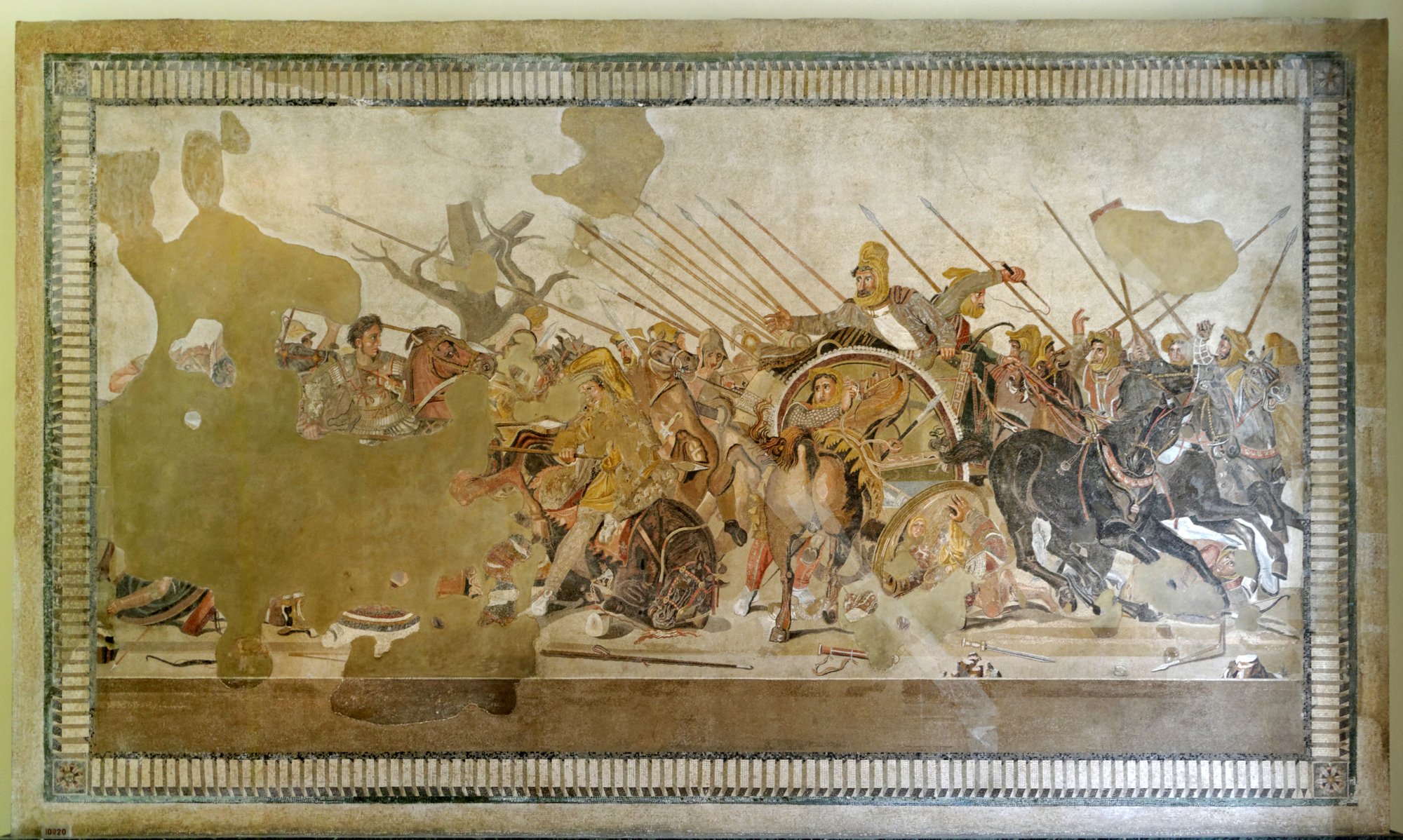
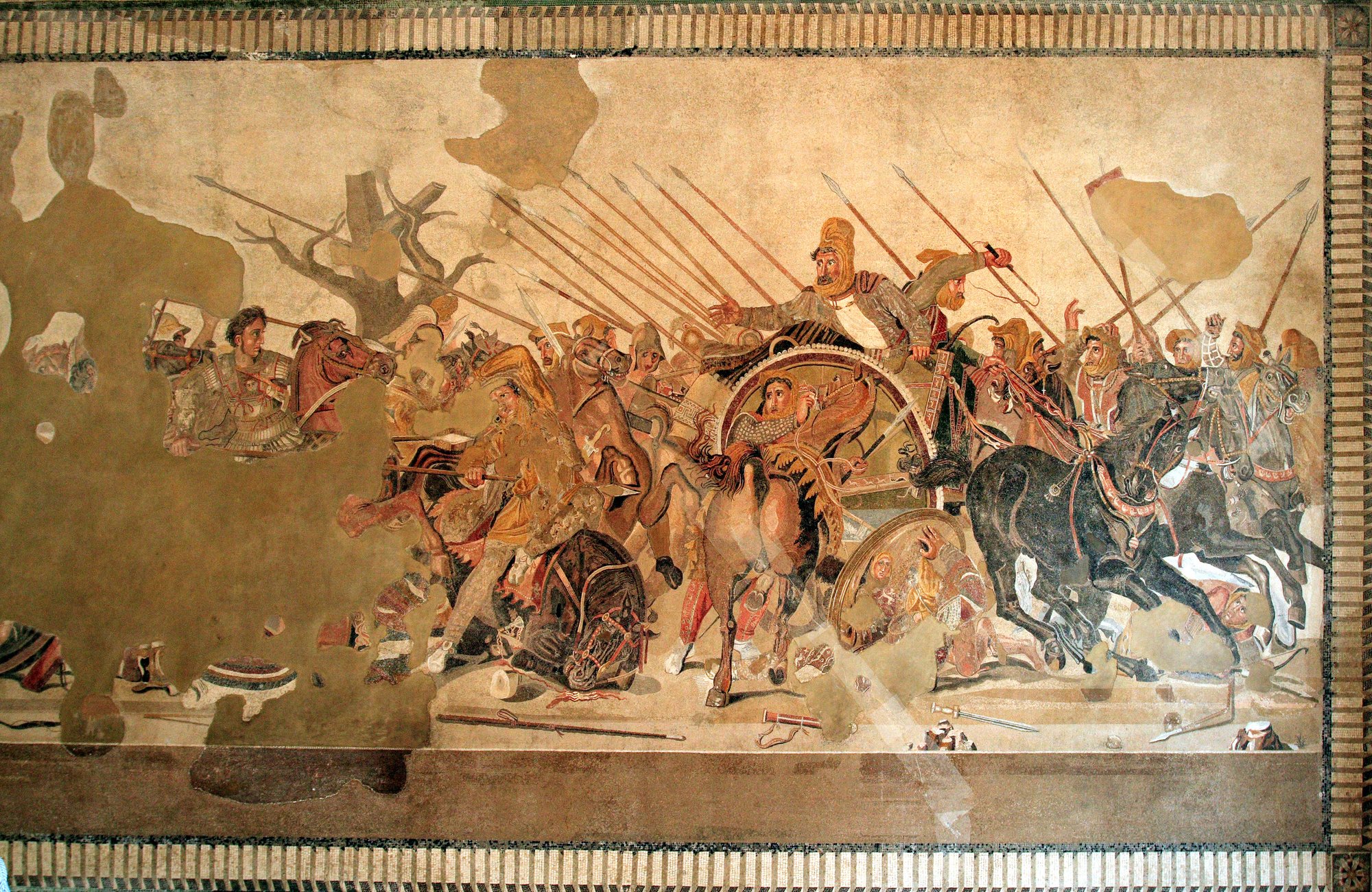
The mosaic is traditionally understood as showing the Battle of Issus, one of Alexander the Great’s victories over the Persian king Darius III. In the image, Alexander charges directly toward Darius, and the whole scene is packed with motion, fear, and tension.
Ancient battle scenes often turn into a blur of bodies, but this one feels strikingly personal. More than 50 men appear in the composition, yet the main figures remain clear and memorable. Alexander is shown on the left, without a helmet, facing right and attacking with his lance. He wears a linen breastplate, called a linothorax, and it bears the head of the Gorgon Medusa, a traditional emblem of Athena. He rides Bucephalus, and his gaze is fixed on Darius.
Darius dominates much of the right side. He is shown in his chariot, holding a bow in his left hand while stretching his right arm toward Alexander. His face shows fear and anxiety, especially in the furrow of his brows and his deep frown. Around him, the scene is unstable and dangerous: his charioteer is trying to turn the chariot away, horses are being driven to flee, and a soldier identified as Darius’ brother Oxyathres is shown sacrificing himself in front of the king’s chariot.
What makes the image feel so modern is its attention to emotion and physical detail. The mosaic captures expressions on the warriors’ faces, the strain of bodies in motion, and dramatic moments frozen in time. One fallen soldier sees his own death reflected in a shield. A horse is shown from behind in a daring perspective. Diagonal spears, crowded figures, and clashing forms create the sense of battle noise and confusion.
Why scholars connect it to a lost Greek painting
One major reason scholars think the mosaic reflects a Greek original is style. The work gives close-up, recognizable portraits of the battle’s main heroes, especially Alexander and Darius. In many Greek battle scenes, heroes can be hard to pick out in the chaos, but here the leading figures are unmistakable.
The mosaic also shows a high level of realism and naturalism. Naturalism in art means making human bodies, faces, and actions look believable and lifelike rather than stiff or symbolic. In this scene, facial expression, emotion, and anatomy are handled with great care. That quality fits well with Hellenistic artistic interests.
Another clue is the sense that the mosaic preserves very specific details that might have been lost if the design had been created much later than the battle itself. Because of that, scholars often believe the Roman mosaic should be connected to an earlier Greek work. Some have proposed that the lost original was by Philoxenus of Eretria. Others have linked it to Apelles or Aristides of Thebes. One ancient reference by Pliny the Elder mentions a battle painting by Philoxenus of Eretria made for the Macedonian king Cassander, which is why that name often appears in discussions of the mosaic.
Even so, the exact original remains uncertain. The Greek painting itself is lost, so the mosaic is precious partly because it may preserve an echo of an artwork that can no longer be seen directly.
The Roman version was not just a passive copy
It would be easy to think of the mosaic as nothing more than an imitation of Greek art, but that misses why the Roman version matters so much.
This was an unusually detailed mosaic for a private residence, and it was probably commissioned by a wealthy owner. It was placed in the House of the Faun, one of Pompeii’s most important houses, in a highly visible space where guests would encounter it. The mosaic decorated the floor of a second tablinum or exedra, a room or open area with seating used for conversation. Since it lay where the patron could receive visitors, it became the first decorative object people would see when entering that room.
That placement matters. It suggests that Alexander was not simply an old historical figure to Roman viewers. He represented heroic power and prestige. Roman leaders modeled themselves on Alexander, and Roman civilians also aspired to the power he symbolized. In that sense, the image was not just about preserving Greek culture. It was also about Roman self-presentation.
The Romans who displayed this scene chose to celebrate a dramatic image of conquest, leadership, and battlefield courage inside their own home. So even if the design goes back to a Greek original, the Roman commission tells its own story about taste, status, and admiration.
How the mosaic was made
The technical side of the Alexander Mosaic helps explain why it has such rich detail. It was made from tiny colored tiles called tesserae. These small pieces were arranged in gradual curves using a method called opus vermiculatum, sometimes described as “worm work” because the lines seem to crawl in winding paths. This careful arrangement allowed for subtle modeling of forms and smoother transitions in color.
The tesserae were extremely small, about 0.08 inches, or 2 millimeters, wide. The mosaic is said to contain approximately one and a half million tiny colored tiles, and it has also been estimated that more than four million pieces were used. However counted, the result is astonishingly intricate.
Its colors depend on natural materials, especially marble found in different shades. The palette is built from reds, yellows, black, and white, but the gradation is rich enough to create volume, shading, and depth. Those effects help produce the lifelike quality that makes the scene feel so immediate.
There is also evidence that the mosaic may have been imported from the East. Some details appear distorted or changed, and some scholars think this suggests it was created in sections and later reassembled in Pompeii.
Preserved by disaster, studied in the present
The mosaic survived because volcanic ash from the eruption of Mount Vesuvius in AD 79 covered Pompeii and preserved it. It was rediscovered in 1831 and transported to Naples in 1843. Today the original is preserved in the National Archaeological Museum in Naples.
Modern study has continued to reveal more about it. In 2015, researchers used non-invasive analysis techniques to examine its physical composition and to distinguish original parts from later additions. In 2018, a photogrammetric model exposed flaws and cracks invisible to the naked eye. In 2021, the National Archaeological Museum of Naples began a major restoration project after identifying problems such as detached tesserae, cracks, bulges, and surface depressions.
A modern copy was also created by the International Center for the Study and Teaching of Mosaic in Ravenna. Installed in the House of the Faun in 2005, it helps visitors understand how this spectacular image once functioned in its original setting.
So whose artwork is it?
That is the real fascination of the Alexander Mosaic. It may preserve the composition and spirit of a lost Hellenistic Greek painting, but it is also unmistakably a Roman object: Roman in date, Roman in location, and Roman in meaning inside a wealthy house at Pompeii.
Rather than choosing one identity over the other, it is better to see the mosaic as a meeting point of artistic traditions. It combines Italic, Hellenistic, and Roman elements. It carries forward a Greek way of imagining heroic battle, while also revealing what Roman patrons wanted to place at the center of their social world.
In other words, the mosaic matters not only because it may echo a lost masterpiece, but because it shows how later viewers chose to preserve, display, and reinterpret that image for themselves.