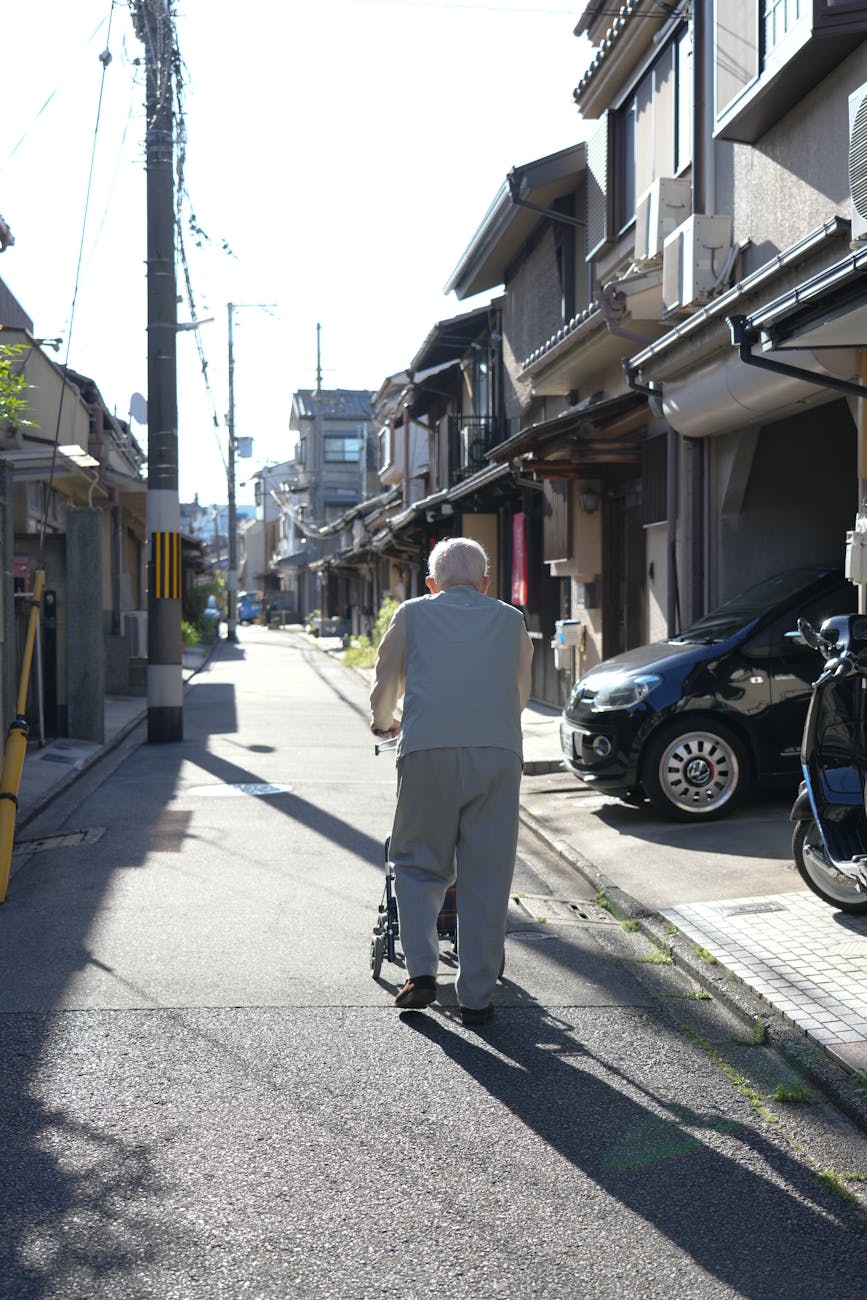
Japan has the highest proportion of elderly citizens of any country in the world, and that demographic shift is reshaping daily life in ways that go far beyond economics. Discussions often focus on pensions, healthcare costs, and labor shortages. But one of the most haunting consequences is deeply personal: some people die alone, and no one realizes for days, weeks, or even longer.
This phenomenon is known in Japan as kodoku-shi, meaning “solitary death.” It has become one of the starkest human symbols of an aging society, where longer life expectancy, smaller families, and social isolation can combine in painful ways.
Watch the story on DeepSwipe

What is kodoku-shi?
Kodoku-shi refers to cases in which people living alone die at home and remain undiscovered for an extended period. The phrase literally means “solitary death,” and it captures more than just the fact of dying alone. It points to isolation so deep that a person’s absence is not immediately noticed.
In Japan, this problem is closely linked to the country’s age structure. A growing share of the population is elderly, and many older people live by themselves. Every year, thousands of deaths go unnoticed for days or weeks. In some cases, the silence lasts far longer.
During the first half of 2024, the National Police Agency reported that 37,227 individuals living alone were found dead at home. Of these, 70% were aged 65 and above. Nearly 4,000 bodies were discovered more than a month after death, including 130 that remained unnoticed for at least a year.
Those numbers are not just statistics. They reveal how loneliness can become a public issue in a super-aged society.

Why Japan is especially vulnerable
Japan’s population has been aging faster than that of any other country. In 2014, about 25.9% of the population was above age 65, rising to 29.1% by 2022. By 2050, an estimated one-third of the country is expected to be 65 or older.
At the same time, fewer children are being born. Japan’s total fertility rate, the average number of children born per woman over her lifetime, has remained below the replacement level of 2.1 since 1974. It fell to a historic low of 1.26 in 2005 and stood at 1.41 in 2016.
Longer lives and fewer births create a population structure with many more older adults and a much smaller younger generation. That matters because social connection often depends on family, neighborhood ties, and frequent contact across generations. As the base of younger people narrows, more older adults can end up with weaker support networks.
From 1974 to 2014, the number of Japanese people aged 65 or older nearly quadrupled, reaching 33 million and accounting for 26% of the population. Over the same period, the share of children aged 14 and under dropped dramatically. The number of elderly people surpassed the number of children in 1997.
This shift happened in Japan in a shorter period than in any other country.
Living longer, but often more alone
Japan is famous for high life expectancy. In 2016, life expectancy was 85.1 years overall: 81.7 for males and 88.5 for females. Improvements in nutrition, medical and pharmacological technology, and living conditions all contributed to this long lifespan. Peace and prosperity after World War II also supported the massive economic growth that helped people live longer.
A high life expectancy is usually a triumph. But when combined with a shrinking population and low fertility, it increases the proportion of elderly people in society. That means more people living into advanced old age, often after spouses, siblings, or friends have died.
Japan also has a remarkable number of centenarians, people aged 100 or older. In 2014, there were 58,820 centenarians in the country, and 87% of them were women. Almost one in five of the world’s centenarians live in Japan.
Long life can be a gift, but it also raises a difficult question: who checks in on people when they become frail, widowed, or isolated?
Family care is changing
Traditionally, elderly Japanese people often relied on their adult children for support. Government policies have also encouraged sansedai kazoku, or “three-generation households,” where parents, children, and grandparents live together or remain closely tied.
But Japanese society has changed. Young people increasingly migrate to major cities such as Tokyo, Osaka, and Nagoya. Women’s participation in the workforce has increased. The cost of caring for both children and older relatives has grown. These changes make traditional family care harder to sustain.
In 2015, 177,600 people between ages 15 and 29 were directly caring for an older family member, showing that family caregiving still exists on a significant scale. Yet it is no longer guaranteed that an elderly person will have someone nearby.
To respond, Japan has developed more nursing homes, adult daycare centers, home health programs, and long-term care services. Some former schools are even converted into elderly care centers as the number of children declines and the need for elder care rises. In 2008, there were about 6,000 special nursing homes caring for 420,000 elderly people.
Even so, many elderly people still live alone.
The social side of an aging society
Population aging is often described in technical language: dependency ratios, shrinking workforces, pension burdens. But the human side is just as important.
In 2014, Japan’s age dependency ratio, which compares the number of people over 65 to those of working age, was 40%. It is expected to rise to 60% by 2036 and nearly 80% by 2060. In simple terms, fewer working-age people will be supporting a much larger elderly population.
That affects more than budgets. It can also affect time, attention, and care. When families are smaller, when adult children live far away, and when communities are less tightly connected, older people can drift into isolation.
Japan is often seen by its citizens as comfortable and modern, and there is not a widespread feeling of a dramatic “population crisis.” Yet the reality of kodoku-shi reveals a quieter kind of crisis: social disconnection.
Loneliness is harder to measure than birth rates or public debt, but the consequences can be devastating. A person may gradually disappear from social life without any headline, only to be discovered long after death.
Why more people are living alone
Several long-term economic and cultural trends have contributed to weaker household ties. Later and fewer marriages, higher education, urbanization, smaller homes, poor work-life balance, and the high cost of raising children have all been linked to lower childbirth and changing family structures.
Japan has also seen a rise in the share of people who never marry. Between 1980 and 2010, the percentage of the population who had never married increased from 22% to almost 30%. Surveys also show that some singles want to marry, while others prefer to remain single for reasons such as preserving freedom, financial burdens, housework, job instability, childcare, nursing care responsibilities, or not wanting to change surname.
These trends matter for old age. A society with more single-person households may eventually produce more elderly people without spouses or children nearby. That does not automatically lead to isolation, but it can increase the risk.
The urban-rural divide and hidden isolation
The Greater Tokyo Area is almost the only part of Japan still growing in population, largely because of internal migration from other regions. Many rural and suburban areas are shrinking. Between 2005 and 2010, the population of 36 out of 47 prefectures declined.
As young people leave, especially young women, some municipalities face the possibility of severe decline or even disappearance by 2040. Rural depopulation also leaves behind abandoned homes and older residents with thinner social networks.
Isolation can happen in both cities and countryside. In large urban areas, people may live physically close but socially distant. In rural areas, communities may weaken as younger generations move away. In either setting, an elderly person living alone may slip out of regular contact.
Government responses to an older, lonelier Japan
Japan has not ignored the challenges of aging. The government has tried to improve welfare services, long-term care facilities, daycare support, and in-home nursing assistance. The Gold Plan, introduced in 1990, aimed to improve services for the elderly and reduce the care burden on families. Long-term care insurance followed in 2000.
The government has also pursued policies to encourage family formation and improve work-life balance, including childcare expansion, parental leave, and protections against maternity harassment, known as matahara. The Child Care and Family Care Leave Law created opportunities for leave after childbirth and time off for children’s illness, while also aiming to reduce long working hours.
These efforts are partly about reversing low fertility and partly about helping families manage care responsibilities. But policies can struggle when workplace expectations, cultural norms, and economic insecurity push in the opposite direction.
That is one reason kodoku-shi remains such a powerful symbol. It is not caused by a single policy failure. It emerges from a wide web of demographic, economic, and social changes.
More than a statistic
Japan’s aging society is often discussed as a test case for the future of many countries. Other parts of East Asia and the Pacific are also aging rapidly, and many of the concerns first visible in Japan are likely to spread.
But the lesson of solitary death is not just demographic. It is emotional and moral. It asks what happens when a modern society becomes older, smaller, and more fragmented. It asks whether longevity without connection can leave people dangerously unseen.
Kodoku-shi is a reminder that aging is not only about how long people live. It is also about how they live, who notices them, and whether anyone is there when they are gone.
In that sense, Japan’s aging society is not only a story of population charts and social spending. It is a story about the basic human need to remain connected to others, even at the very end.