Japan is often described as the world’s most aged society, and the reason is not a single dramatic event. It is the result of two long-running demographic forces working at the same time: people are living much longer, and far fewer children are being born than are needed to replace the population.
That combination has reshaped the country over decades. Japan’s population peaked at 128.1 million in October 2008 and then began to decline. In 2014, the population was estimated at 127 million. If the same broad trend continues, it is expected to shrink to 107 million by 2040, 97 million by 2050, and 87 million by 2060.
What makes this especially striking is that Japan is not aging because mortality suddenly exploded. In fact, the opposite happened first: life expectancy rose dramatically. The country became older because fewer births kept arriving year after year, while more people survived into old age.
Watch the story on DeepSwipe
The core of the story: longer lives, fewer births
A population ages when the share of older people rises compared with the share of younger people. In Japan, that shift has been unusually rapid.
From 1974 to 2014, the number of people aged 65 or older nearly quadrupled, reaching 33 million and accounting for 26% of the population. Over a similar period, the share of children aged 14 and younger fell from 24.3% in 1975 to 12.8% in 2014. By 1997, the number of elderly people had already surpassed the number of children.
This is why Japan’s age structure looks so unusual. Instead of a classic population pyramid with many children at the bottom and fewer people at older ages, the base has narrowed. In 2014, the age dependency ratio — the ratio of people over 65 to those aged 15 to 65 — was 40%. It is expected to rise to 60% by 2036 and nearly 80% by 2060.
That means a smaller working-age population is expected to support a much larger elderly population through labor, taxes, pensions, healthcare, and caregiving.

How life expectancy rose so dramatically
Japan’s long life expectancy is one of the main reasons the country has aged so fast. In 2016, life expectancy was 85.1 years overall, including 81.7 years for males and 88.5 years for females.
This is a huge change compared with the period just after World War II, when average life expectancy was about 54 years for women and 50 for men. Over the following decades, life expectancy rose rapidly.
Several factors helped drive that improvement:
- improved nutrition
- advanced medical and pharmacological technologies
- improved living conditions
- peace and prosperity after World War II
These changes were tied to Japan’s post-war economic growth, which helped create conditions for longer lives. The country also became known for exceptionally high longevity, with close to 30% of the population aged 65 or older.
Longer life does not mean people stop needing support. As the population grows older, healthcare spending rises because older people tend to spend more time in hospitals and with physicians. On any given day in 2011, 2.9% of people aged 75 to 79 were in a hospital, and 13.4% were visiting a physician.
The result is a paradox: a healthier, longer-lived society is also one that must devote more resources to care in old age.
The fertility problem: births stayed too low for too long
The second half of the story is fertility. Fertility rate here means the average number of children a woman is expected to have in her lifetime. For a population to replace itself without immigration, the replacement threshold is commonly given as 2.1 children per woman.
Japan’s total fertility rate has stayed below 2.1 since 1974. It fell to a historic low of 1.26 in 2005, and in 2016 it was still only 1.41.
That long period of below-replacement fertility is crucial. A country does not need a sudden collapse in births to begin shrinking. It only needs births to remain too low for decades. Over time, fewer children are born, then fewer young adults enter the workforce, and eventually fewer potential parents exist in the next generation as well.
Japan also had a post-war baby boom between 1947 and 1949, followed by a prolonged period of low fertility. That helped create a large older generation followed by smaller younger ones, intensifying the aging pattern.
According to projections based on current fertility, people over 65 could account for 40% of Japan’s population by 2060, while those under 20 may make up only 13%, down from 40% in 1960.
Why births fell
The drop in births was shaped by both economic and cultural change. The reasons are wide-ranging rather than simple.
Among the factors linked to lower childbirth are:
- later and fewer marriages
- higher education
- urbanization
- growth of nuclear family households rather than extended family households
- poor work-life balance
- increased participation of women in the workforce
- declining wages and lifetime employment
- small living spaces
- the high cost of raising a child
Economic insecurity has become especially important for younger adults. About 40% of Japan’s labor force is made up of non-regular workers, including part-time and temporary employees. According to the Labor Ministry, non-regular employees earn about 53% less than regular employees on a comparable monthly basis. Young men in this group are less likely to consider marriage or to be married.
Overwork also matters. Many young Japanese report that fatigue from long working hours reduces their motivation to pursue romantic relationships.
At the same time, marriage patterns have shifted. Between 1980 and 2010, the share of the population that had never married rose from 22% to almost 30%, even as the population aged. A 2022 government survey found that among singles, 46.4% wanted to marry, but around a quarter explicitly preferred to remain single.
Reasons given for avoiding marriage included loss of freedom, financial burden, and housework. Women also cited the burden of housework, childcare, and nursing care, while men cited financial and job instability. Some women said they did not want to change their surname.
Dating, relationships, and delayed family formation
Japan’s aging is also connected to changing relationship patterns. In 2015, 1 in 10 Japanese adults in their 30s reported having had no heterosexual sexual experiences. After accounting for people who may have had same-sex intercourse, researchers estimated that around 5% of people had no sexual experience whatsoever.
Among people aged 18 to 39, the share without sexual experience increased between 1992 and 2015 for both women and men. Men with stable jobs and higher incomes were more likely to have had sex, while unemployment and insecure work were strongly linked to higher rates of virginity.
A related term that drew attention in Japan is herbivore men, or sōshoku danshi. According to a 2010 survey, 61% of single men in their 20s and 70% of single men in their 30s described themselves this way, meaning they were not interested in getting married or having a girlfriend.
A 2022 survey by the Japanese Cabinet Office found that around 40% of unmarried men in their 20s had never been on a date. Among young adult women, the figure was 25%.
All of this does not just affect romance. It directly affects how many families form, and how many children are ultimately born.
Why aging leads to population decline
A common assumption is that a country shrinks only when deaths surge. Japan shows that long-term low fertility can be just as powerful.
When there are not enough births for many years, each younger generation is smaller than the last. Even if people live longer, the total number of people eventually begins to fall because too few children are entering the population.
That is exactly what happened in Japan after the 2008 population peak. A 2020 global analysis found that Japan was among 23 countries that could see a total population decline of 50% or more by 2100.
Some researchers describe the country as a super-ageing society, meaning aging has advanced to an extraordinary degree in both rural and urban areas.
What aging looks like in everyday life
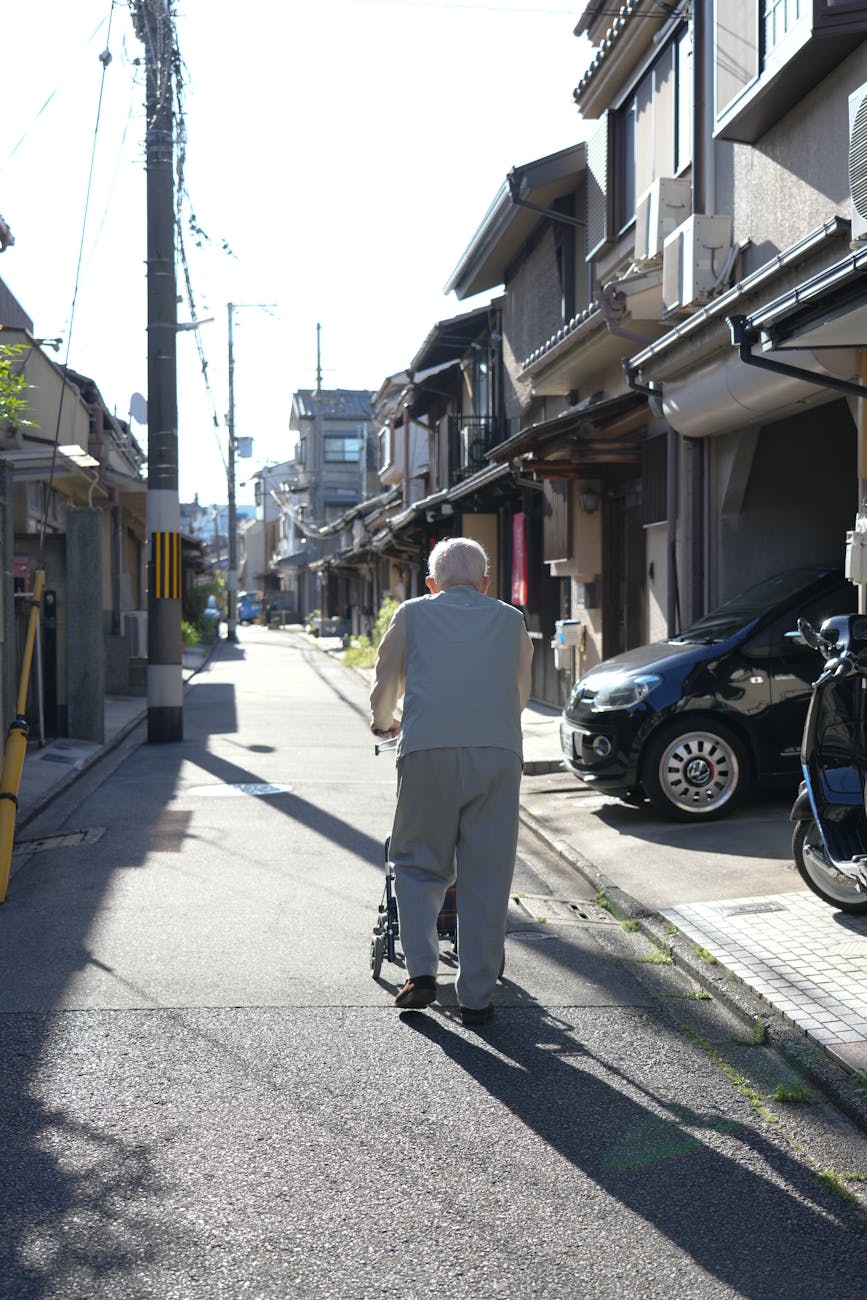
The numbers are dramatic, but the social effects may be even more visible. Japan closes about 400 primary and secondary schools every year, converting some into care centers for the elderly. In 2014, sales of adult diapers surpassed diapers for babies — a symbolic sign of how deeply the age balance has changed.
Family care is also under pressure. Traditionally, older Japanese often relied on their adult children, and the idea of sansedai kazoku, or three-generation households, has long been encouraged. But migration to major cities, the rising participation of women in the workforce, and the cost of caring for both children and elderly relatives have made this more difficult.
As a result, demand has grown for nursing homes, adult daycare centers, and home health programs. In 2008, around 6,000 special nursing homes were caring for 420,000 Japanese elders.
Another troubling effect is isolation. Many elderly people live alone, and some die unnoticed for days, weeks, or longer. This phenomenon is known as kodoku-shi, meaning “solitary death.” During the first half of 2024, police reported 37,227 people living alone were found dead at home, with 70% aged 65 or above.
The economic pressure of an older society
Aging is not only a social issue; it changes the whole economy. With fewer young workers entering the labor market and more older workers retiring, labor shortages grow. At the end of 2015, Japan had 125 jobs for every 100 job seekers.
The pressure is especially severe in industries such as agriculture and construction. The average farmer in Japan is 70 years old, and about one-third of construction workers are 55 or older, while only one in ten is younger than 30.
The government and companies have responded in several ways. Many companies raised the mandatory retirement age from 55 to as high as 65 during the 1980s and 1990s, and some allow employees to keep working beyond retirement age. The age at which pension benefits begin has gradually risen from 60 to 65.
Japan also introduced long-term-care insurance in 2000 and has invested in medical technologies such as regenerative medicine and cell therapy. Some small and medium-sized firms have created jobs and workplace arrangements specifically suited to older workers.
Still, projections are sobering. The OECD estimated that labor shortages would lower Japan’s economic growth by 0.7% annually until 2025, and by 0.9% annually after that.
Why Japan stands out globally
Japan’s population is aging faster than any other country. The share of people aged 65 or older doubled from 7.1% in 1970 to 14.1% in 1994 — a shift that took much longer in countries such as Italy, Sweden, and France.
Japan also has more centenarians than any other country. In 2014, it had 58,820 centenarians, and almost one in five of the world’s centenarians lived there. Of these, 87% were women.
This makes Japan a leading example of what happens when high life expectancy and low fertility combine over a long period. Other parts of East Asia are now moving in a similar direction, but Japan reached this stage earlier and more rapidly.
The big lesson from Japan
Japan is aging so fast because it experienced two demographic revolutions at once: remarkable gains in longevity and a long, sustained drop in births below replacement level. Neither force alone would have transformed the country so dramatically. Together, they changed its age structure, workforce, families, and future population size.
It is a reminder that demographic change is usually slow in any single year but powerful across decades. A society can look stable on the surface while its age balance quietly shifts underneath — until one day schools close, care homes expand, and the entire country feels older than it did before.