Full article · 7 min read
Agriculture’s Plastic Mulch Problem: The Dirty Secret in Modern Farming
Plastic is often associated with packaging, bottles, and bags. But one of its quieter frontiers is agriculture, where plastic products have become deeply woven into how many farms operate. Across fields and greenhouses, farmers use films, mulch, trays, protective mesh, and irrigation tubing to help boost yields and improve efficiency. This broad family of farm plastics is often called agriplastic: plastic products used in farming.
These materials can help conserve water, suppress weeds, raise soil temperature, aid fertilizer application, and support crop growth. But they also create a long-lasting problem in the ground beneath our feet. One of the biggest concerns is plastic mulch, a thin plastic film laid over soil. It may look harmless from above, but over time it can leave behind a hidden legacy in farmland: fragments, residues, and microplastics that are difficult to remove.
What is plastic mulch, exactly?
Plastic mulch is a covering placed on top of soil, often to suppress weeds, conserve water, increase soil temperature, and support fertilizer use. It is part of a larger set of agricultural plastics that also includes greenhouse and tunnel films, shade cloth, pesticide containers, seedling trays, protective mesh, and irrigation tubing.
These products are used extensively in agriculture to increase crop yields and improve the efficiency of water and agrichemical use. Agrichemicals are chemical products used in farming, such as fertilizers and pesticides. From a short-term farming perspective, that sounds efficient. From a long-term environmental perspective, it creates a complicated waste stream that is hard to manage.
The plastics commonly used for these products include low-density polyethylene, linear low-density polyethylene, polypropylene, and polyvinyl chloride. Readers do not need to memorize the chemistry to understand the issue: these are durable synthetic materials designed to last long enough to perform useful work in the field, but not easy enough to disappear safely afterward.
The residue doesn’t stay on the surface
One of the most striking facts about long-term mulch use is how much residue can remain in the soil. In places where mulch has been used for more than 10 years, mulch residue has been measured at 50 to 260 kilograms per hectare in topsoil.
A hectare is 10,000 square meters, roughly the size of a soccer field. That means a substantial mass of plastic can accumulate in the upper layer of farm soil over time, even if the original mulch looked thin and lightweight.
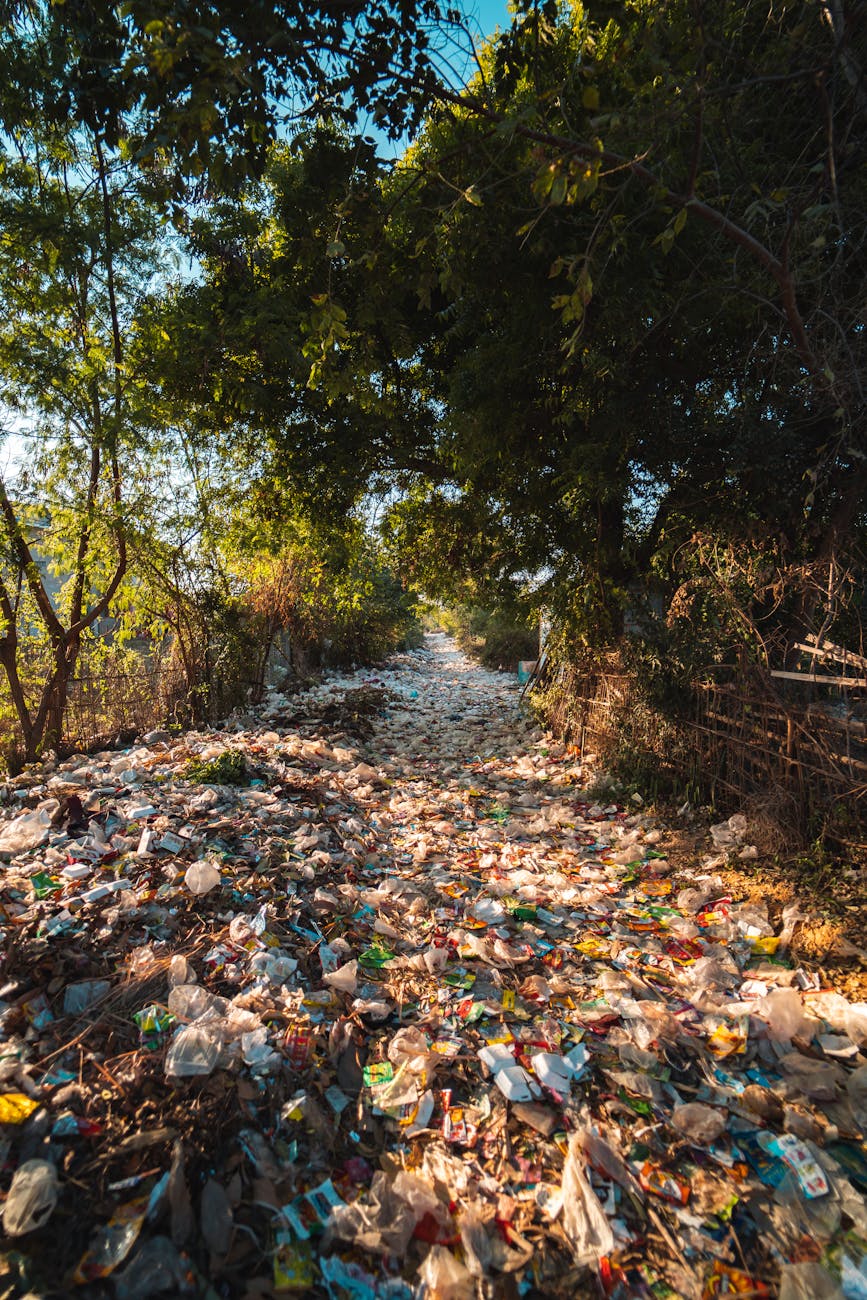
This matters because the problem is not always visible in large sheets. Weathering and degradation gradually break the mulch apart. Instead of vanishing, it fragments into smaller and smaller pieces. Some remain as larger scraps, while others become microplastics, tiny plastic particles that build up in soil.
This makes mulching a major source of both microplastic and macroplastic contamination in agricultural soils. Macroplastics are the larger pieces; microplastics are the much smaller fragments. The smaller the pieces get, the harder they are to collect, track, and remove.
Why agricultural plastic is so hard to recycle
If farm plastics create waste, why not simply recycle them? The answer is that agricultural plastics, especially plastic films, are not easy to recycle.
A major obstacle is contamination. These materials can carry high levels of pesticides, fertilizers, soil, debris, moist vegetation, silage juice water, and UV stabilizers. The contamination can reach up to 40–50% by weight. That makes collection and processing far more difficult than recycling cleaner plastic waste.
There is also the practical challenge of gathering flimsy, dirty plastic from large outdoor areas. Farm films can tear, degrade, and mix with mud and crop residue. Once that happens, the economics and logistics of recycling become much less attractive.
Because of these difficulties, agricultural plastics are often buried, abandoned in fields and watercourses, or burned. Each of those outcomes creates its own environmental risks.
From fields to rivers and seas
When plastic mulch is left in the environment, it does not stay neatly where it started. Residual plastic can leak from soils into wider ecosystems. Precipitation run-off and tidal washing can carry microplastics into the marine environment.
That means a plastic sheet originally used to help grow crops can eventually contribute to pollution far beyond the farm itself. This is one reason the issue has drawn growing attention: agricultural plastic pollution is not just a waste-management problem on private land. It can become part of a larger chain of contamination affecting waterways, soils, and food-producing ecosystems.
What plastic fragments do to soil
Plastic residue is more than an eyesore. It can affect the way soil functions.
There is a risk that plastic mulch deterioration will reduce soil quality, deplete soil organic matter, increase soil water repellence, and emit greenhouse gases. Soil organic matter is the carbon-rich material in soil made from decomposed plant and animal remains. It is important for fertility, structure, and water retention. If it declines, soils can become less healthy and less resilient.
The buildup of plastic in topsoil can also alter soil structure and nutrient transport, and affect salt levels. In simple terms, soil works because it is a living, structured system that moves water, air, and nutrients. Plastic fragments can interfere with that balance.
The problem is not just the plastic itself. Additives in residual plastic film, including UV and thermal stabilizers, may have harmful effects on crop growth, soil structure, nutrient transport, and salt levels. These additives are substances mixed into plastic to make it perform better, for example by helping it resist sunlight or heat. Useful in manufacturing, they may be far less welcome once they remain in soil for years.
Can plastic affect plants and the food chain?
The concern extends beyond soil texture. Residual plastic and its additives may affect crop growth. At the same time, microplastics released through fragmentation can absorb and concentrate contaminants capable of being passed up the trophic chain.
The trophic chain is the feeding chain: how substances move from one organism to another through ecosystems. If microplastics carry concentrated contaminants, the concern is that those substances may move through environmental pathways rather than staying isolated in one patch of soil.
This helps explain why agricultural plastics are increasingly discussed not just as litter, but as a soil contamination and ecosystem health issue.
A huge but hard-to-measure problem
The total amount of plastics used in agriculture is difficult to pin down precisely. One study reported that almost 6.5 million tonnes per year were consumed globally in 2012, while another estimated global demand in 2015 at between 7.3 million and 9 million tonnes.
Even with uncertainty in the exact totals, the overall picture is clear: plastic use in agriculture is massive. And because much of that plastic is used outdoors under sunlight, weather, and mechanical stress, fragmentation is not a rare accident. It is a predictable outcome if collection and management are inadequate.
The bigger agricultural context
This issue also fits into a broader pattern in modern agriculture. Farming has repeatedly adopted technologies that increase yield or efficiency, only to discover environmental side effects later. Agriculture already faces linked pressures including soil degradation, water pollution, biodiversity loss, and contributions to climate change. Plastic contamination adds another layer to that burden.
Modern farming often relies on inputs and materials that solve one problem while creating another. Plastic mulch can suppress weeds and improve water efficiency, but if residues build up year after year, the long-term cost may be paid by the soil itself.
That tradeoff is especially important because healthy soil is not just dirt holding roots in place. It is one of the foundations of agricultural productivity. When soil quality declines, farming becomes more fragile.
Why this “dirty secret” matters
Plastic mulch is useful because it is effective. That is exactly why the problem is serious. A technology that is widely adopted across many farming systems can leave behind an equally widespread environmental footprint.
The dirty secret is not that plastic is used in farming. It is that its remnants can persist in soil, fragment into microplastics, resist recycling, and spread into wider ecosystems. What begins as a tool for better crop management can end as long-term contamination.
For anyone who cares about food, farming, and the environment, this is a reminder that agricultural efficiency should not be judged only by what happens during one growing season. It also has to account for what is left behind in the field long after harvest.
Sources
Based on information from Agriculture.
More like this
Don’t let your curiosity fragment like plastic mulch — download DeepSwipe and grow cleaner, smarter knowledge every day.