Full article · 8 min read
Black Holes, Accretion Disks, and Jets: Nature’s Brightest Engines
Black holes are famous for trapping light, yet the regions around them can become some of the brightest places in the universe. That apparent contradiction is the key to understanding why black holes are not just cosmic sinkholes, but powerful engines. When gas and dust fall toward a black hole, they usually do not drop straight in. Instead, they swirl into an accretion disk, heat up intensely, and radiate enormous amounts of energy. In some cases, the system can shine so strongly that it rivals or even outshines an entire galaxy.
This brilliance does not come from light escaping the black hole itself. It comes from matter just outside the event horizon, the boundary beyond which nothing can escape. The black hole’s gravity drives surrounding material into extreme motion, and that motion turns gravity into heat and radiation.
Why falling matter becomes so bright
Gas falling into the gravitational well of a massive object typically forms a disk-like structure because of conservation of angular momentum. In simple terms, material already has some sideways motion, so instead of plunging directly inward, it spreads into a flat, rotating disk around the black hole.
As the disk evolves, its angular momentum is transferred outward by internal processes. That allows some material to move farther inward. As it does, gravitational energy is converted into heat. The result is an enormous flux of radiation, especially X-rays. The gas in the inner parts of the disk can reach temperatures from thousands to millions of Kelvin.
At those temperatures, the gas becomes plasma, a superheated state of matter in which particles are electrically charged. This makes the environment around a feeding black hole highly energetic and highly luminous.
In many black hole systems, the inner accretion disk orbits at extremely high speed because it lies so close to the black hole. Friction in this region heats the gas enough to produce electromagnetic radiation that telescopes can detect, mainly in X-rays. That is why many black holes are found not by seeing the black hole itself, but by observing the glowing material around it.
Accretion disks: the structure of the feeding zone
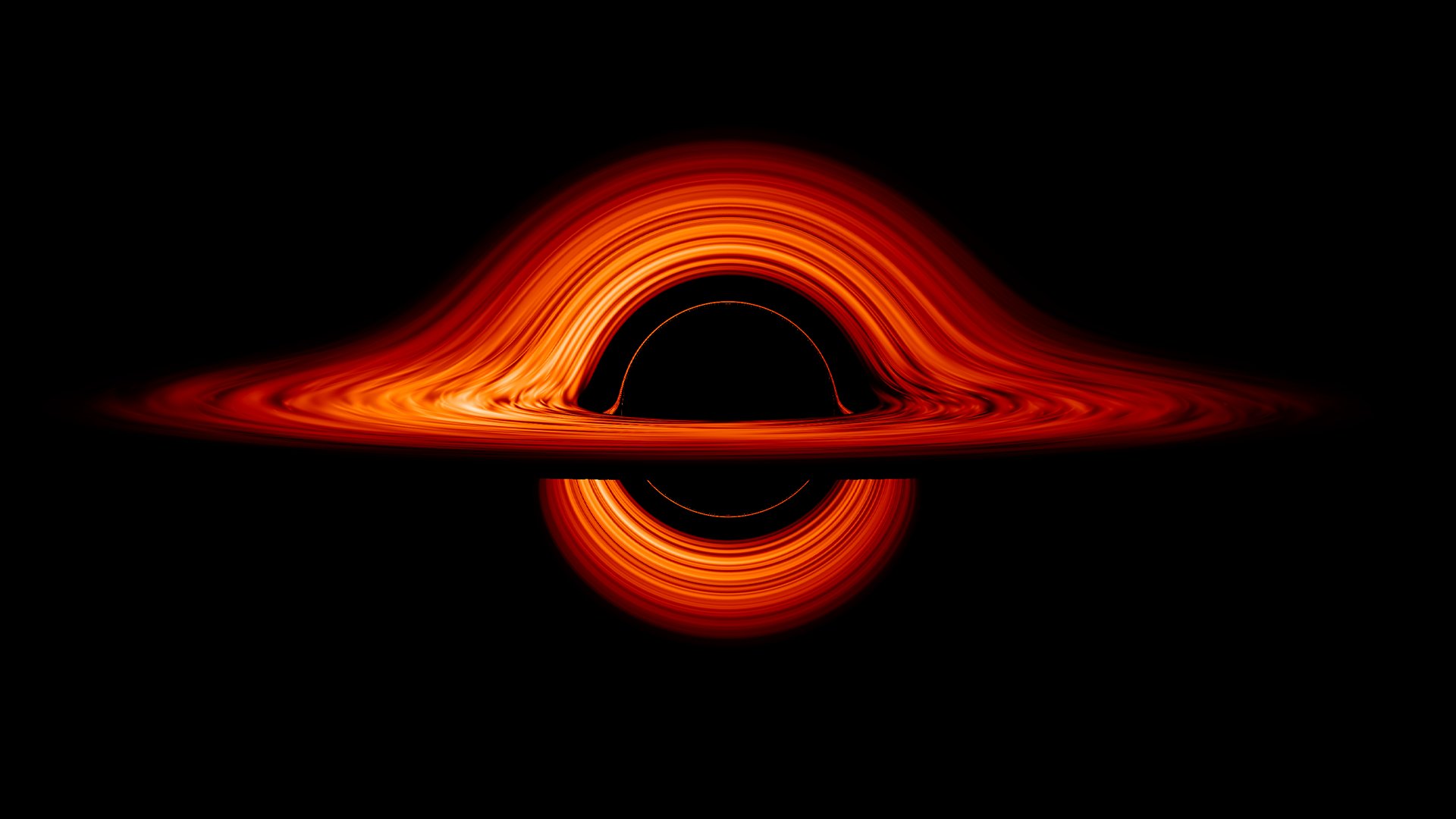
Accretion disks are not all the same. Some are geometrically thin, meaning they stay close to the black hole’s equatorial plane and have a fairly well-defined inner edge. Others are geometrically thick, supported by their own pressure and temperature, and can extend farther inward.
Astronomers also describe disks as optically thick or optically thin. An optically thick disk appears bright and opaque, while an optically thin one is more translucent and fainter when viewed from afar.
The color and appearance of a disk depend on several factors, including the black hole’s mass, its angular momentum, and the disk’s turbulence and magnetisation. Quasar accretion disks are generally expected to appear blue. By contrast, the disk around a stellar black hole would likely look orange, yellow, or red, with the innermost regions brightest.
Motion also changes what observers see. Due to the Doppler effect, the part of the disk rotating toward an observer appears bluer and brighter, while the part rotating away appears redder and dimmer.
The last stable orbit before the plunge
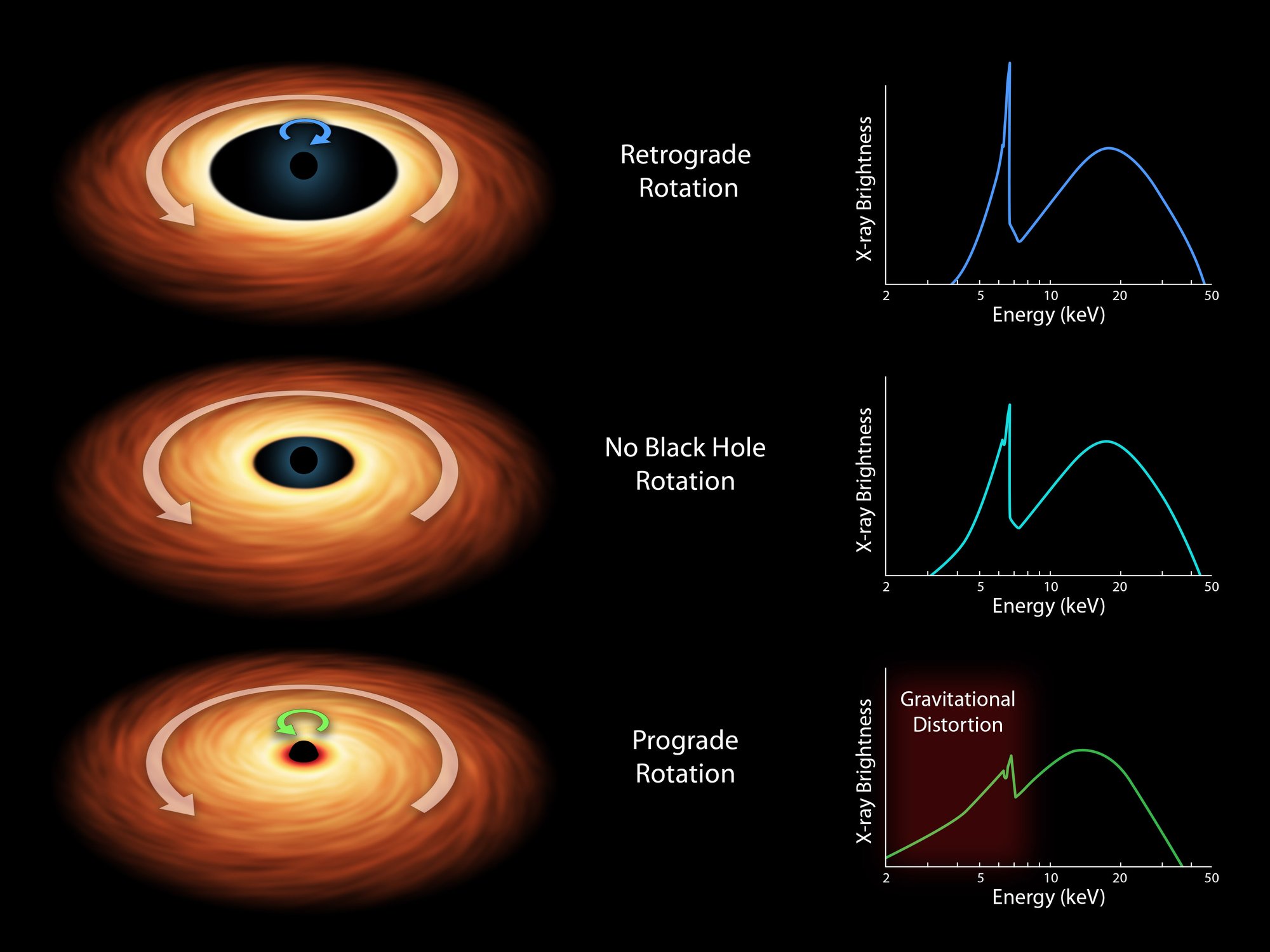
One of the most important ideas in black hole accretion is the innermost stable circular orbit, often shortened to ISCO. This is the smallest radius at which matter can stably orbit a black hole. Inside that boundary, circular motion is no longer stable. A tiny inward disturbance sends matter spiraling down toward the black hole.
That is why the ISCO is often described as the last stable orbit. Outside it, matter can continue circling. Inside it, the final plunge begins.
For a non-spinning black hole, the ISCO lies at three times the Schwarzschild radius, or six times GM divided by c squared. For spinning black holes, the location changes. Matter orbiting in the same direction as the black hole’s spin can remain stable closer in, while matter orbiting the opposite way has its stable orbit pushed farther out.
This detail matters because the closer matter gets before plunging, the more gravitational energy can be released first.
How efficient black holes can be
Black holes are extraordinary energy converters. By the time matter in the disk reaches the ISCO, between 5.7% and 42% of its mass can be converted into energy, depending on the black hole’s spin. That makes accretion onto black holes one of the most efficient known ways of releasing energy in the universe.
The episode highlights the upper end of that range: up to 42% of a gas parcel’s mass can become energy before the material disappears past the final safe orbit. Most of that energy is released very close to the black hole. About 90% of it comes out within roughly 20 black hole radii.
This helps explain why the area around a black hole can be so dazzling even though the black hole itself is dark.
Jets: black holes as cosmic blowtorches
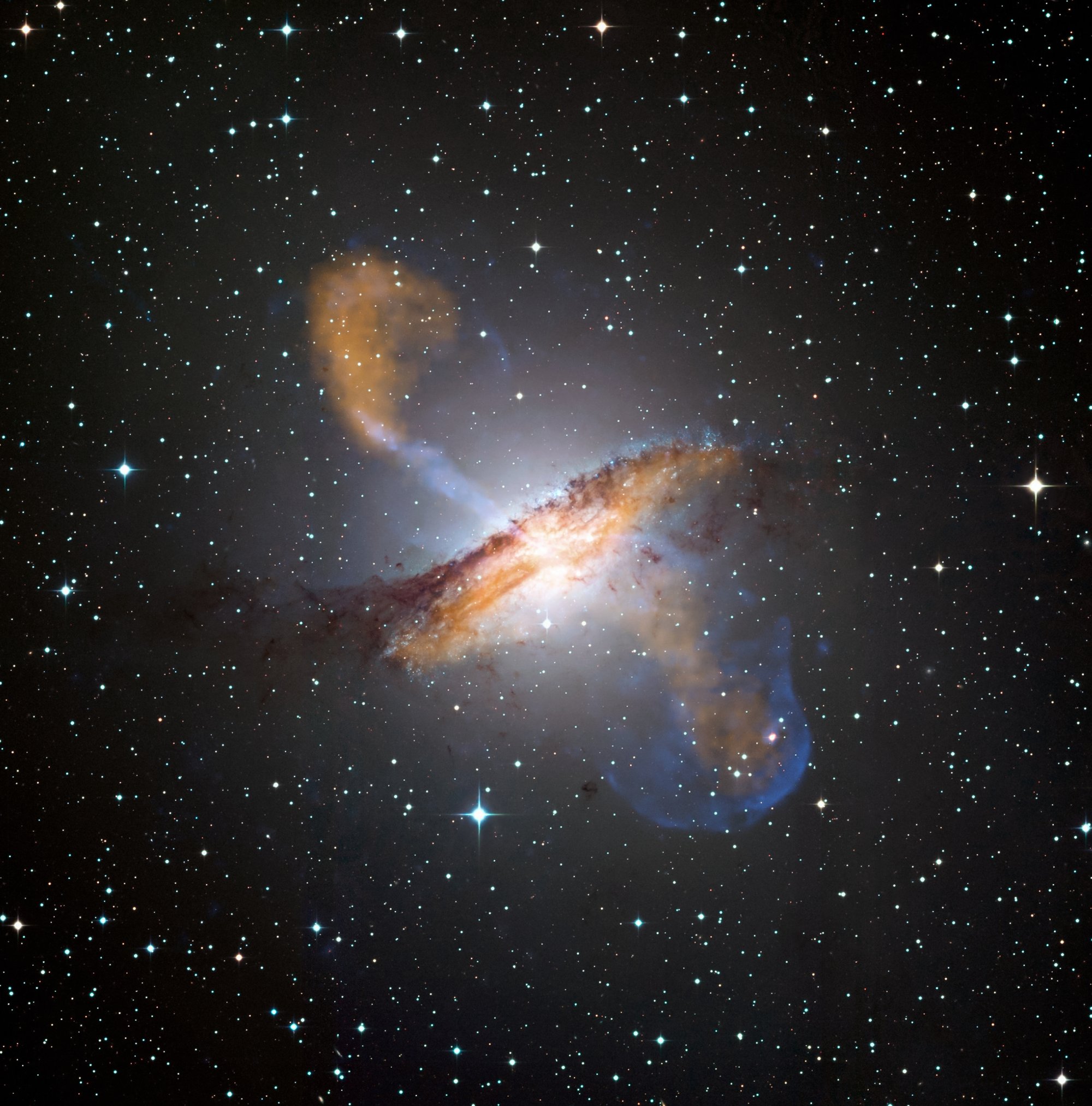
Some black holes do more than glow. They launch narrow, powerful outflows called relativistic jets. These are thin streams of plasma fired away from the black hole along its rotation axis at more than one-tenth of the speed of light.
Only a small fraction of the infalling matter is redirected this way, but the results can be spectacular. Jets can extend as far as millions of parsecs from the black hole. A parsec is an astronomical distance unit equal to about 3.26 light-years, so these jets can reach truly enormous scales.
Jets are seen around black holes of many different masses, but they are typically observed around spinning black holes with strongly magnetized accretion disks. In many systems, the jets can be brighter than the disk itself.
Exactly how jets form is still not settled. Proposed mechanisms include the Blandford–Znajek process, in which magnetic field lines dragged by a rotating black hole help launch matter into space, and the Penrose process, which involves extracting rotational energy from the black hole.
Quasars: when feeding black holes dominate a galaxy
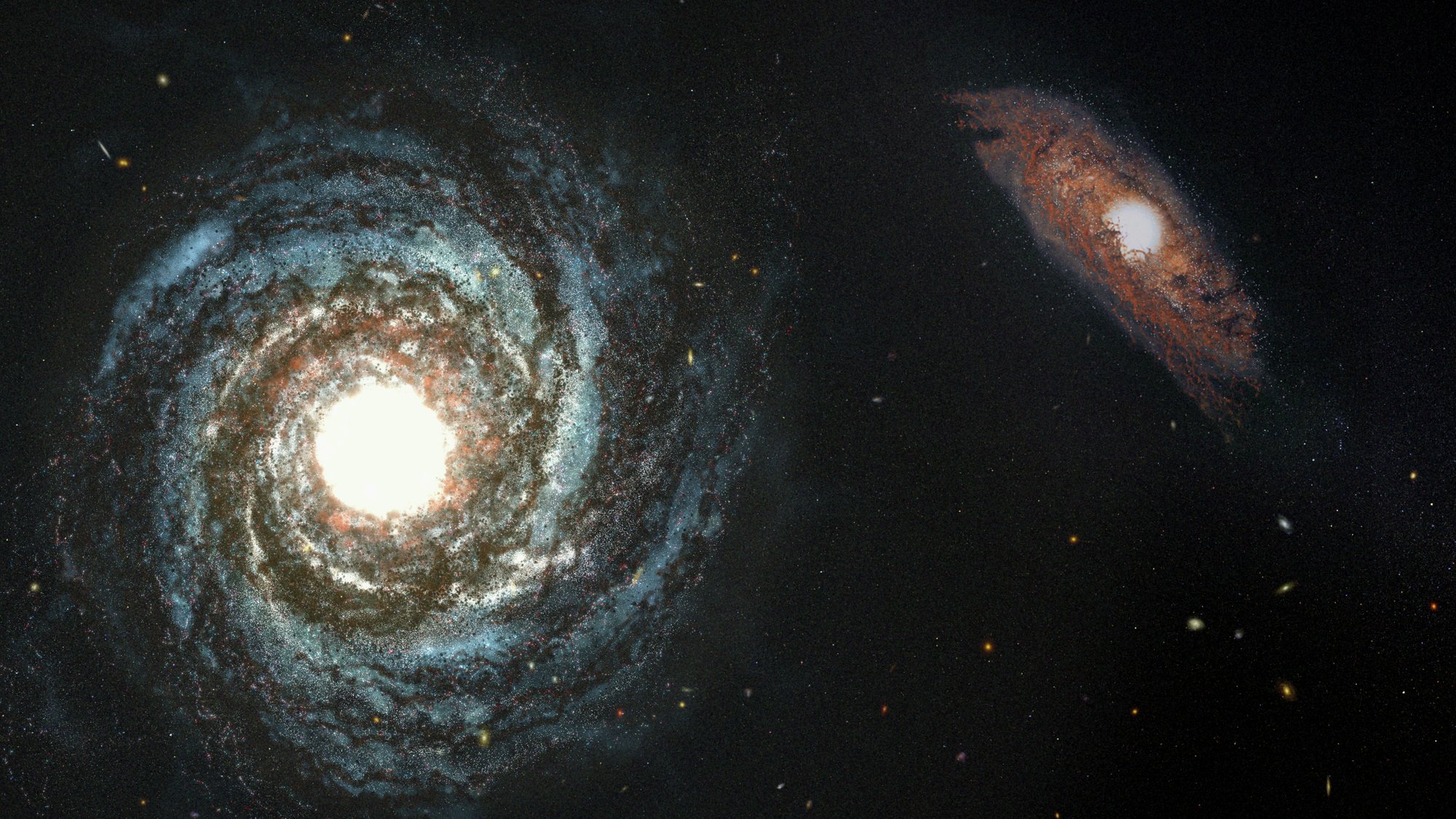
Among the brightest objects in the universe are quasars, extremely luminous galactic centers powered by accreting supermassive black holes. These systems can radiate with such intensity because huge amounts of matter are falling inward and releasing energy through the accretion process.
Active galactic nuclei, often abbreviated AGN, are galaxy centers with unusual and extreme activity, including strong radiation and distinctive spectral features. They are understood as regions where a supermassive black hole is actively feeding. Such a nucleus typically includes the black hole, an accretion disk of interstellar gas and dust, and often two jets perpendicular to the disk.
This is why black hole feeding is so important in astronomy. It does not just light up one object. It can transform the visible behavior of an entire galaxy.
How outflows affect galaxies
The effects of accretion do not stop near the event horizon. Black hole winds and jets can shape the larger galaxy around them.
Rapid accretion can produce winds that compress nearby gas. That compression can accelerate star formation. In that sense, outflows from a black hole can help ignite the birth of stars.
But the reverse can also happen. If the winds grow too strong, they can drive nearly all the gas out of the galaxy, quenching star formation instead. Without gas, the raw material for making stars is lost.
Jets can influence galaxies in another way as well. They may energise nearby cavities of plasma and eject low-entropy gas from the galactic core, making gas in galactic centers hotter than expected.
So black holes are not merely consumers. Through accretion and outflows, they can become regulators of galactic evolution.
The Eddington limit and super-Eddington feeding
There is a theoretical cap on how fast a black hole should be able to accrete. At a certain rate, the outward pressure from the emitted radiation becomes as strong as the inward pull of gravity. This threshold is called the Eddington limit.
In principle, that limit should choke off faster growth. In practice, many black holes appear able to accrete beyond it because of non-spherical geometry or instabilities in the accretion disk. This is known as super-Eddington accretion, and it may have been common in the early universe.
That matters because astronomers have found extremely bright quasars at very early cosmic times, and ordinary slow growth may not be enough to explain them.
Why black holes can look brighter than galaxies
It sounds absurd that a black hole system could outshine a galaxy full of stars, but the basic reason is straightforward: accretion releases energy with astonishing efficiency in a compact region.
A galaxy’s stars emit light through nuclear processes spread across vast distances. By contrast, a feeding black hole can release a huge amount of energy from matter packed into a tiny volume near the event horizon. The environment becomes so hot and luminous that the black hole’s immediate neighborhood can dominate the light output of the host galaxy.
That is why quasars and other active black hole systems rank among the universe’s most energetic phenomena.
A dark object with a brilliant neighborhood
Black holes themselves remain hidden behind the event horizon. Yet their surroundings can blaze across the electromagnetic spectrum, especially in X-rays, and in some cases throw jets across intergalactic distances.
That combination is what makes them so compelling. A black hole is defined by no escape, but the infalling matter around it can turn gravity into one of nature’s brightest displays. Accretion disks reveal how matter behaves under extreme conditions. Jets show how black holes can channel energy outward on scales far larger than the hole itself. And quasars prove that a single actively feeding black hole can reshape the appearance and future of a whole galaxy.
In the universe, darkness and brilliance are not always opposites. Around black holes, they are partners.
Sources
Based on information from Black hole.
More like this

Fall into a knowledge accretion disk—download DeepSwipe and let your curiosity blaze brighter than a quasar.