Full article · 8 min read
Why Some Black Holes Are Surprisingly “Low-Density”
Black holes are famous for being the ultimate symbols of compression: objects so compact that not even light can escape once it passes the event horizon, the boundary of no return. So it sounds almost absurd to say that some black holes can have an average density comparable to water.
Yet that is exactly what happens for very large black holes.
This strange result does not mean black holes are soft, watery, or somehow weak. It comes from a simple geometric fact: as a black hole’s mass increases, its radius increases too, and the volume inside that radius grows even faster. The bigger the black hole, the lower its average density can be.
The key idea: mass grows, but volume grows faster
For a nonspinning, uncharged black hole, the size of the event horizon is set by the Schwarzschild radius. That radius is proportional to the black hole’s mass. In plain language, if you make the black hole more massive, its radius gets bigger in direct proportion.
But volume does not scale the same way radius does. Volume grows with the cube of radius. So if the radius gets larger, the enclosed volume balloons much faster than the mass does. That is why the average density inside the Schwarzschild radius is inversely proportional to the square of the black hole’s mass.
This leads to one of the most counterintuitive facts in black hole physics: supermassive black holes are, on average, far less dense than stellar black holes.
A black hole with a mass of 10^8 times the mass of the Sun has an average density comparable to that of water. That is not a metaphor. It is a direct consequence of how black hole radius and volume scale with mass.
What “average density” really means here
This is where the wording matters.
When physicists talk about the average density of a black hole in this context, they mean the total mass divided by the volume inside the event horizon, using the Schwarzschild radius as the boundary. It is a mathematical average over that whole region.
That does not mean the black hole is filled with ordinary material the way a planet, star, or bucket of water is. In fact, general relativity predicts that every black hole has a central singularity, where the curvature of spacetime becomes infinite. For a non-rotating black hole, that singularity is a point; for a rotating black hole, it is a ring singularity.
So the “water-like density” fact is not about the black hole’s interior being physically similar to water. It is about how the total mass compares to the enormous volume enclosed by the horizon in very large black holes.
Bigger black holes can look “fluffier” on paper
This is why the biggest black holes can seem almost misleadingly gentle when you calculate average density.
A stellar black hole forms when a very massive star collapses at the end of its life cycle. These black holes have relatively small radii, so their mass is packed into a comparatively tiny volume. Their average density is therefore extremely high.
Supermassive black holes are different. They can have millions of solar masses, and there is broad agreement that such black holes exist in the centres of most galaxies. Because their masses are so enormous, their event horizons are also enormous. The resulting volume grows so dramatically that the average density drops.
So in one sense, the largest black holes are the least dense black holes on average.
That sounds backwards, but it follows directly from the math.
The event horizon is not a solid surface
Another reason this topic feels strange is that people often imagine a black hole as a hard, ultra-dense ball. But a black hole is defined by its event horizon, not by a physical surface like the crust of a planet.
The event horizon is a boundary in spacetime. Once matter or light crosses it, escape is impossible. To an outside observer, this horizon marks the limit beyond which no information can come back out.
Crossing the event horizon produces no locally detectable change for an infalling observer. That is one of the most unsettling predictions of general relativity. From far away, though, an object approaching the horizon appears to slow down, dim, and become more red-shifted because of gravitational time dilation and gravitational redshift.
So when people talk about the “size” of a black hole, they usually mean the size of the event horizon. That is the size used in the density calculation.
Why black holes are not cosmic vacuum cleaners
The idea that black holes pull in everything nearby is one of the most persistent myths in astronomy. The reality is more subtle.
From far away, the external gravitational field of a black hole is identical to that of any other body of the same mass. In other words, a black hole does not have magical extra pulling power just because it is a black hole.
If you replaced an object with a black hole of the same mass, distant orbits would behave the same way.
This is why black holes are not cosmic vacuum cleaners roaming the universe and swallowing everything automatically. To be captured, matter still has to get close enough and lose enough energy or angular momentum. Otherwise, it can orbit just as it would around any other massive object.
This point fits perfectly with the “low-density giant black hole” idea. A supermassive black hole may have a vast event horizon and a low average density, but from far away its gravity still depends on its mass, not on some special sucking property.
Accretion disks: why black holes can be surrounded by brilliant light
If black holes do not emit light themselves, why are they sometimes associated with some of the brightest objects in the universe?
The answer is the material around them.
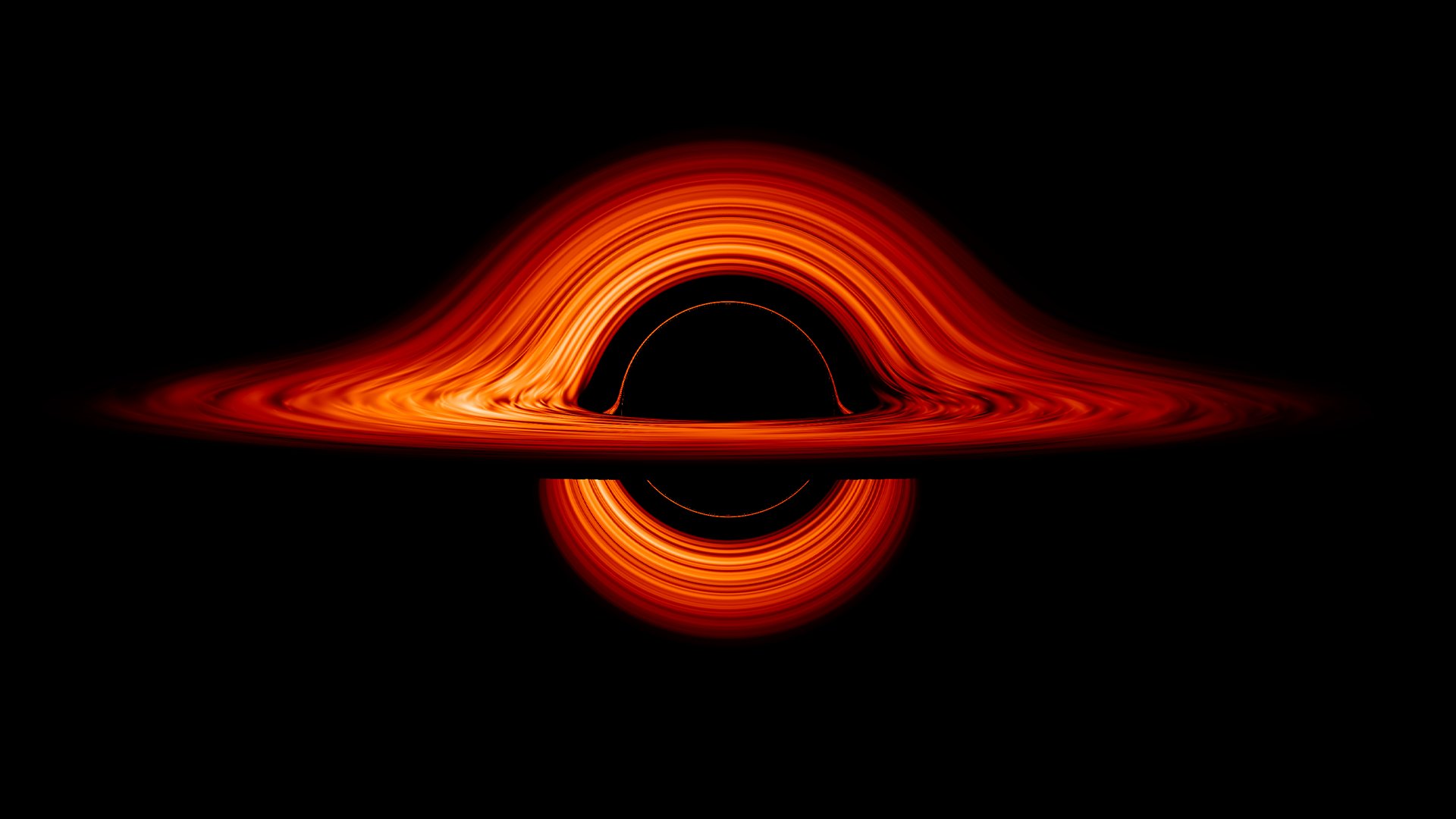
Matter falling toward a black hole often forms an accretion disk, a disk-like structure of infalling plasma. Plasma is a hot, ionized state of matter in which electrons are no longer bound to atoms. Friction and internal processes in the disk heat this material intensely, causing it to emit light, especially X-rays.
In extreme cases, this process powers quasars, which are among the brightest known objects in the universe. Black holes can also launch relativistic jets, narrow streams of plasma moving at more than one-tenth the speed of light.
So the black hole itself remains dark, but its surroundings can blaze.
Supermassive black holes and galaxy centres
The most massive black holes are found in galactic centres. There is consensus that supermassive black holes exist in the centres of most galaxies, including the Milky Way.
At the centre of our galaxy lies Sagittarius A*, a compact radio source that has been shown to contain a supermassive black hole of about 4.3 million solar masses. Astronomers inferred this by tracking stars orbiting an invisible object in a very small region of space. Those stellar motions provide strong evidence for a concentrated, massive object.
The Event Horizon Telescope later released an image of Sagittarius A*, adding further confirmation.
Another famous image came in 2019, when the Event Horizon Telescope published the first direct image of a black hole and its vicinity, showing the supermassive black hole in the centre of Messier 87.
These observations helped turn black holes from theoretical predictions into directly studied astronomical objects.
A history of a once-radical idea
The concept behind black holes is older than many people realize. In the late 18th century, John Michell and Pierre-Simon Laplace both considered the possibility of stars so massive that light could not escape.
But modern black holes arise from general relativity. In 1915, Albert Einstein completed the theory, describing gravity as the curvature of spacetime. Soon after, Karl Schwarzschild found the first solution that would later be understood as describing a black hole.
For decades, black holes were treated more as mathematical curiosities than physical realities. That changed in the mid-20th century, especially after work by Oppenheimer and Snyder on gravitational collapse and later clarification by David Finkelstein, who identified the Schwarzschild surface as an event horizon.
By the 1960s and 1970s, black hole research entered a golden age. Theoretical advances, astronomical discoveries such as pulsars, and the acceptance of Cygnus X-1 as a black hole candidate helped establish black holes as real features of the universe.
The odd lesson of black hole density
Black holes are still extreme objects. Their gravity traps light. Their event horizons seal off the inside from the outside. General relativity predicts singularities at their centres. None of that becomes less dramatic just because a giant black hole can have a low average density.
In fact, that contrast is what makes the idea so memorable.
The bigger the black hole, the larger the event horizon. The larger the horizon, the larger the enclosed volume. And because that volume grows faster than mass, the average density falls as black holes get more massive.
So yes: one of the universe’s most fearsome objects can, in a perfectly valid average sense, be “as dense as water.”
That is not a loophole or a trick. It is one of the clearest examples of how black holes defy everyday intuition while still obeying elegant physical rules.
Sources
Based on information from Black hole.
More like this
Dive past the event horizon of boring scrolling — download DeepSwipe and let your brain orbit bigger ideas every day.