Full article · 7 min read
Milky Way Satellites That Don’t Behave
The Milky Way is not alone. It is surrounded by smaller companion galaxies, called satellite galaxies, that orbit our galaxy as part of its local neighborhood. But these satellites do not seem to behave in the simple, scattered way astronomers expected.
One of the strangest findings is that many of the Milky Way’s satellite galaxies appear to lie in a very large disk and orbit in the same direction. That is surprising because, under standard cosmology, satellite galaxies should form in dark matter halos and be more widely distributed, moving in random directions. Instead, the arrangement around the Milky Way looks unusually tidy.
That unexplained pattern has made the satellites of our galaxy especially interesting. Rather than being minor background objects, they may hold clues to how the Milky Way formed, how it interacts with nearby galaxies, and why its outer regions look the way they do.
What counts as a Milky Way satellite?
A satellite galaxy is a smaller galaxy gravitationally bound to a larger one. In the Milky Way’s case, these companions include the Large Magellanic Cloud and the Small Magellanic Cloud, along with a number of dwarf galaxies.
Some of the dwarf galaxies orbiting the Milky Way include the Sagittarius Dwarf Elliptical Galaxy, Ursa Minor Dwarf, Sculptor Dwarf, Sextans Dwarf, Fornax Dwarf, and Leo I Dwarf. The smallest dwarf galaxies of the Milky Way are only about 500 light-years in diameter, including Carina Dwarf, Draco Dwarf, and Leo II Dwarf. There may also be more satellites still waiting to be found: the detection of nine new satellites in a relatively small patch of sky in 2015 supported the idea that some Milky Way companions remain undetected.
The Milky Way has also absorbed some dwarf galaxies in the past. One example is the progenitor of Omega Centauri. That means the population of satellites is not fixed. Some remain in orbit, some are being pulled apart, and some have already been incorporated into the galaxy.
The surprising satellite disk
In 2005, with further confirmation in 2012, researchers reported that most satellite galaxies of the Milky Way lie in a very large disk and orbit in the same direction. This was unexpected.
To understand why, it helps to unpack a few terms. Standard cosmology is the leading framework astronomers use to describe how structure forms in the universe. In that picture, galaxies like the Milky Way sit inside dark matter halos, which are large regions dominated by unseen matter that interacts through gravity. If satellite galaxies formed and assembled in the usual way within such a halo, astronomers expected them to be distributed more broadly and to move in many different directions.
But the Milky Way’s satellites do not appear to follow that expectation. Their shared alignment and common orbital direction suggest a much more organized structure than predicted. The article notes plainly that this discrepancy is still not explained.
That makes the satellite disk especially compelling. When observations and theory do not line up, astronomers pay attention. The mismatch could point to missing details in our picture of how satellite systems form, or to a more eventful history for the Milky Way itself.
The Magellanic Clouds are not quiet neighbors
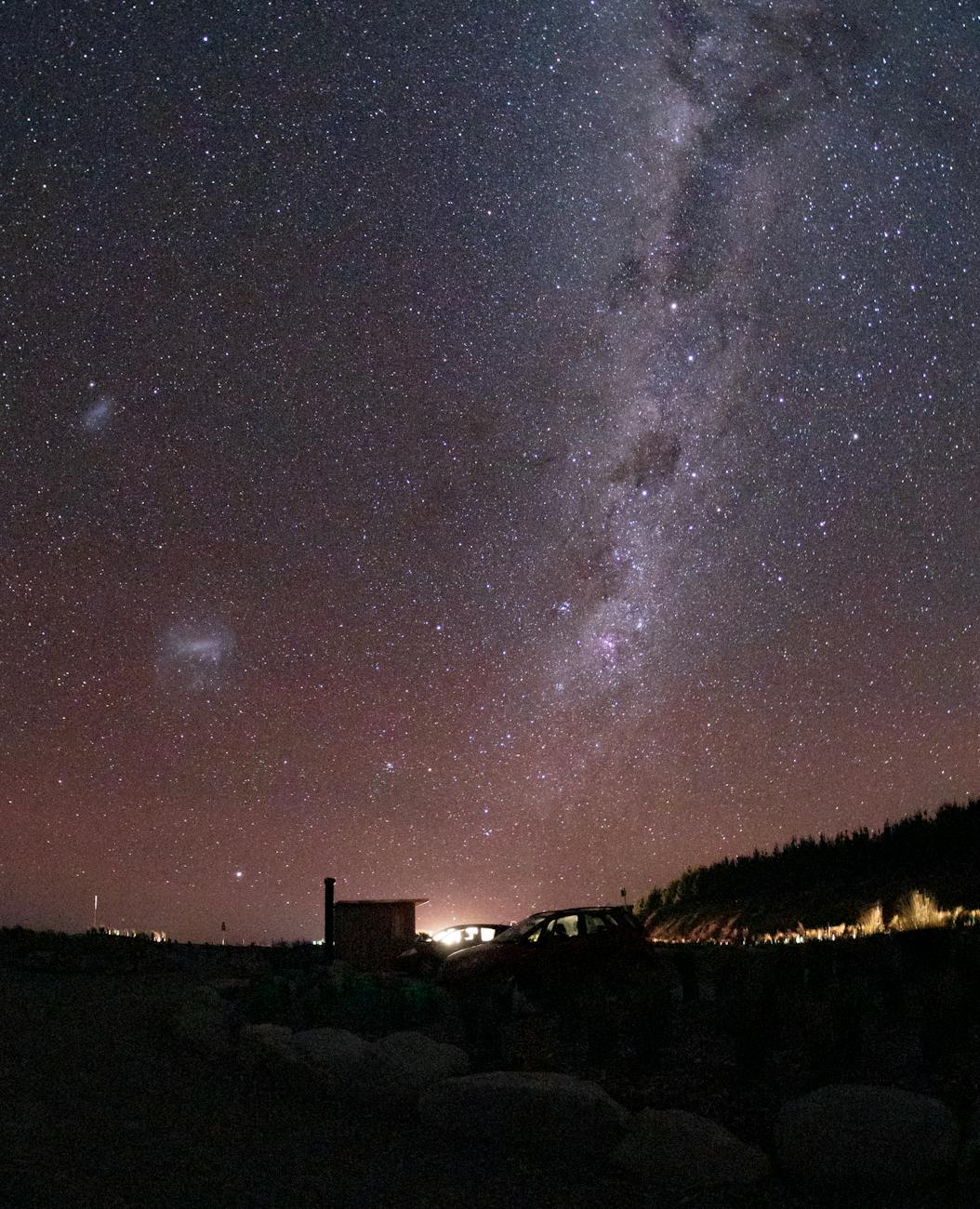
Two of the Milky Way’s best-known satellites are the Large Magellanic Cloud and the Small Magellanic Cloud. The Large Magellanic Cloud is the largest of the Milky Way’s smaller companions, with a diameter of 32,200 light-years, and it has a close companion in the Small Magellanic Cloud.
These galaxies are not just passive objects orbiting at the edges. They are connected to the Milky Way through the Magellanic Stream, a stream of neutral hydrogen gas extending from the Magellanic Clouds across 100 degrees of the sky. This stream is thought to have been dragged from the Clouds during tidal interactions with the Milky Way.
Their gravitational influence may also help explain why the Milky Way’s disk is warped. A warp is a bend or ripple in the galactic disk rather than a perfectly flat shape. In January 2006, researchers reported that the previously unexplained warp in the Milky Way’s disk had been mapped and found to be a ripple or vibration set up by the Large and Small Magellanic Clouds as they orbit the Milky Way, causing vibrations when they pass through its edges.
That finding changed the picture of these companions. Earlier, the Clouds were considered too small to have much effect, at around 2% of the mass of the Milky Way. But their motion appears capable of disturbing the larger galaxy after all.
The role of the dark matter wake
Why would relatively small companion galaxies have such a noticeable impact on a much bigger galaxy? Computer modeling offered an answer: a dark matter wake.
Dark matter is the invisible matter inferred from gravity. It cannot be seen directly with electromagnetic radiation, but it contributes mass and shapes how galaxies move. A wake, in this context, is a trailing concentration left behind a moving object, somewhat like a boat leaving disturbed water behind it.
In the computer model described in the article, the movement of the Large and Small Magellanic Clouds creates a dark matter wake that amplifies their influence on the Milky Way. In other words, the galaxies themselves are not acting alone. Their passage stirs the surrounding dark matter, and that extra gravitational response boosts the effect on the Milky Way’s disk.
This idea helps connect several pieces at once: the Magellanic Clouds, the warp in the disk, and the unseen dark matter halo surrounding the galaxy. It also shows how the outskirts of the Milky Way can be reshaped not only by stars and gas, but by structures we cannot observe directly.
A galaxy with a messy outer history
The Milky Way’s outer regions already show signs that interactions matter. Its disk is warped along an S curve. Astronomers have also found structures and debris linked to interactions with smaller galaxies, including the Sagittarius Dwarf Elliptical Galaxy and a ribbon of galactic debris produced as that dwarf is torn apart by its interaction with the Milky Way.
There is also continuing debate about some large outer structures. The Monoceros Ring, for example, has been described as a ring of gas and stars torn from other galaxies billions of years ago, though other researchers have argued it is instead an overdensity produced by the flared and warped thick disk of the Milky Way. Either way, the outskirts of the galaxy are not simple or static.
This broader context matters for the satellite puzzle. If the Milky Way has grown through mergers and accretion, and if nearby galaxies can warp its disk and leave behind streams of gas or stellar debris, then the present-day layout of its satellites may preserve evidence of that complicated history.
Why this remains a real mystery
The striking part is not just that the Milky Way has satellites. Many galaxies do. The mystery is that the Milky Way’s satellites seem arranged in a way that standard expectations did not predict.
Astronomers expected a wider distribution and more random orbital directions. Instead, many of the satellites lie in a single vast disk and move the same way. At the same time, two of the most prominent satellites, the Magellanic Clouds, appear able to shake the Milky Way’s disk and raise a warp, especially if a dark matter wake amplifies their pull.
So the Milky Way’s companions are doing two unusual things at once. Their overall alignment is unexpectedly orderly, and some of them may be dynamically important enough to reshape the galaxy itself.
That is why the final question remains so intriguing: why the tidy lineup? Right now, it is still unexplained. And in astronomy, an unexplained pattern is often where the most interesting discoveries begin.
The bigger picture
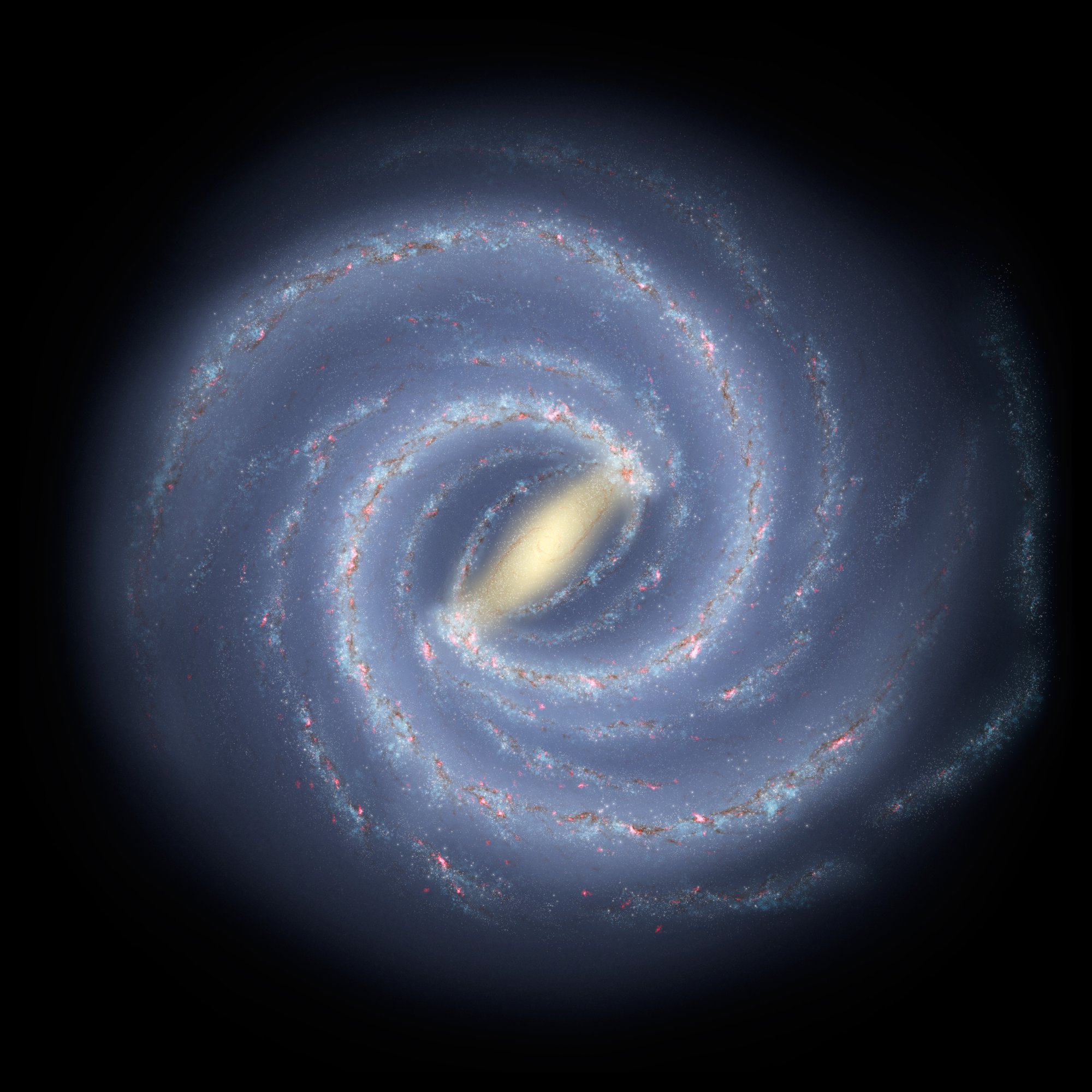
The Milky Way is a barred spiral galaxy that includes the Solar System, and it has several satellite galaxies as part of the Local Group. Those companions are not just decorative neighbors. They may be active participants in the story of our galaxy.
Their strange alignment challenges expectations. Their gravitational interactions may ripple through the galactic disk. And their motions, gas streams, and debris hint that the Milky Way’s past may have involved more disturbance and complexity than a clean textbook diagram suggests.
Sometimes the best way to learn about a giant system is to study the smaller objects circling it. In the Milky Way’s case, those small companions may be revealing that our galaxy is still carrying the marks of interactions, accretion, and mysteries not yet solved.
Sources
Based on information from Milky Way.
More like this
Catch cosmic clues one swipe at a time—download DeepSwipe and explore the Milky Way’s weirdest neighbors.