Full article · 8 min read
The Sun: The Star That Truly Runs the Solar System
The Sun can feel so familiar that it is easy to overlook just how extreme it really is. It is not just a bright object in the sky. It is the star at the centre of the Solar System, and it contains about 99.86% of the Solar System’s total mass. That means nearly everything else in our planetary neighbourhood is, in a gravitational sense, the leftovers orbiting the main event.
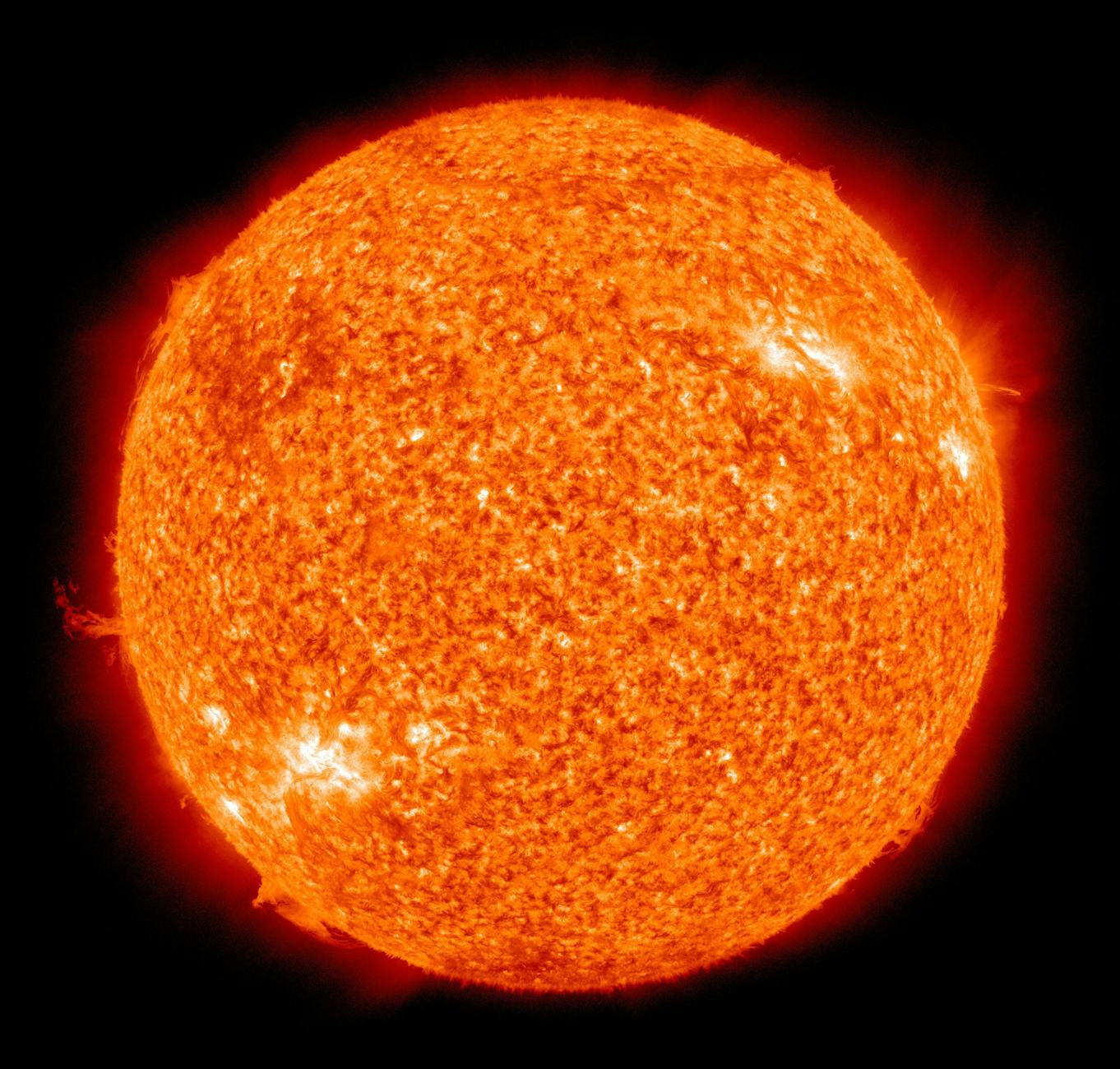
From Earth, the Sun may seem like a smooth glowing disk. In reality, it is a vast sphere of hot plasma, a state of matter in which atoms are broken apart into charged particles. Deep in its core, nuclear fusion powers this enormous object by turning hydrogen into helium and releasing energy. That energy eventually streams away from the Sun mainly as visible light and infrared radiation, with about 10% at ultraviolet energies.
For life on Earth, this is everything. The Sun is the main source of energy for life, supports photosynthesis, allows vision in animals, and drives climate and weather.
Why the Sun matters so much
The Sun dominates the Solar System in both mass and influence. Its diameter is about 1,391,400 kilometres, making it about 109 times wider than Earth. Its mass is around 330,000 times that of Earth. Even at an average distance of about 149.6 million kilometres away, it still completely controls Earth’s orbit and defines the scale of the Solar System.
That average Earth–Sun distance became so important that astronomers turned it into a standard unit: the astronomical unit, or au. Light itself takes about 8 minutes and 20 seconds to travel from the Sun to Earth.
The Sun is also astonishingly bright. It is by far the brightest object in Earth’s sky. At the distance of Earth’s orbit, the solar constant — the amount of solar power falling on a directly exposed area at the top of Earth’s atmosphere — is approximately 1,368 watts per square metre. By the time sunlight reaches Earth’s surface, the atmosphere reduces that amount, often to something closer to 1,000 watts per square metre in clear conditions when the Sun is high in the sky.
A giant sphere of plasma, not solid fire
Calling the Sun a “ball of fire” is common, but not quite right. The Sun is made of plasma, not ordinary flame. Plasma is a superheated state in which matter is so energetic that electrons are no longer bound normally to atoms.
The Sun’s visible surface layer, called the photosphere, is made mostly of hydrogen and helium. In the photosphere, hydrogen makes up roughly 73% of the mass and helium about 25%, while heavier elements such as oxygen, carbon, neon, and iron make up only a small fraction.
Even though the Sun looks like it has a neat edge, it does not have a hard solid boundary. Its density drops off with height, and the “surface” people usually mean is simply the photosphere, the layer from which visible light escapes.
Remarkably, the Sun is almost a perfect sphere. Measurements show its oblateness — the tiny difference between its equatorial radius and polar radius — is only about 8.2 parts per million. That makes it the natural object closest to a perfect sphere ever observed.
Where the Sun’s power comes from
At the centre of the Sun is the core, extending to about 20–25% of the solar radius. This is where fusion happens. Temperatures there are close to 15.7 million kelvin, and densities can reach about 150 times the density of liquid water.
In the core, the main energy source is the proton–proton chain, a set of fusion reactions that converts hydrogen into helium. Every second, the Sun’s core fuses about 600 billion kilograms of hydrogen into helium and converts about 4 billion kilograms of matter into energy.
That sounds almost impossible, but it follows the famous mass–energy relation: a small amount of mass can become a huge amount of energy. The Sun’s total power output is about 3.846 × 10^26 watts.
What is especially interesting is that the Sun is stable. Fusion in the core regulates itself. If the fusion rate rises a bit, the core heats and expands slightly, reducing density and slowing fusion back down. If fusion slows, the core contracts a little, density rises, and fusion speeds up again. This balance is a major reason the Sun stays relatively steady over immense timescales.
Why sunlight takes so long to get out
You might think energy made in the Sun’s core reaches space almost instantly. It does not. The core’s energy first moves through the radiative zone, where photons repeatedly scatter off dense matter. A photon can take around a million years to cross this region.
Above that lies the convection zone, where hot plasma rises, cools, and sinks in a churning cycle that carries energy upward. This motion creates the Sun’s granular surface appearance, called solar granulation.
Only when energy reaches the photosphere can it escape as sunlight. So while light takes just over 8 minutes to travel from the Sun to Earth, the energy behind that light may have spent an extraordinarily long time working its way outward from the core.
The kinds of light the Sun sends us
Sunlight is not just visible light. At the top of Earth’s atmosphere, solar energy is made up of about 50% infrared, 40% visible light, and 10% ultraviolet.
Infrared radiation is associated with heat. Visible light is the part human eyes can detect. Ultraviolet radiation has shorter wavelengths and higher energy; Earth’s atmosphere filters out more than 70% of solar ultraviolet, especially at shorter wavelengths.
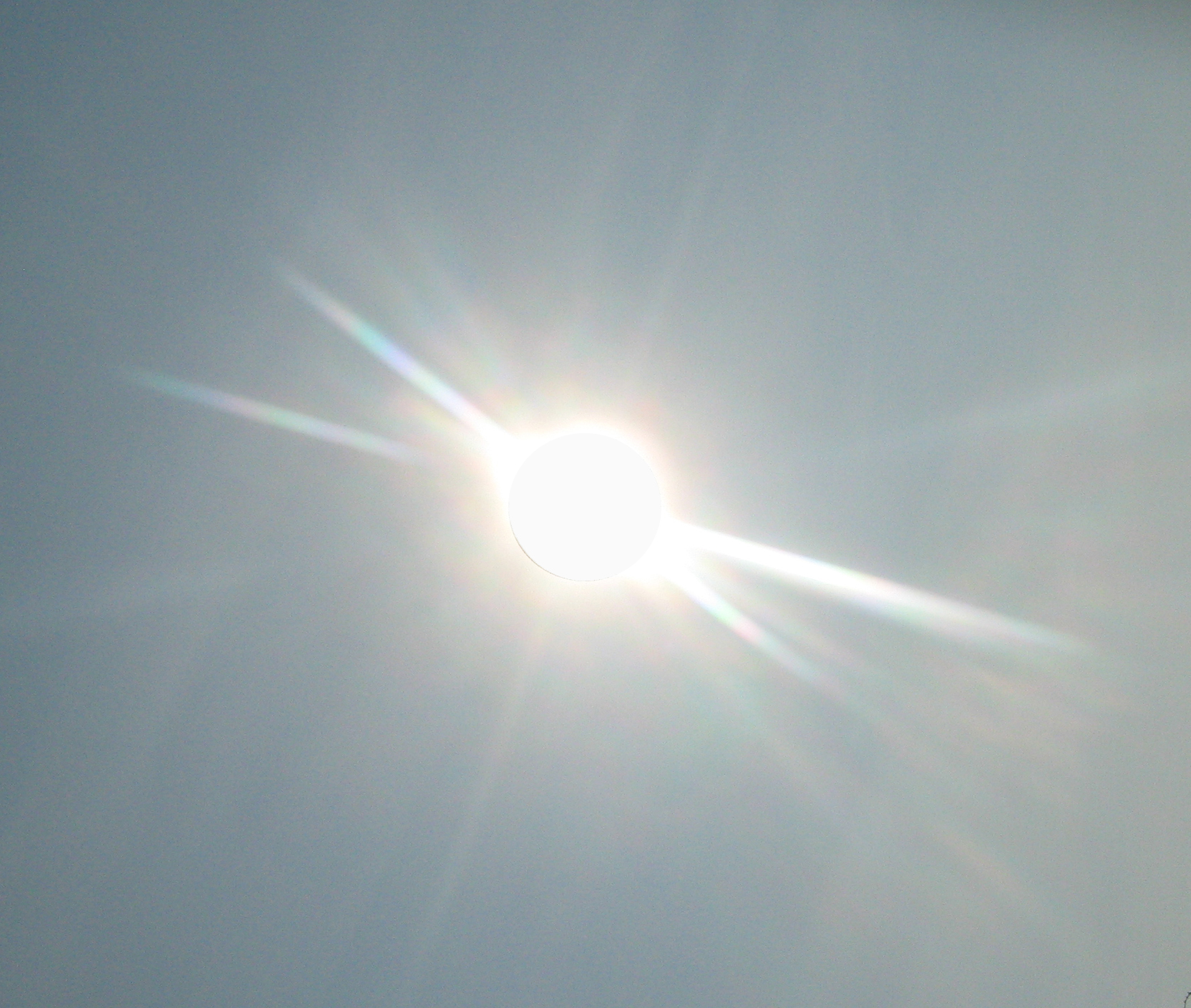
From space, the Sun’s colour is white. When it appears yellow, orange, or red from Earth, that is mainly because the atmosphere scatters light differently depending on the Sun’s position in the sky. When the Sun is low on the horizon, the shorter wavelengths are scattered more strongly, leaving the warmer colours more prominent.
The Sun is huge — but distance still matters
Despite its enormous size, the Sun is far enough away that it fits comfortably into our sky as a disk. Its mean distance from Earth is about 149.6 million kilometres. That distance varies slightly over the year as Earth moves in its orbit.
This combination of immense size and enormous distance creates a useful perspective: the Sun is gigantic beyond ordinary human intuition, yet still only one star among many. It is estimated to be brighter than about 85% of stars in the Milky Way, most of which are red dwarfs.
The Sun is classified as a G-type main-sequence star, more specifically G2V. “Main-sequence” means it is currently in the long, stable phase of a star’s life in which hydrogen fusion in the core provides the primary energy source.
Rotation, motion, and domination
The Sun is not standing still. It rotates, but not as a rigid object. Because it is made of plasma, different latitudes rotate at different rates. The equator rotates in about 25.6 days, while the poles take about 33.5 days. From Earth, the apparent equatorial rotation period is about 28 days.
The Sun also moves through the galaxy. It orbits the centre of the Milky Way at an average speed of about 230 km/s, taking roughly 220 to 250 million Earth years to complete one galactic orbit.
Within the Solar System, though, it remains overwhelmingly dominant. The Sun has eight known planets orbiting it, along with dwarf planets, asteroids, comets, and many icy bodies beyond Neptune. Its gravitational field is estimated to dominate surrounding stars out to about two light-years.
The Sun and life on Earth
The episode is right to frame the Sun as the power source for life. Energy from the Sun supports photosynthesis, and photosynthesis in turn underpins food webs across Earth. Sunlight also enables vision in animals and powers Earth’s climate system.
Without the Sun’s steady outpouring of light and heat, Earth would not be the world we know. The atmosphere absorbs and filters parts of solar radiation, especially ultraviolet, and this filtering helps shape conditions on the planet’s surface.
The Sun’s energy also has biological effects. Ultraviolet radiation can cause sunburn and is the main cause of skin cancer, but it also contributes to vitamin D production. The same radiation has antiseptic properties and can be used to sanitise tools and water.
A familiar star with an extraordinary story
The Sun formed about 4.6 billion years ago from the collapse of matter within a giant molecular cloud. Most of that matter gathered in the centre, while the rest flattened into a disk that later became the Solar System. Once the central region became hot and dense enough, nuclear fusion began.
Today, the Sun is roughly halfway through the main-sequence part of its life. It has remained relatively stable for billions of years and is expected to stay fairly stable for about five billion more.
Even so, it is slowly changing. Since the beginning of its main-sequence life, the Sun has expanded in radius by 15%, its surface temperature has risen from 5,620 K to 5,772 K, and its luminosity has increased by 48%.
So the Sun is not just the centre of the Solar System in space. It is also the centre of its history: the object from which the planets formed, the source of the energy that powers Earth, and the massive star around which almost everything else moves.
The most amazing part may be this: the most important object in our skies is also the one we are most likely to take for granted. It feels ordinary only because it is always there.
Sources
Based on information from Sun.
More like this
Turn your daily scroll into a solar upgrade — download DeepSwipe and orbit smarter knowledge every day.