Full article · 8 min read
Visual Arts: How Painting Reinvented Itself
Painting has reinvented itself again and again across human history. What makes it so fascinating is that it never stayed fixed for long. It began with images deep inside caves, later became a tool for creating the illusion of three-dimensional space, then loosened into shimmering impressions of modern life, and eventually shattered its own visual rules through emotion, symbolism, and abstraction.
Among the visual arts, painting has often held a special status. In both Western art and East Asian art, it was often treated as one of the highest forms of artistic expression, partly because it was seen as relying strongly on the imagination of the artist. Over time, painters kept finding new ways to use that imaginative freedom.
Painting Began in the Dark
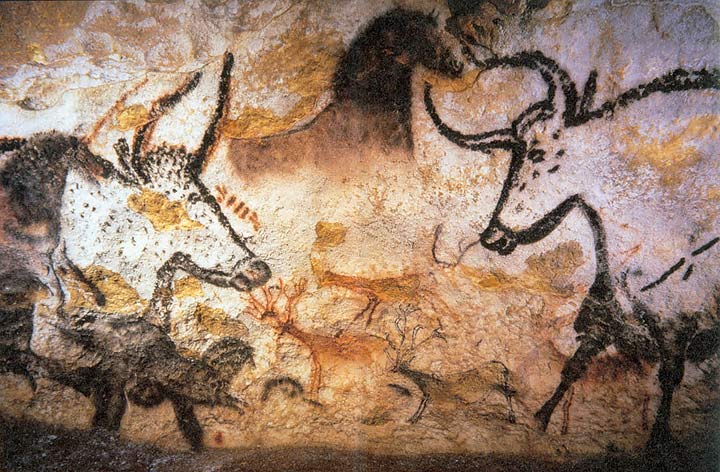
The story of painting stretches back to prehistoric caves and rock faces. The earliest known cave paintings date to between 32,000 and 30,000 years ago, including those in the Chauvet cave in southern France. Later celebrated murals at Lascaux, dating to around 17,000 to 15,500 years ago, show animals painted in red, brown, yellow, and black. Bison, cattle, horses, and deer appear across walls and ceilings, proving that painting started not in galleries or studios, but in hidden spaces lit only by ancient hands.
This early painting tradition was closely linked with drawing. Drawing and painting both reach back tens of thousands of years, and even older non-figurative cave images included hand stencils and simple geometric shapes. Figurative art means art that represents recognizable subjects, such as animals or people, rather than purely abstract patterns.
As civilizations developed, painting moved into new materials and settings. In ancient Egypt, paintings of human figures appeared in tombs, and ink drawings on papyrus were used as models for painting or sculpture. In the great temple of Ramesses II, Nefertari is shown being led by Isis, illustrating how painting could also carry spiritual or religious meaning. Greek painting influenced later traditions, though much of it has been lost. Surviving works such as the Fayum mummy portraits and the mosaic of the Battle of Issus at Pompeii help show the importance of painting in the ancient world.
Painting was never only about recording what people saw. It also expressed spiritual motifs and ideas, from mythological scenes on pottery to monumental religious works like those associated with chapel painting.
The Renaissance Turned Paint Into Illusion
A major reinvention came during the Renaissance in Europe. From Giotto in the 13th century to Leonardo da Vinci and Raphael in the early 16th century, Italian painters transformed what painting could do. Their work pursued a more convincing sense of space and form, making flat surfaces feel almost sculptural.
A key technique here was chiaroscuro. This term refers to the use of strong contrasts between light and shadow to create the illusion of solid, three-dimensional forms. Instead of figures looking flat, chiaroscuro made them appear to occupy space. It was one of the great breakthroughs in painting’s visual language.
This period became one of the richest in Italian art. It followed the era when monks had produced illuminated manuscripts during the Middle Ages, and it marked a new level of prestige for painting in Europe.
At the same time, painters in northern Europe developed their own powerful innovations. Artists such as Jan van Eyck, Pieter Bruegel the Elder, and Hans Holbein the Younger were influenced by the Italian school, but they also excelled in the glazing technique with oils. Glazing means applying thin layers of oil paint to build up depth and luminosity. Luminosity is the sense of glowing light within the image. The result was remarkable richness, with colors that seemed to shine from within.
So painting had changed again: from symbolic and ancient wall imagery into a sophisticated illusion machine capable of depth, glow, and dramatic realism.
Drama, Light, and the Power of the Painted Scene
After the Renaissance came another shift. The Baroque period, from the late 16th century to the late 17th century, pushed painting toward drama. Main Baroque artists included Caravaggio, Peter Paul Rubens, and Annibale Carracci.
Caravaggio became known for heavy use of tenebrism. Tenebrism is a style of dramatic lighting in which dark areas dominate the image and strongly illuminated parts stand out with intense force. It is related to the broader Baroque taste for theatrical visual impact.
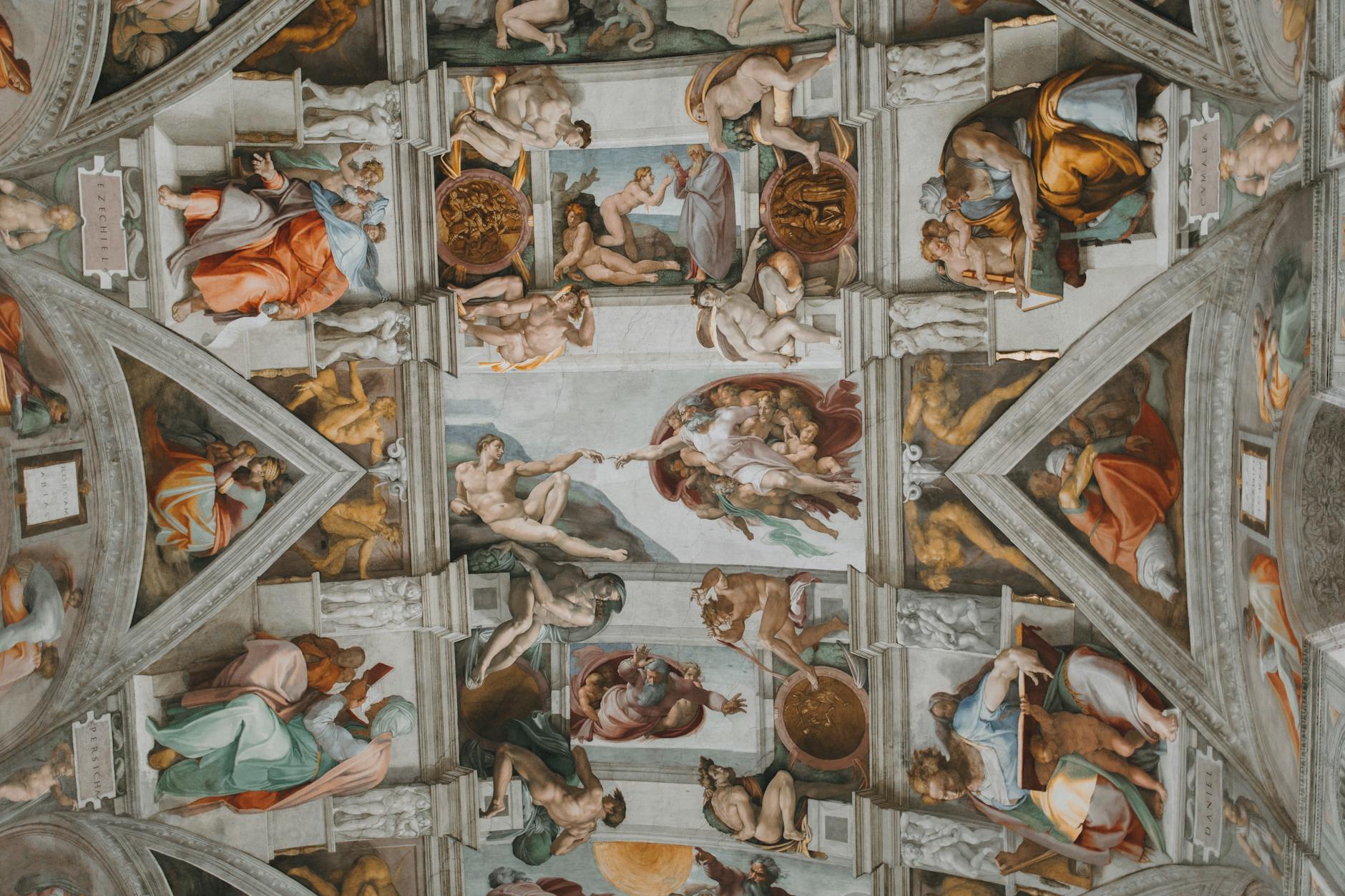
Rubens worked for local churches in Antwerp and also painted a series for Marie de' Medici. Carracci drew influence from the Sistine Chapel and helped develop illusionistic ceiling painting, a form that makes painted ceilings appear to open up into imagined spaces above. Much of Baroque development was tied to the Protestant Reformation and Counter Reformation, and this historical pressure helped shape its dramatic overall visuals.
Painting was no longer just trying to imitate the visible world. It was learning to stage emotion through light itself.
Impressionism Changed What Reality Looked Like
In 19th-century France, painting reinvented itself yet again through Impressionism. This movement included Claude Monet, Pierre-Auguste Renoir, and Paul Cézanne. Instead of prioritizing polished detail, these painters adopted a freely brushed style and often chose scenes of modern life outside the studio.
Their method was radical for its time. They used pure, unmixed colors and short brush strokes to create intense color vibration. Rather than carefully finishing every surface, they aimed for the impression of reality. That phrase captures the heart of Impressionism: not a precise inventory of details, but the feeling of a moment as seen by the eye.
This also changed what counted as important in painting. Attention to detail became less central, while the artist’s own perception of landscapes, nature, and everyday life became more important. Painting became dynamic, adjusting to new techniques and new ways of seeing.
In other words, painting stopped pretending that reality was stable and fully knowable. It began to suggest that what we see is fleeting, shifting, and personal.
Post-Impressionists Broke the Rules on Purpose
Toward the end of the 19th century, several younger painters took Impressionism further. These post-impressionists kept the spirit of innovation but pushed beyond surface impressions toward emotion and symbolism.
They used geometric forms and unnatural color to depict feelings and deeper meanings. Paul Gauguin was strongly influenced by Asian, African, and Japanese art. Vincent van Gogh, a Dutchman who moved to France, drew on the strong sunlight of the south. Toulouse-Lautrec became known for vivid paintings of nightlife in the Paris district of Montmartre.
This was another reinvention of painting’s purpose. Color no longer had to match the visible world. Shapes no longer had to behave naturally. A painting could distort reality in order to say something emotionally or symbolically true.
Symbolism and expressionism took that freedom even further. Edvard Munch developed a symbolistic approach at the end of the 19th century. His most famous work, The Scream from 1893, is widely interpreted as expressing the universal anxiety of modern man. Inspired in part by the French impressionist Manet, Munch helped open the way for the German expressionist movement.
Expressionist artists such as Ernst Kirschner and Erich Heckel distorted reality for emotional effect. That phrase is crucial: distorted reality. Painting no longer had to reassure viewers with familiar appearances. It could unsettle them instead.
Cubism Reassembled the World
Then came one of painting’s boldest breaks with tradition: Cubism. Developed in France, this style focused on the volume and space of sharp structures within a composition. Pablo Picasso and Georges Braque were its leading figures.
Cubist painters broke objects apart, analyzed them, and reassembled them in abstracted form. To abstract something means to simplify, reshape, or reorganize it so that it no longer appears exactly as it does in ordinary vision. Rather than showing one fixed viewpoint, Cubism challenged the whole idea that painting should imitate what the eye sees in a single glance.
This was painting questioning its own foundations. If Renaissance art had asked how to make a flat surface look like real space, Cubism asked whether that goal was even necessary. By the 1920s, this path developed into surrealism with Dali and Magritte, showing how one visual revolution could trigger another.
Why Painting Keeps Reinventing Itself
Painting’s history is not a straight line toward perfection. It is a series of reinventions. Cave painters filled dark walls with animal forms. Renaissance artists created the illusion of 3-D space through chiaroscuro. Northern European painters used oil glazing to achieve depth and glow. Impressionists replaced precision with perception. Post-impressionists used unnatural color and geometry to reach emotion and symbolism. Expressionists distorted reality, and Cubists broke it into pieces and rebuilt it.
That restless change is part of why painting remains so compelling within the visual arts. Again and again, painters have asked the same basic question in new ways: what can an image do? The answers have included spiritual meaning, dramatic lighting, realistic illusion, fleeting sensory experience, emotional distortion, and abstract structure.
Painting did not just evolve. It kept rewriting its own rules.
Sources
Based on information from Visual arts.
More like this
See how ideas transform like great paintings do — download DeepSwipe and swipe through your next art-fueled obsession.


