Full article · 7 min read
The World’s Longest Art Tradition: Aboriginal Rock Art
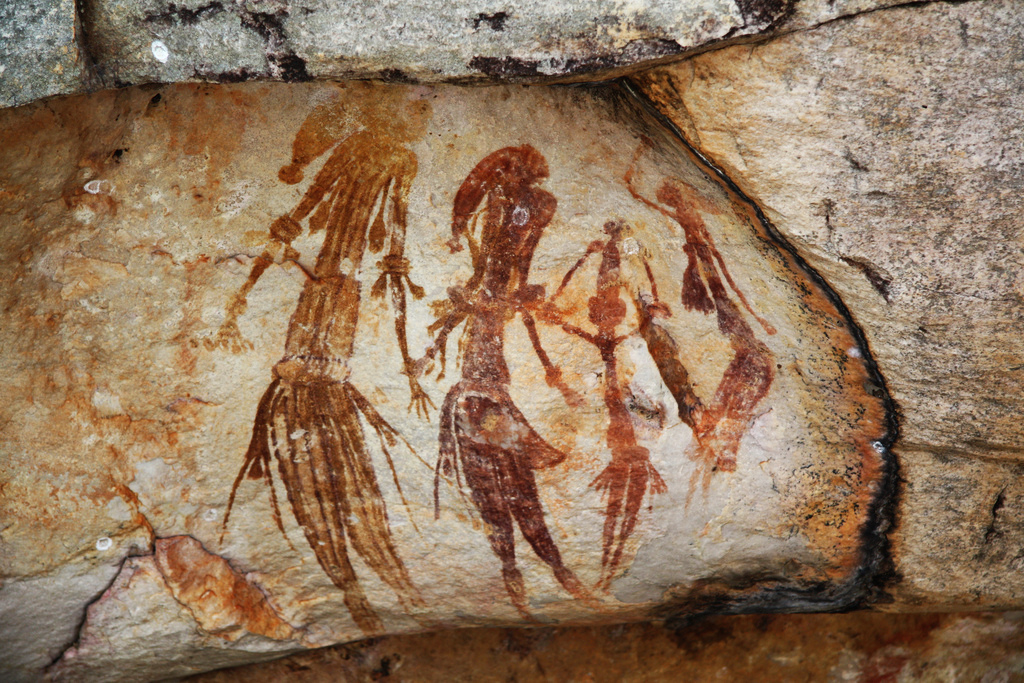
Aboriginal Australian rock art is extraordinary not just because it is ancient, but because it is continuous. It is described as the longest continuously practiced artistic tradition in the world, stretching back as far as 60,000 years. That span is almost hard to imagine: while empires rose and fell elsewhere, people in Australia continued marking stone, passing down visual knowledge across immense stretches of time.
This tradition survives across hundreds of thousands of sites, making the Australian landscape one of the great art archives on Earth. These are not just old images on rock walls. They are part of a living cultural practice tied to memory, meaning, place, and survival.
What rock art is, and why it matters
Rock art refers to images made on rock surfaces. In Oceania, petroglyphs, painting, wood carving, stone carving, tattooing, and textile work all appear as important art forms, but Aboriginal Australian rock art stands apart for its age and continuity.
These works were created by Indigenous Australians, the original inhabitants of the Australian continent and nearby islands. Their ancestors arrived in Australia around 50,000 years ago, and some rock paintings are dated as far back as 60,000 years. Because many early Oceanian peoples did not use writing systems, visual art carried a special weight. It could preserve stories, beliefs, and practical knowledge in ways that were memorable and communal.
That helps explain why rock art was never only decorative. It could hold meaning that was spiritual, social, and practical all at once.
Why paint the rocks?
The purposes of Aboriginal rock paintings were varied. Some were used in magic, meaning rituals believed to influence the world. In this context, images could be tied to hopes for success in hunting or to the idea of increasing animal populations. Other paintings were connected to amusement. That range is striking: the art could be sacred, useful, playful, or all three together.
The idea that paintings might help increase animal numbers for hunting shows how closely art and daily life could be linked. In many early societies, there was no sharp divide between religion, storytelling, survival, and creativity. A painted rock surface could be a place where imagination and necessity met.
This also helps modern viewers avoid a common mistake: thinking of ancient art as primitive decoration. These images could be tools of memory, ritual, and community life.
A tradition spread across an entire continent
One of the most remarkable facts about Aboriginal rock art is its sheer scale. It is spread across hundreds of thousands of sites. That means this is not the product of one community, one period, or one isolated burst of creativity. It is a continent-wide artistic inheritance.
Australia itself is vast, and its environments are highly varied, from tropical rainforests in the northeast to mountain ranges and immense arid regions known as the outback. Across this huge landmass, Indigenous communities developed and maintained artistic traditions over tens of thousands of years.
The continuity matters as much as the age. Many ancient artworks around the world survive only as relics of disappeared practices. Aboriginal rock art is different because it belongs to a tradition that has continued to be practiced. That makes it not merely old, but enduring.
Art before writing
Across Oceania, many early peoples created rich artistic traditions without a writing system. Because works were often made on perishable materials, much has been lost. Stone and rock, however, preserved what wood, bark, and fiber could not.
In that context, rock art becomes even more powerful. It functioned in a world where images could do the work that writing does in other societies: storing memory, transmitting stories, reinforcing belief, and shaping identity. A painted figure or carved mark could carry knowledge across generations.
This is part of what gives the tradition its emotional force today. The rocks are not silent remnants. They are traces of communication from deep time.
Oceania’s wider world of ancient art
Aboriginal rock art sits within a broader Oceanian story of creativity. The artistic traditions of Oceania vary greatly, but many carry themes of fertility or the supernatural. Sculpture in Oceania first appears on New Guinea as a series of stone figures found across the island, especially in the mountainous highlands. One of these has been dated to around 1500 BCE.
Later, other monumental traditions emerged across the Pacific. On Easter Island, also called Rapa Nui, people began building the moai around 1100 CE. These are the famous large stone statues for which the island is known, and nearly 900 were raised there.
On Pohnpei in Micronesia, another astonishing achievement appeared around 1200 CE: Nan Madol. This was a city of artificial islands connected by canals, a megalithic construction that still stands as one of the Pacific’s most unusual ancient sites.
Placed beside Aboriginal rock art, these works reveal something important about Oceania: its art history is not small or marginal. It includes monumental stone building, large-scale sculpture, and one of the oldest surviving artistic traditions on the planet.
From Australia to the wider Pacific
Oceania is often divided into four major subregions: Australasia, Melanesia, Micronesia, and Polynesia. Australia belongs to Australasia, while places like Pohnpei are in Micronesia and Rapa Nui is in Polynesia. The ocean links these places together, but their artistic traditions are highly diverse.
That diversity is part of what makes the comparison so compelling. In Australia, rock art spread across hundreds of thousands of sites and persisted over vast lengths of time. In Polynesia, the people of Easter Island created nearly 900 moai. In Micronesia, the people of Pohnpei built Nan Madol from artificial islets and canals. Different materials, different scales, different meanings — but all show how visual and built forms carried memory, power, and identity.
The oldest unbroken tradition
The phrase “longest continuously practiced artistic tradition” deserves a closer look. “Continuously practiced” means the tradition was not simply born in the distant past and then abandoned. It continued through generation after generation. That continuity connects present people with very ancient ancestors through shared cultural practice.
This is especially important in Australia, where Indigenous Australians are the original inhabitants of the continent and nearby islands. Their deep history on the land helps explain why rock art is not just archaeologically significant. It is also culturally alive.
The paintings are therefore more than evidence of age. They are evidence of endurance.
More than monuments
The moai of Rapa Nui and the canals of Nan Madol are dramatic examples of Oceanian “mega-art,” but Aboriginal rock art offers something different and, in its own way, even more astonishing. Instead of one famous site or one burst of construction, it represents a vast, long-running network of human expression. It is distributed, cumulative, and intimate.
A single rock surface might seem quieter than a colossal stone statue, but its significance can be just as profound. Across Oceania, art could carry the supernatural, encode social meaning, and preserve collective memory. In Australia, this happened again and again over tens of thousands of years.
The rocks still speak
To look at Aboriginal rock art is to encounter a record of people thinking, believing, playing, and making meaning across immense spans of time. Some images were connected to ritual or magic. Some aimed to influence animal abundance for hunting. Some were made for amusement. Together, they show that art has long been woven into everyday life, not separated from it.
They also remind us that the history of art is much bigger than the story of museums, canvases, and written manifestos. In Oceania, and especially in Australia, some of the most important artistic traditions were carved or painted into the land itself.
That is what makes Aboriginal rock art so powerful. It is ancient, but not frozen. It is widespread, but deeply local. It is visually striking, but also full of meaning beyond what a quick glance can capture.
Over 60,000 years, the rocks became more than surfaces. They became memory made visible.
Sources
Based on information from Oceania.
More like this
Let ancient art spark a fresh scroll — download DeepSwipe and uncover world-sized stories, one swipe at a time.


