Full article · 6 min read
Earth's Exosphere and Atmospheric Escape
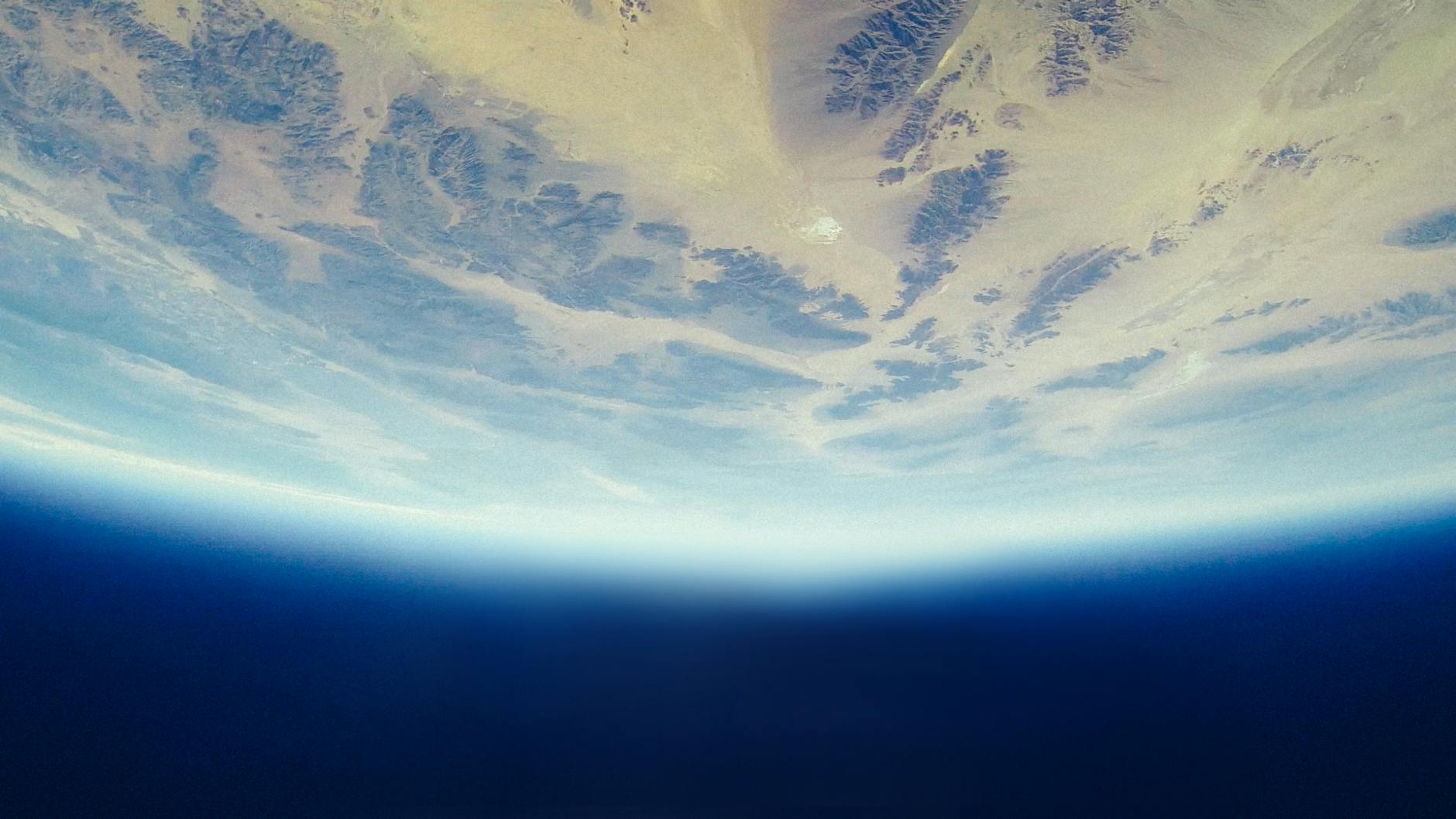
Earth’s atmosphere does not end with a sharp line. Instead, it fades gradually upward, becoming thinner and thinner until it merges with the environment of space. At the very top of this fading boundary lies the exosphere, the outermost layer of the atmosphere and one of the strangest regions surrounding the planet.
This is where air stops behaving the way most people imagine air. Near the ground, gas molecules are packed closely enough to collide constantly, helping create winds, clouds, and weather. In the exosphere, by contrast, atoms and molecules are so widely separated that they can travel hundreds of kilometres without colliding. In that sense, Earth is not wrapped in a neat atmospheric shell. It is slowly leaking into space.
What the exosphere actually is
The exosphere begins above the thermosphere, at a boundary called the thermopause, also known as the exobase. From there, it stretches outward to a very poorly defined limit where Earth’s atmosphere blends into the solar wind and the interplanetary medium.
That fuzzy outer edge is part of what makes the exosphere so fascinating. Unlike the lower layers of the atmosphere, it does not have a simple, universally agreed upper boundary. Some definitions place its outer limit at about 10,000 kilometres above Earth, while others extend it much farther, to about 190,000 kilometres, roughly halfway to the Moon. That enormous uncertainty says a lot about the nature of the exosphere: it is not a solid atmospheric cap, but a gradual transition zone.
The height of the exobase itself also changes. It can vary from about 500 kilometres to about 1,000 kilometres during periods of higher incoming solar radiation.
A layer so thin it barely acts like a gas
The exosphere is mainly made up of extremely low densities of hydrogen, along with limited amounts of helium, carbon dioxide, and nascent oxygen closer to the exobase. “Nascent oxygen” refers to newly formed atomic oxygen rather than the more familiar two-atom oxygen molecules found lower in the atmosphere.
Because particles in this region are so far apart, the exosphere no longer behaves like a normal gas. In the lower atmosphere, gases are constantly mixed by collisions and turbulence. In the exosphere, that picture breaks down. Particles move freely on long paths, following ballistic trajectories. That means they travel like projectiles under gravity rather than bouncing around in a dense swarm.
Some of these particles migrate in and out of the magnetosphere or the solar wind. And some never come back.
Earth is constantly losing part of its atmosphere
One of the most striking facts about the exosphere is that atmospheric escape is happening all the time. Every second, Earth loses about 3 kilograms of hydrogen and 50 grams of helium, along with much smaller amounts of other constituents.
That may sound dramatic, but it is best understood as a continuous trickle from the very outer fringe of the atmosphere rather than a sudden drain. The exosphere is so sparse that the particles with enough freedom and the right trajectories can simply escape Earth’s pull and continue into space.
Hydrogen is especially likely to escape because it is very light. In the upper atmosphere, lighter gases become more common with altitude. This happens above the well-mixed lower atmosphere, in a region where molecular diffusion becomes more important than turbulent mixing. In this upper zone, called the heterosphere, gases separate more by molecular weight, and the lightest elements dominate at the greatest heights.
Why the atmosphere doesn’t have a clean ending
People often talk about “going into space” as if there were a clear border, but Earth’s atmosphere does not really stop at a precise altitude. A commonly used conventional marker is the Kármán line at 100 kilometres above Earth, but that is a practical definition rather than a physical wall.
In reality, the atmosphere becomes progressively thinner with altitude. Even well above 100 kilometres, atmospheric effects still matter. The exosphere makes this especially clear. It exists as an extended, fading envelope where Earth’s influence gradually gives way to outer space.
This blurred edge is also reflected in the geocorona, a far-ultraviolet glow caused by neutral hydrogen, which extends to at least 100,000 kilometres.
No weather, no clouds, but still part of Earth’s atmospheric system
The exosphere is far too thin for meteorological phenomena. There are no clouds, storms, or weather systems there. Weather depends on denser air, water vapor, and the constant churning motions of the lower atmosphere, especially the troposphere. The exosphere has none of that.
Still, it remains part of the larger atmospheric structure. Below it lies the thermosphere, and lower still are the mesosphere, stratosphere, and troposphere. Together these layers form a continuous atmospheric system, even though conditions change radically with height.
Near Earth’s surface, air is dense and pressure is high. Higher up, pressure and density both decrease. By the time you reach the exosphere, the atmosphere is so tenuous that some scientists consider it closer to interplanetary space than to a conventional atmospheric layer.
Satellites live in this fading frontier
Although the exosphere is too thin for weather, it is not empty. Many artificial satellites orbit Earth within this outermost region.
That makes the exosphere a kind of frontier zone: too sparse to behave like ordinary air, yet still part of the atmospheric environment that spacecraft must pass through and operate within. It is a reminder that “space” around Earth is not a perfect vacuum. Even at great heights, the outer atmosphere still exists in a diluted form.
This gradual thinning also matters because the upper atmosphere interacts with solar radiation and with the broader space environment. The exosphere sits where Earth’s atmosphere and outer space overlap, making it a key region for understanding both atmospheric loss and satellite conditions.
How the exosphere fits into the bigger atmosphere
Most of Earth’s atmospheric mass is concentrated much lower down. About three quarters of the atmosphere’s mass lies within about 11 kilometres of the surface, and 99.99997% is below 100 kilometres. That means the exosphere contains only an incredibly tiny fraction of the atmosphere’s total mass.
Yet despite being so insubstantial, it reveals something profound about Earth: the atmosphere is not a sealed container. It is dynamic, layered, and open at the edges.
Lower in the atmosphere, turbulence keeps gases relatively well mixed up to around 100 kilometres. Above that, in the heterosphere, the lack of strong mixing allows lighter gases to become more abundant with altitude. The upper part of this region is composed almost completely of hydrogen, the lightest element. That helps explain why hydrogen is the main gas Earth loses to space.
The quiet drama above the sky
The exosphere is easy to overlook because it has none of the obvious drama of thunderstorms, auroras, or blazing meteors. Yet it may be one of the most philosophically intriguing parts of Earth’s atmosphere.
It is the place where the familiar world of air becomes something else entirely. Molecules drift enormous distances without collisions. Gravity still holds on, but only weakly. Spacecraft pass through. Hydrogen slips away. And the planet’s atmosphere, instead of ending, simply fades.
That makes the exosphere less like a roof over Earth and more like a whisper into space — a vast, nearly invisible region where our planet slowly, constantly, and quietly lets go.
Sources
Based on information from Atmosphere of Earth.
More like this
Follow Earth’s atmosphere all the way to its fading edge — download DeepSwipe and let your curiosity escape into space.


