Full article · 6 min read
Titan: The Moon With Weather, Seas, and a Real Atmosphere
Titan stands out as one of the strangest worlds in Saturn’s realm. It is Saturn’s largest moon, and it is bigger than Mercury, although it is less massive. That alone would make it notable. But Titan goes much further: it is the only moon in the Solar System with a substantial atmosphere.
That thick atmosphere changes everything. It gives Titan a sky, drives complex chemistry overhead, and helps create a world with lakes and seas on its surface. Instead of familiar Earthly oceans made of water, Titan is known for hydrocarbon lakes and seas, especially near its north pole. These are liquids made of compounds such as methane and ethane, substances that are gases on Earth under ordinary conditions but can exist as liquids in Titan’s extreme cold.
Why Titan is so unusual
Many moons are little more than airless balls of rock or ice. Titan is different. Its atmosphere is not a trace veil but a major one, making it unique among moons. In fact, Titan is the only satellite in the Solar System known to have a major atmosphere, and it is also the only satellite known to have hydrocarbon lakes.
Titan is not just Saturn’s biggest moon; it dominates the whole Saturn system in another way. More than 90% of the mass orbiting Saturn, including the rings, is contained in Titan alone. That makes it the system’s true heavyweight.
A moon with seas and coastlines
One of the most compelling discoveries about Titan came from the Cassini–Huygens mission. During flybys of Titan, Cassini captured radar images showing large lakes and their coastlines, complete with numerous islands and mountains. Later observations identified hydrocarbon lakes near Titan’s north pole, and in March 2007 hydrocarbon seas were found near the north pole as well.
These are not tiny puddles. One of the northern seas is almost the size of the Caspian Sea. That gives Titan something astonishingly Earth-like in shape, even though the chemistry is utterly alien: shorelines, large bodies of liquid, and a weather-influenced landscape.
The word hydrocarbon simply refers to molecules made of hydrogen and carbon. On Titan, these compounds can pool into lakes and seas because the environment is so cold. This creates a surface that behaves in some ways like an Earth landscape, but with very different liquids.
Chemistry in Titan’s atmosphere
Titan’s atmosphere is not just thick; it is chemically interesting. A complex organic chemistry occurs there. In this context, organic chemistry means chemistry based on carbon-containing molecules. That does not mean life is present, but it does mean Titan is a place where complicated carbon chemistry can happen naturally.
Scientists reported the detection of polycyclic aromatic hydrocarbons in Titan’s upper atmosphere in 2013. These are carbon-and-hydrogen molecules built from multiple linked rings. They are considered a possible precursor for life, meaning they may be among the kinds of molecules that can appear before living chemistry ever begins.
Titan is therefore not just a moon with weather and seas. It is also a vast natural chemistry lab, with reactions taking place high above the surface in its substantial atmosphere.
Where Titan’s nitrogen may have come from
Another intriguing idea concerns the origin of Titan’s atmospheric nitrogen. In 2014, NASA reported strong evidence that the nitrogen in Titan’s atmosphere came from materials in the Oort cloud associated with comets, rather than from the materials that formed Saturn earlier.
The Oort cloud is a distant reservoir of icy objects surrounding the Solar System. Comets are linked with this far-off region, so the idea suggests that Titan’s atmosphere may preserve a connection to material from the outermost reaches of the Solar System.
That possibility makes Titan even more fascinating. Its air may not simply be a leftover from Saturn’s formation, but a record of ancient icy material delivered from much farther away.
How we learned what Titan is really like
For centuries, astronomers knew Titan only as one of Saturn’s moons. Christiaan Huygens discovered it after correctly identifying Saturn’s rings in the 17th century. Much later, research in the early 20th century confirmed that Titan had a thick atmosphere, a feature unique among the Solar System’s moons.
Space exploration transformed Titan from a blurry point of light into a real world. Voyager 1 performed a close flyby of Titan and greatly increased knowledge of the moon’s atmosphere. It showed that Titan’s atmosphere is impenetrable at visible wavelengths, meaning ordinary visible light could not reveal the surface below.
Cassini changed that by using radar, which could see through the atmospheric haze. That is how scientists mapped large lakes, coastlines, islands, and mountains. The Huygens probe then descended onto Titan’s surface on 14 January 2005, marking one of the most remarkable explorations of a moon in spaceflight history.
Titan in the Saturn system
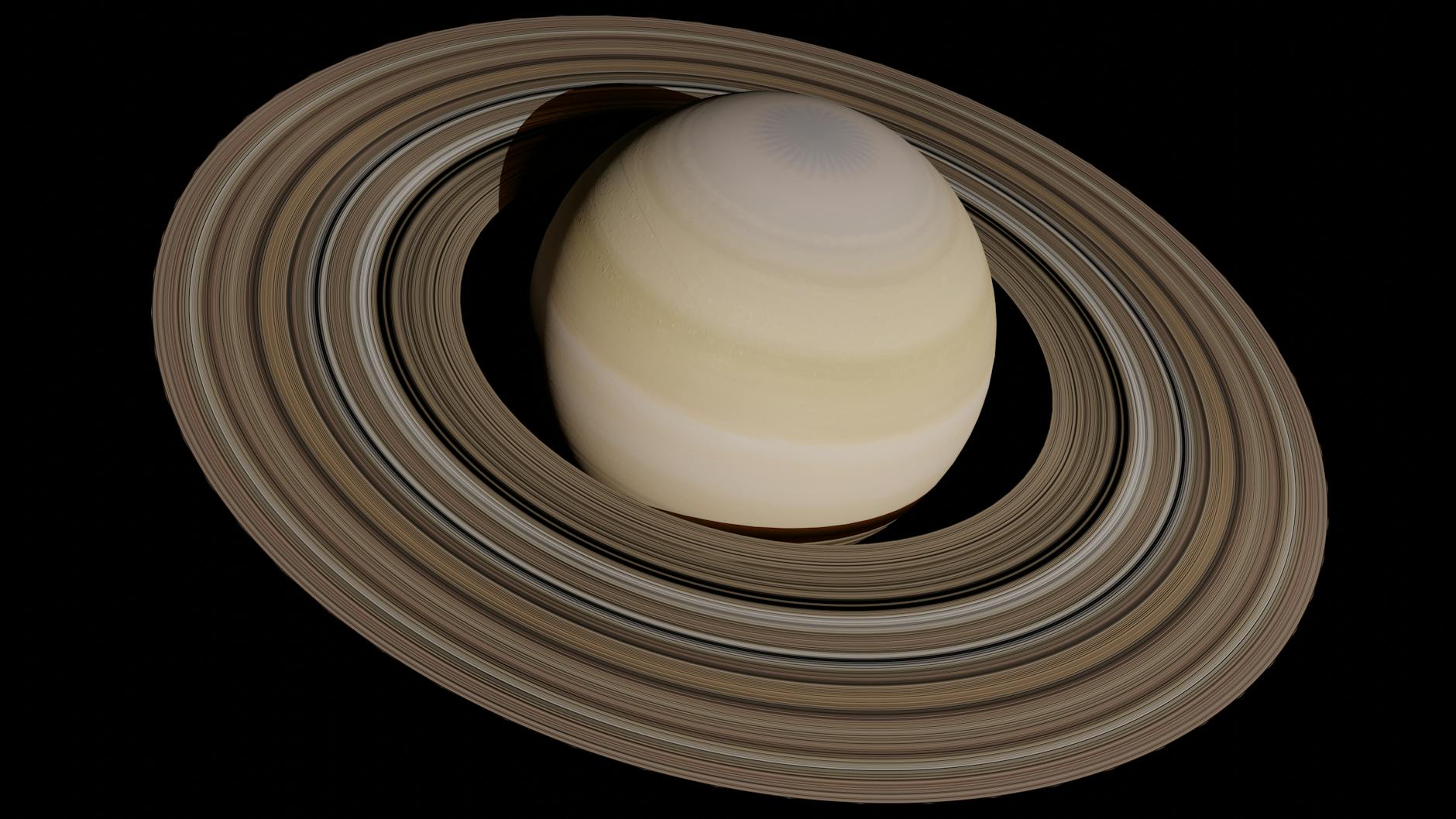
Saturn is famous for its bright rings and huge family of moons, with 274 known moons and 63 formally named. Yet Titan still dominates. It is Saturn’s largest moon and the second largest moon in the Solar System. Despite Saturn’s spectacular ring system, Titan outweighs the rest of the material orbiting the planet by an enormous margin.
This contrast is part of what makes the Saturn system so compelling. Saturn itself is a giant planet known for ice-rich rings and fast winds, but Titan adds a whole different kind of wonder: an atmosphere-rich moon with seas, islands, mountains, and complex chemistry.
A world that feels strangely familiar
Titan is alien, but it also echoes Earth in surprising ways. It has a substantial atmosphere, weather-related surface features, and coastlines shaped around large bodies of liquid. Those similarities make it easy to imagine, but the underlying reality is much colder and chemically different.
Instead of water seas, Titan has hydrocarbon seas. Instead of an ordinary moon’s bare surface under black space, Titan has a thick sky overhead. Instead of simple, inactive chemistry, Titan’s atmosphere hosts complex organics, including polycyclic aromatic hydrocarbons.
That blend of familiar forms and unfamiliar substances is what gives Titan its grip on the imagination. It is not just another moon. It is a place with landscape, weather, and chemistry all its own.
Why Titan keeps drawing attention
Titan has remained a major target of scientific interest because it brings together several rare features in one world. It is the only moon with a substantial atmosphere. It is the only satellite known to have hydrocarbon lakes. It supports complex organic chemistry. And it may preserve clues about material linked to comets and the distant Oort cloud.
Among Saturn’s many wonders, Titan may be the most complete world-like environment orbiting the ringed planet. It has weight, weather, shoreline, and sky. That makes it one of the most extraordinary moons in the Solar System.
Sources
Based on information from Saturn.
More like this
Take a knowledge dive deeper than Titan’s hydrocarbon seas — download DeepSwipe and explore a new world every day.