Full article · 7 min read
Tardigrades and the Strange “Almost All Head” Body Plan
Tardigrades are famous as tiny survivors of dehydration, radiation, vacuum, and other brutal conditions. But one of the most intriguing things about them is not just how tough they are. It is how weirdly they are built.
These eight-legged micro-animals, often called water bears or moss piglets, have a body plan that stands out even among the already unusual animals of the broader ecdysozoan world. Genetic and anatomical evidence points to a remarkable conclusion: most of a tardigrade’s body corresponds to the head region of an arthropod.
That means the creature many people imagine as a tiny plump tank is, in a deep evolutionary sense, something like a head-dominated animal. For scientists trying to understand how tardigrades evolved, this is a major clue.
What does “almost all head” actually mean?
To understand the idea, it helps to know what Hox genes are. Hox genes are developmental genes that help lay out the body from front to back. In many animals, they help define where head, thorax, abdomen, and other body regions belong.
Tardigrades lack several of the Hox genes found in arthropods. Arthropods are the huge animal group that includes insects, spiders, and crabs. They also lack a large intermediate body region. In insects, that missing region would correspond to the entire thorax and abdomen.
As a result, practically the whole tardigrade body, except for the last pair of legs, is made up of segments homologous to the head region in arthropods. In evolutionary biology, “homologous” means structures are related by shared ancestry, even if they may not look or function exactly the same today.
This makes tardigrades unlike the long-bodied segmented forms people often expect when thinking about relatives of arthropods. Instead of having a clearly extended middle body, they appear to have evolved a highly compact form.
Why this matters for evolution
This unusual body map suggests that tardigrades evolved from an ancestral ecdysozoan with a longer body and more segments. In other words, they were not always built as tiny compact animals.
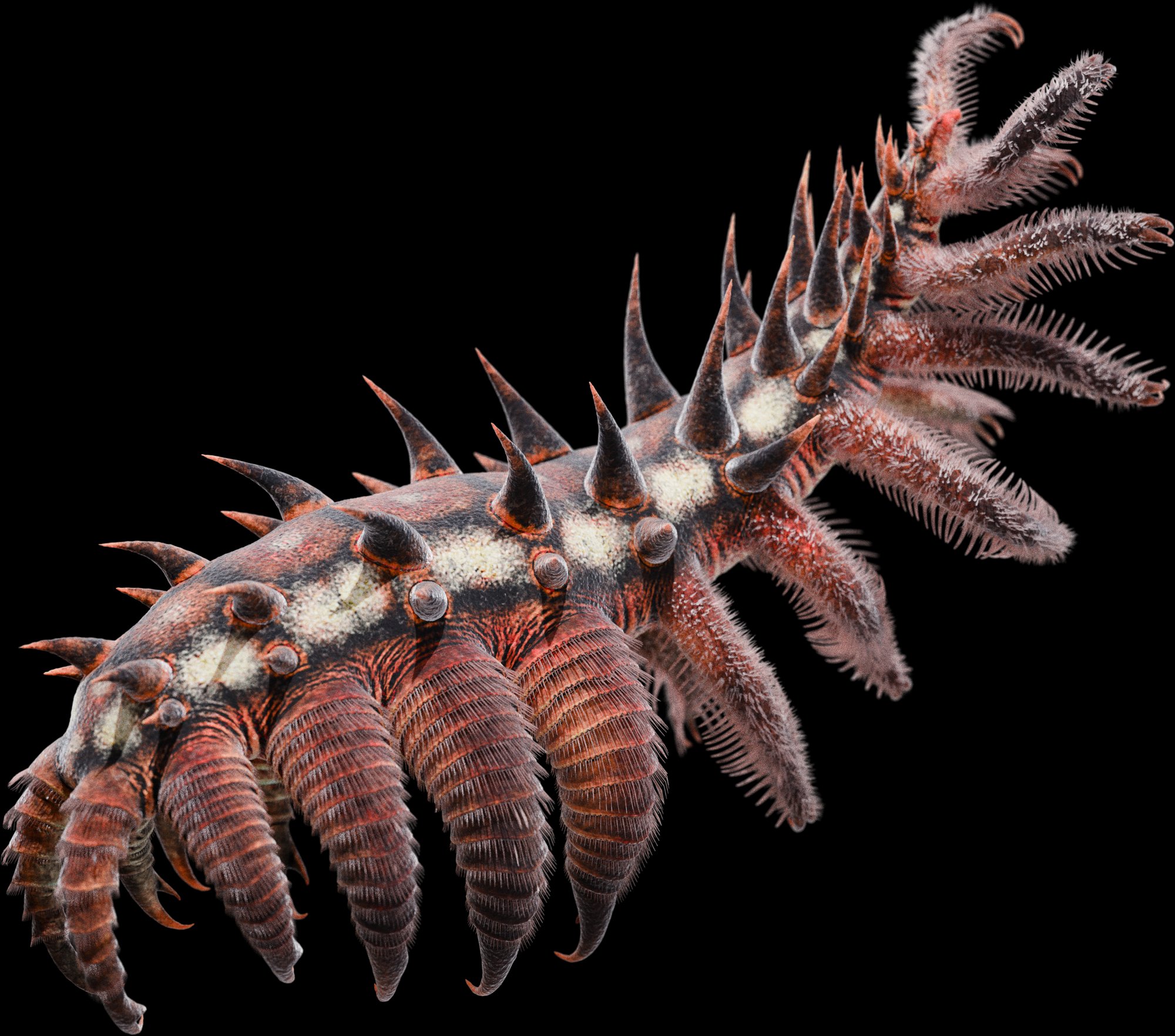
Multiple lines of evidence indicate that tardigrades are secondarily miniaturised from a larger ancestor, probably a lobopodian. Lobopodians were worm-like early animals with stubby legs. Some researchers think this ancestor may have resembled the mid-Cambrian animal Aysheaia.
Miniaturisation means evolving into a much smaller form from larger ancestors, not starting out tiny from the beginning. In tardigrades, this shrinkage appears to have been accompanied by a drastic simplification or compression of the body plan.
A 2023 review concluded that, despite the diversity of body plans across Panarthropoda, the tardigrade body plan maps best with a simple one-to-one alignment of anterior segments. “Anterior” means front-end segments, reinforcing the idea that the tardigrade body is strongly biased toward what would be head territory in related animals.
Fossils from deep time
The story reaches far back into prehistory. The earliest known tardigrade fossil is from the Cambrian, around 500 million years ago.
Tardigrade fossils are rare, but the known ones are especially valuable because they show how ancient the lineage is. The only known specimens include fossils from mid-Cambrian deposits in Siberia, plus a few preserved in amber from the Cretaceous of North America and the Neogene of the Dominican Republic.
The Siberian fossils differ from living tardigrades in notable ways. They had three pairs of legs instead of four, a simplified head morphology, and no posterior head appendages. Even so, they shared columnar cuticle construction with modern tardigrades. Scientists think these fossils represent a stem group of living tardigrades.
A stem group is an extinct branch that is closer to a living group than to anything else, but falls outside the modern crown group. In plain terms, these fossils may not be modern tardigrades exactly, but they help show what early relatives looked like on the road toward today’s species.
The oldest remains of modern tardigrades include Milnesium swolenskyi from Late Cretaceous New Jersey amber, around 90 million years old. Another fossil species, Beorn leggi, comes from Canadian amber dated to roughly 72 million years ago.
From lobopodian ancestor to tiny water bear
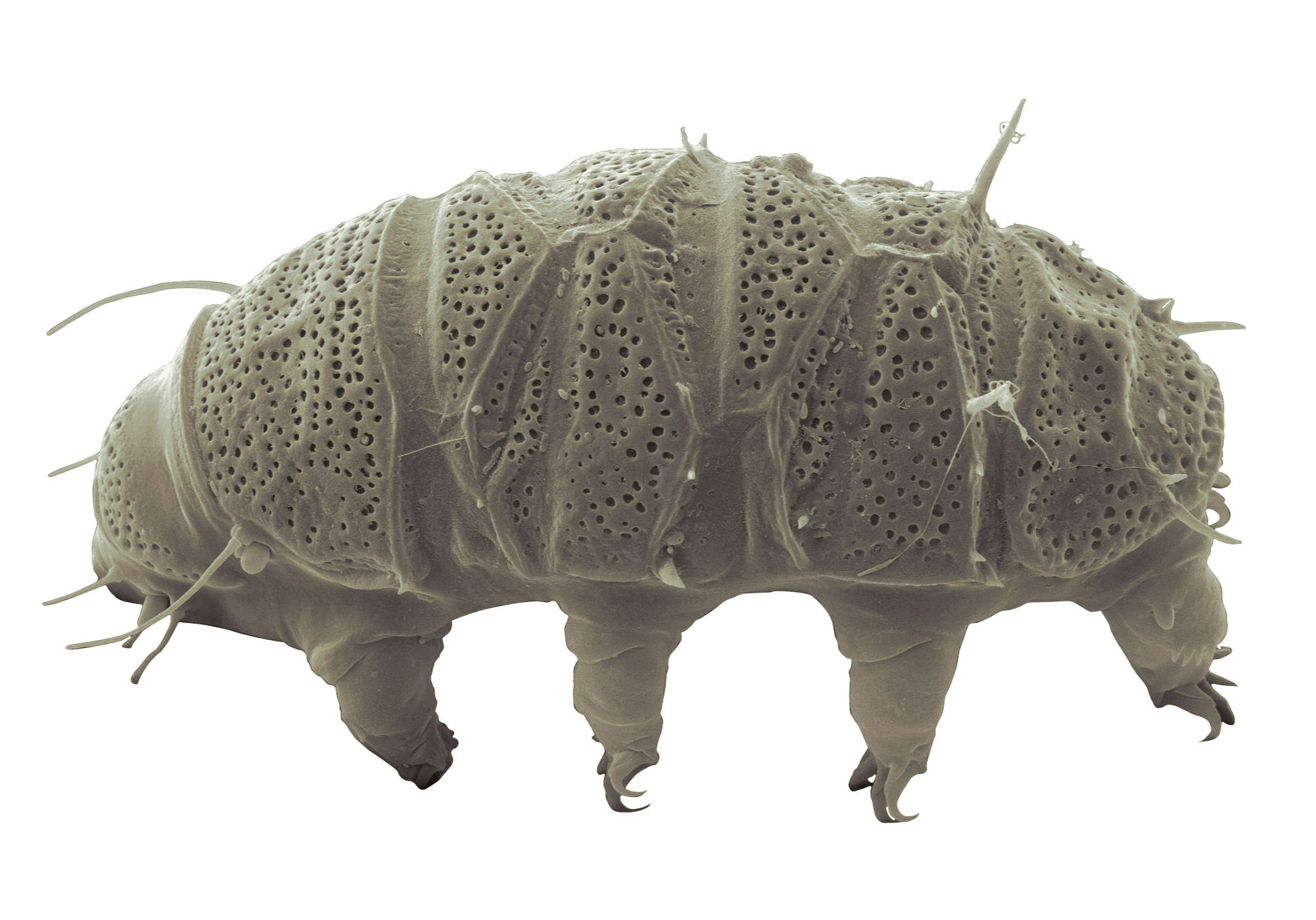
The idea that tardigrades descended from larger, more elongated ancestors helps explain why their body plan is so scientifically important. They may be tiny today, often about 0.5 mm long when fully grown, but their lineage likely began with something much less compressed.
Living tardigrades are short and plump, with four pairs of hollow unjointed legs. Each leg ends in claws or sticky pads, depending on the species. Their body cavity is a haemocoel, an open circulatory system filled with colourless fluid. They have no lungs, gills, or blood vessels, relying instead on diffusion through the cuticle and body cavity for gas exchange.
That compact construction fits a micro-animal lifestyle. But evolutionarily, it may also be the end result of a dramatic reduction from a larger-bodied ancestor. Genomic studies may eventually reveal more about how tardigrades miniaturised themselves from larger ecdysozoans.
Their family tree is still argued over
If tardigrades are so peculiar, where exactly do they belong on the animal family tree?
That remains debated. Morphological and molecular phylogenetics studies have proposed several different relationships within Panarthropoda, the broader grouping that includes tardigrades, arthropods, and onychophorans.
Onychophorans are velvet worms, soft-bodied animals often discussed as close relatives in this part of the tree of life. Arthropods, by contrast, are the armored and jointed giants of the same broader evolutionary neighborhood.
Several hypotheses have been proposed:
- The Tactopoda hypothesis says tardigrades are sister to arthropods.
- The Antennopoda hypothesis says tardigrades are sister to the group made of onychophorans plus arthropods.
- The Lobopodia hypothesis says tardigrades are sister to onychophorans.
In evolutionary language, “sister” means the closest relative on a branching family tree.
The issue is still unresolved because different lines of evidence point in different directions. A 2012 study using ribosomal RNA markers found that Heterotardigrada and Arthrotardigrada seemed to be paraphyletic. In 2018, a broader study integrating morphology and molecules concluded that while Arthrotardigrada appears paraphyletic, Heterotardigrada is accepted as a clade.
These may sound like technical details, but they matter. Every shift in the family tree changes how scientists interpret the origin of the tardigrade body plan, including how and when that “mostly head” organization evolved.
A compact form with global reach
Despite their bizarre anatomy and unresolved family ties, tardigrades have spread astonishingly widely. They live on mountaintops, in the deep sea, in tropical rainforests, and in the Antarctic. They are cosmopolitan as a group, found on land, in freshwater, and in the sea.
Most species live in damp habitats such as mosses, lichens, liverworts, soil, and leaf litter. In freshwater and marine settings, they live on and in the bottom, including between particles and around seaweeds. Some habitats are even more specialized, including hot springs and life associated with marine invertebrates.
Their eggs and resistant life-cycle stages are small and durable enough for long-distance transport by wind or on the feet of other animals. In mosses, they can reach densities of more than 2 million per square metre.
So the same lineage that may have undergone dramatic miniaturisation and body-plan compression also became extraordinarily successful at colonizing habitats across the biosphere.
Tiny, tough, and evolutionarily revealing
Tardigrades are often celebrated for surviving severe conditions, from dehydration and starvation to extreme temperatures, pressure, radiation, air deprivation, and even exposure to outer space. But the evolutionary story behind their tiny bodies is just as compelling.
They are not simply miniature oddities. They appear to preserve evidence of a major evolutionary transformation: shrinking from larger ancestors, losing or compressing much of the body axis, and ending up with a form in which most of the body corresponds to what would be the head region in arthropods.
That makes tardigrades more than durable little curiosities in moss. They are a living puzzle about how animal bodies can be reorganized across deep time.
And somehow, this tiny head-shaped tank ended up almost everywhere on Earth.
Sources
Based on information from Tardigrade.
More like this
Go full water bear on your curiosity — download DeepSwipe and let your brain slow-walk into big evolutionary mysteries.