Full article · 6 min read
Tardigrade Love: Molts, Stabs, and Spiky Eggs
Tardigrades are famous for surviving dehydration, radiation, vacuum, and even exposure to space. But their love lives are just as strange and fascinating. These tiny eight-legged animals, often called water bears or moss piglets, reproduce in ways that sound almost invented: sperm may be placed into a cloaca, pushed through the female’s cuticle, or tucked beneath that outer covering so eggs can later be fertilized in a shed skin.
For creatures usually only around 0.5 millimetres long when fully grown, tardigrades have surprisingly varied reproductive strategies. Their eggs can be smooth, knobbled, ovoid, or decorated with pyramids and bottle-like shapes. Some species court each other. Some appear to have no males at all. And the babies emerge fast, breaking out of their eggs with tiny piercing mouthparts called stylets.
Tiny bodies, complicated reproduction
Most tardigrade species have separate male and female individuals, though some are hermaphroditic and self-fertilizing. In others, males seem to be absent, suggesting that parthenogenesis is common. That means females can produce offspring without fertilization.
Both sexes have a single gonad, which is the organ that produces reproductive cells. In males this is a testis; in females, an ovary. The female has a single oviduct, the tube through which eggs pass. This opening may sit just above the anus or open directly into the rectum, forming a cloaca. A cloaca is a shared chamber used by more than one body system, in this case linked to both reproduction and waste elimination.
That shared opening is important because one tardigrade mating method involves the male placing sperm directly into the female’s cloaca. But that is only one option. Tardigrade reproduction is notable because different species use different methods, and some of them are strikingly direct.
He stabs, she molts
In one reproductive route, the male penetrates the female’s cuticle and places sperm straight into her body cavity. The cuticle is the tough outer body covering that tardigrades molt and replace as they grow. It contains chitin and hardened proteins, giving the animal protection while still allowing flexibility.
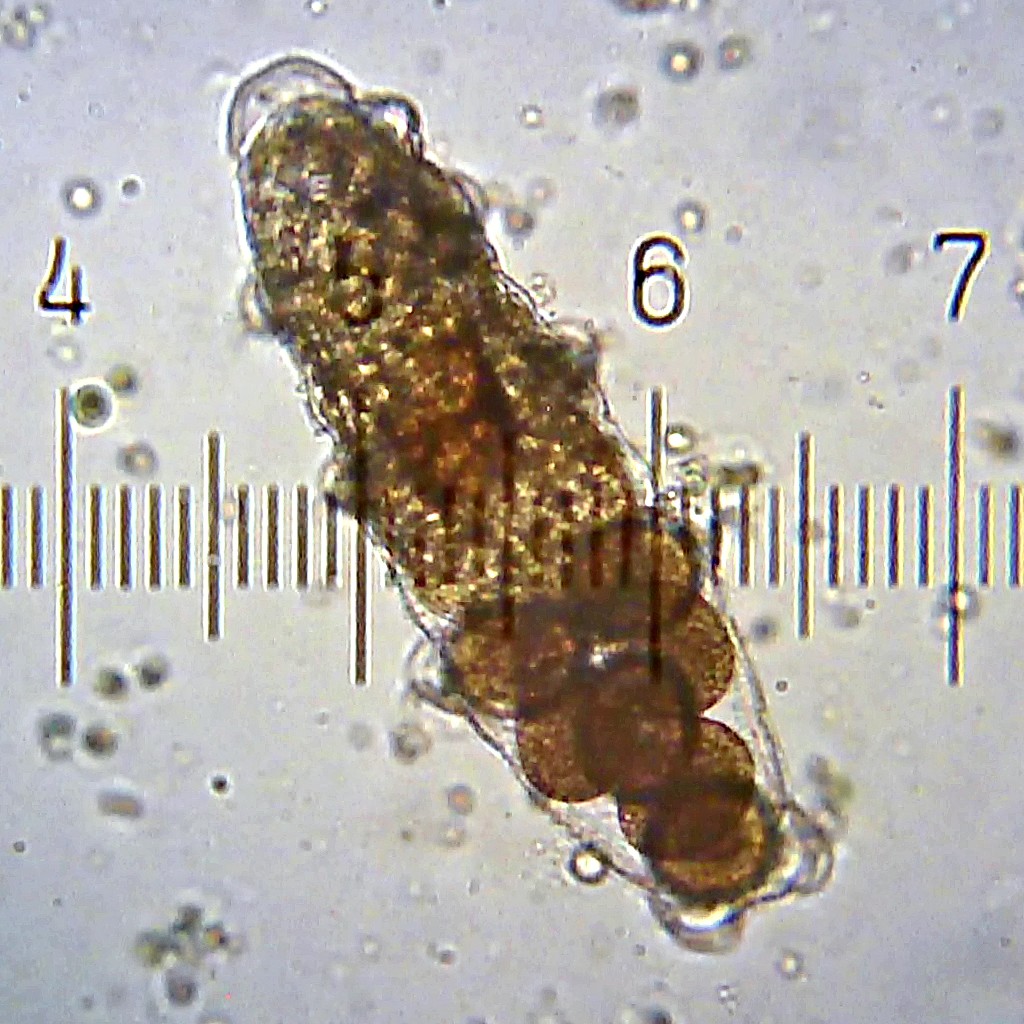
Another method is even more unusual. In species such as Hypsibius annulatus, the male places sperm under the female’s cuticle. Later, when she molts, she lays her eggs into that cast cuticle, and the eggs are fertilized there. The cast cuticle is simply the shed outer skin left behind after molting.
This means reproduction can be linked directly to one of the defining features of tardigrade biology: molting. Like other animals in the broader moulting lineage Ecdysozoa, tardigrades periodically shed their cuticle. In some species, that discarded skin becomes a ready-made nursery.
Courtship can be surprisingly gentle
Not all tardigrade mating is abrupt. In some aquatic species, courtship takes place before fertilization. The male strokes the female with his cirri, thin sensory appendages on the body, to stimulate her to lay eggs. Fertilization then happens externally.
That detail is a reminder that tardigrades are not just passive microscopic dots. They have a nervous system, sensory structures, and behaviors that can be quite specific. Their head includes sensory cirri and antenna-like clavae that may act as chemoreceptors, helping them detect chemical signals.
So although tardigrades are often celebrated for endurance, their reproductive lives also involve timing, contact, and species-specific behavior.
Eggs with spikes, knobs, and bottle shapes
Tardigrade eggs are among the most visually striking parts of their biology. Depending on the species, eggs may be spherical or ovoid. Some are covered in ornamentation that can look like knobs, pyramids, or bottle-shaped projections.
One species, Austeruseus faeroensis, has spherical eggs about 80 micrometres in diameter with a knobbled surface. In other species, such as Hypsibius annulatus, the eggs may be ovoid. These surface features make tardigrade eggs especially recognizable under a microscope.
Terrestrial tardigrade eggs have drought-resistant shells, which makes sense for animals often living in mosses, lichens, soil, and leaf litter where moisture can come and go. Aquatic species handle egg placement differently: they may glue eggs to a surface or leave them inside a cast cuticle.
The variety in egg form reflects the broad range of habitats tardigrades occupy. They live from mountaintops to the deep sea, from tropical rainforests to Antarctica, and their reproductive structures help them cope with those different settings.
Up to 30 eggs, then a rapid hatch
A female tardigrade can lay up to 30 eggs, depending on the species. The eggs hatch within about 14 days, which is a remarkably quick start for an animal with such a dramatic reputation for surviving hardship.
When the hatchlings emerge, they use stylets to open the eggshell. Stylets are paired piercing structures near the mouth. Tardigrades use them in feeding to puncture plant or animal cells and suck out fluids, but in hatchlings these same dagger-like tools help them break free from the egg.
That first use of the stylets is an efficient beginning. From the start, the young are equipped with structures that matter for both survival and feeding.
Why the weird methods matter
Tardigrades live in environments that can be unstable. Many species inhabit damp mosses and lichens that may dry out, while others live in freshwater or marine bottoms between particles or around seaweeds. Their eggs and resistant life stages are small and durable enough to be transported long distances by wind or on the feet of other animals.
In that context, flexible reproductive strategies can be useful. Fertilizing eggs in a cast cuticle, attaching eggs to a substrate, or producing drought-resistant eggshells are all ways of making reproduction work in a tiny animal living in patchy, shifting habitats.
Tardigrades are not rare at all in the right places. In soil, there can be as many as 300,000 per square metre, and on mosses, densities can exceed 2 million per square metre. Yet despite being abundant, they remain easy to overlook because of their microscopic size.
More than indestructible mascots
Popular culture often treats tardigrades as nearly indestructible oddities, and their ability to endure extremes is genuinely extraordinary. They can enter a cryptobiotic tun state when dried out, suspending metabolism and becoming highly resistant to multiple stresses. But focusing only on survival misses how biologically rich they are.
They are animals with muscles that move their legs in stepping motions, claws that grip while walking, sensory structures in the head, and reproductive systems that range from self-fertilization to external courtship-based mating. They feed with mineral stylets, molt their cuticle, and produce eggs whose shapes can be beautiful under magnification.
Even their popularity partly comes from this contrast: they are both bizarre and oddly relatable. Their crawling has been described as clumsy and adorable, and because they are common in mosses and lichens, they can be collected and viewed under a low-power microscope by students and amateur scientists.
A microscopic drama in every drop
The reproductive world of tardigrades is a miniature drama of anatomy and timing. Sperm may be delivered through a cloaca, through the cuticle, or beneath it. Eggs may be left on a surface, protected by drought-resistant shells, or tucked into a shed skin. Courtship may involve a gentle stroking with cirri. And within about two weeks, hatchlings armed with stylets cut their way into the world.
For animals best known as champions of survival, tardigrades also prove that life’s smallest creatures can have some of the most inventive ways of making more life.
Sources
Based on information from Tardigrade.
More like this
Swipe into the tiny, wild world of water bears — download DeepSwipe and hatch a new obsession every day.


