Full article · 7 min read
Tardigrades: Tough, Not Invincible
Tardigrades have a reputation as nearly indestructible animals. These tiny eight-legged creatures, often called water bears or moss piglets, have survived conditions that would quickly kill most life: dehydration, radiation, vacuum, extreme temperatures, crushing pressure, and even exposure to space. That reputation is well earned.
But there is an important catch. Tardigrades are incredibly tough, yet they are not invincible. They do not endlessly flourish in every extreme environment. In many cases, they are enduring danger rather than living comfortably in it. Their famous survival tricks buy time, not immortality.
What makes a tardigrade so hard to kill?
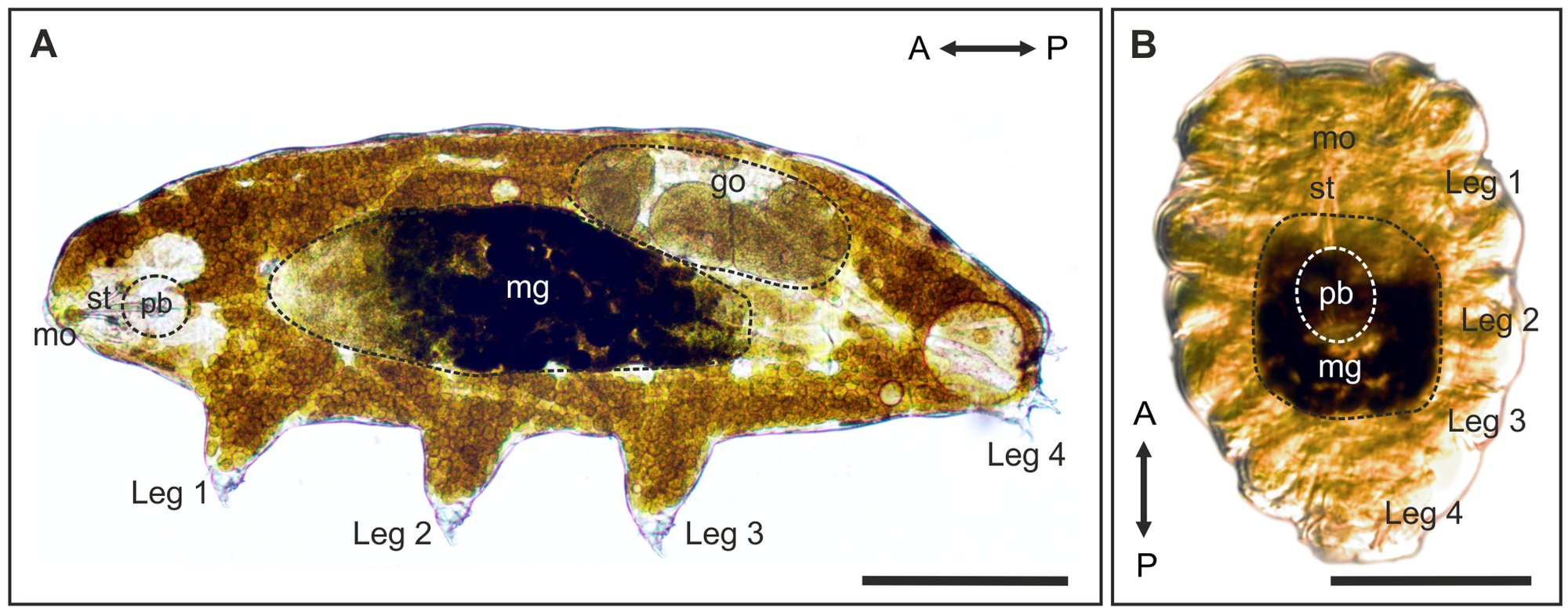
Tardigrades are microscopic animals, usually about 0.5 millimetres long when fully grown, with short plump bodies and four pairs of legs. They live across an astonishing range of habitats, from mountaintops and tropical rainforests to the deep sea and Antarctica. Many species are found in damp mosses, lichens, soil, and leaf litter.
Their resilience comes from an ability to enter unusual survival states when conditions turn hostile. In terrestrial and freshwater species, one of the most famous is the dehydrated "tun" state. A tun is a shriveled, dormant form created when water disappears from the environment. In that state, no metabolic activity takes place. That means the animal is not feeding, growing, or reproducing. It is essentially paused.
This shutdown allows tardigrades to tolerate severe stresses for long periods. In the tun state, they can go without food or water for years and become far more resistant to environmental extremes than they are when active.
Toughness has limits
One of the biggest misconceptions about tardigrades is that they are universal extremophiles. An extremophile is an organism specially adapted to live and thrive in extreme conditions. Tardigrades are different. They are not generally using extreme environments as their preferred home. Instead, they often survive them temporarily.
That distinction matters. Their odds of dying increase the longer they remain exposed to harsh conditions. So while tardigrades can endure remarkable shocks, they are not magic animals with unlimited durability.
This is why the phrase “tough, not invincible” fits them so well. Their biology is extraordinary, but every stress has a breaking point.
Shot at 900 metres per second
Among the more startling measurements of tardigrade resilience is their ability to survive impacts up to about 900 metres per second. They can also withstand momentary shock pressures up to about 1.14 gigapascals.
A gigapascal is a unit of pressure equal to a billion pascals. In simple terms, that is an immense amount of force delivered over an area. The fact that tardigrades can survive such momentary shock pressure helps explain why they are often treated as symbols of biological toughness.
Still, these figures should not be read as proof that tardigrades can shrug off anything forever. These are survival limits under specific conditions, not evidence of permanent invulnerability.
The tun state: a biological pause button
The tun state is central to the tardigrade legend. When water is unavailable, many terrestrial and freshwater tardigrades pull in their legs and form a desiccated cyst-like shape. This cryptobiotic state lets them suspend metabolism completely.
Cryptobiosis is a suspended condition in which normal life processes stop. In tardigrades, this allows survival during drought and dramatically boosts resistance to other stresses. In that state, they can endure temperatures as low as −272 °C and as high as +149 °C for at least short periods, as well as vacuum, lack of oxygen, ionising radiation, and high pressure.
That sounds almost supernatural, but it is better understood as emergency preservation. The tun buys time until better conditions return. It is not a mode for active living.
Why “survival” is not the same as “success”
When a tardigrade survives a severe condition, that does not automatically mean it escapes unharmed. Some survive and recover. Some survive but reproduce less successfully. Some die if exposure lasts too long.
This pattern showed up clearly in space experiments. In 2007, dehydrated tardigrades were flown on the FOTON-M3 mission and exposed for 10 days to vacuum, or to vacuum plus solar ultraviolet radiation. Back on Earth, more than 68% of the tardigrades protected from ultraviolet were revived by rehydration, and many went on to produce viable embryos.
But hydrated tardigrades exposed to vacuum and solar ultraviolet did poorly. Only three individuals of Milnesium tardigradum survived. Ultraviolet radiation also reduced egg-laying in M. tardigradum. So even for one of the most durable animal groups known, extreme conditions can come with serious costs.
Seasonal armor in Arctic waters
Not all tardigrade stress responses involve complete shutdown. The marine species Halobiotus crispae uses a different strategy called cyclomorphosis, an annual shift between body forms.
In summer, it has an active morph. In winter, it changes into a hibernating form called a pseudosimplex. This winter form can resist freezing and low salinity, meaning water with reduced salt content, but it remains active throughout. Reproduction, however, takes place only in the summer morph.
This is a fascinating reminder that tardigrade survival is not one single trick. Different species use different strategies depending on habitat. A marine species in cold Arctic waters does not respond exactly like a moss-dwelling species facing drought.
The molecules behind the myth
Scientists once thought tardigrades relied mainly on large amounts of the sugar trehalose to survive drying out, because trehalose is common in other organisms that tolerate desiccation. But tardigrades do not make enough trehalose for that to explain their survival.
Instead, they produce intrinsically disordered proteins in response to desiccation. These proteins do not have one rigid structure. That flexibility may help them protect cell membranes by associating with the polar heads of lipid molecules. They may also form a glass-like matrix that shields the cytoplasm, the material inside cells, from damage during drying.
Some of these proteins are unique to tardigrades and are known as tardigrade specific proteins. Their desiccation response is genetically complex as well. In Hypsibius exemplaris, 1,422 genes are upregulated during anhydrobiosis, the form of cryptobiosis triggered by desiccation.
Tardigrades also possess a cold shock protein that may help regulate translation after freezing. Translation is the process by which cells use RNA instructions to build proteins.
For radiation, tardigrades have another line of defense: the Dsup, or damage suppressor, protein. In Ramazzottius varieornatus and Hypsibius exemplaris, Dsup proteins bind to nucleosomes and help protect chromosomal DNA from damage by hydroxyl radicals. In R. varieornatus, Dsup also confers resistance to ultraviolet-C by upregulating DNA repair genes.
All of this helps explain why tardigrades can survive extreme stress. Their toughness is not just about being small or drying out. It is built into their molecular machinery.
Space survivor, but not space conqueror
Few facts have boosted tardigrades’ fame more than their survival in space. They have indeed survived exposure to outer space, and later flew on the International Space Station, where they showed they could survive microgravity and cosmic radiation.
Yet this does not mean space is somehow easy for them. The results from space exposure make the same point seen elsewhere: survival depends strongly on the exact condition. Dehydrated tardigrades can do far better than hydrated ones. Ultraviolet radiation is particularly harmful. Reproduction can suffer even when some individuals live.
Tardigrades are impressive space survivors. They are not animals for which open space is a normal, healthy habitat.
Why their reputation keeps growing
Part of the tardigrade mystique comes from how easy they are to find. They are common in mosses and lichens on walls and roofs, and can be collected and viewed under a low-power microscope. If dry, they can even be reanimated on a slide by adding a little water. That makes them accessible to students and amateur scientists.
Their clumsy crawling has also made them oddly lovable. Combined with their extreme survival feats, that has turned them into a charismatic group that appears in science fiction, toys, art, and popular science.
But the most interesting truth may be less flashy than the myth. Tardigrades are not immortal super-animals. They are tiny creatures with a set of highly effective emergency responses. They endure freezing, drying, pressure, radiation, and even space not because they are beyond biology, but because their biology has evolved remarkable ways to pause, protect, and recover.
The real lesson of tardigrades
If there is a breaking point for tardigrades, it depends on the stress, the species, and the state the animal is in. A tun is a strategy, not a guarantee. A winter pseudosimplex is protection, not permanent dominance over cold. A surviving individual does not mean a thriving population.
That makes tardigrades more interesting, not less. Their story is not about invulnerability. It is about the limits of life, and how far life can stretch before those limits finally win.
Sources
Based on information from Tardigrade.
More like this
Push your curiosity past the pressure limit — download DeepSwipe and explore bite-sized science that survives the scroll.