Full article · 6 min read
Tardigrades’ Pause Button: How the Cryptobiotic Tun Helps Water Bears Survive
Tardigrades are tiny eight-legged animals often called water bears or moss piglets, and they have become famous for one astonishing trick: when conditions turn harsh, some of them can nearly shut life down without actually dying.
That survival mode is the cryptobiotic tun, a shriveled, protective form that lets tardigrades endure conditions that would rapidly kill most animals. It sounds almost impossible, but for these micro-animals, it is a real part of life.
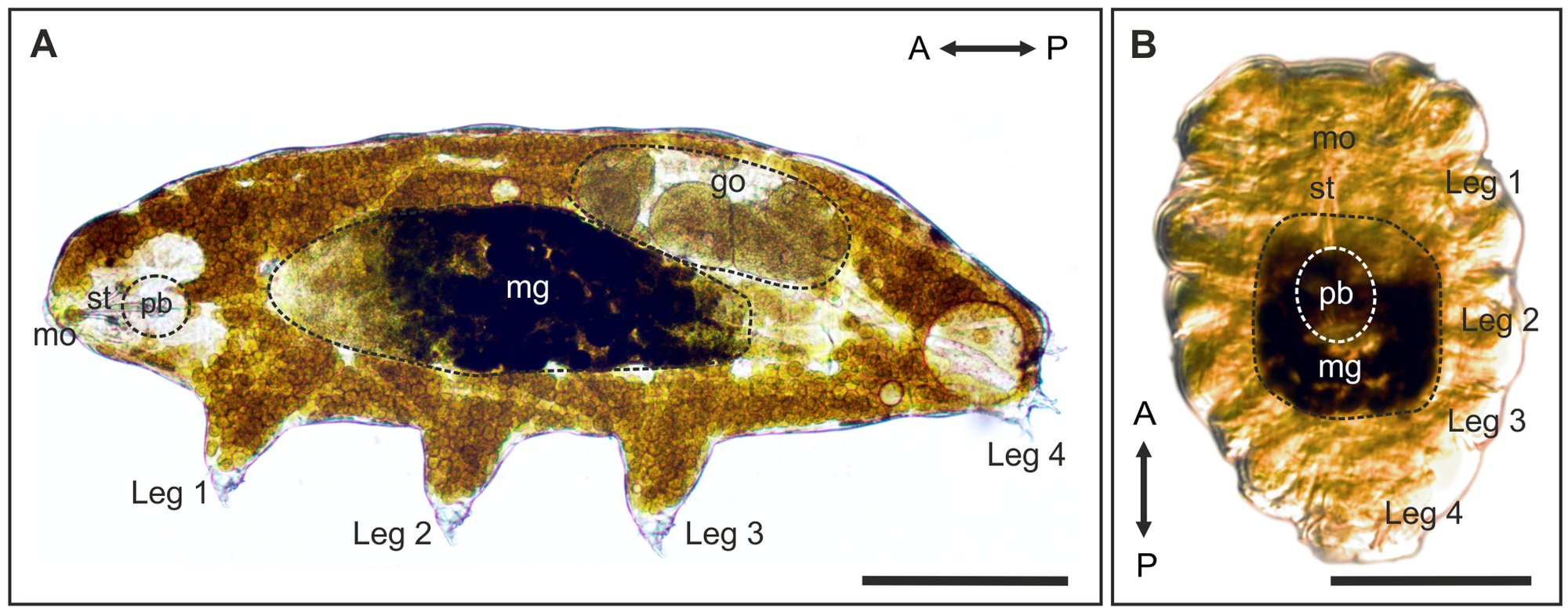
Usually about 0.5 mm long when fully grown, tardigrades are short, plump animals with four pairs of legs ending in claws or sticky pads. They are common in damp habitats such as mosses and lichens, and many can be collected and viewed under a low-power microscope. Their clumsy crawl and their near-mythic toughness have made them one of the most popular microscopic animals on Earth.
What is cryptobiosis?
Cryptobiosis is a reversible state in which metabolism is suspended. In simple terms, the animal is not actively growing, feeding, or carrying out the normal chemical work of life. For terrestrial and freshwater tardigrades, this is especially important when water disappears.
If the moss, lichen, or pond around them dries out, they can pull in their legs and transform into a desiccated cyst called a tun. In that state, no metabolic activity takes place. This is not ordinary sleep or hibernation. It is a far more extreme shutdown.
The remarkable part is that tardigrades in a tun can go without food or water for several years. That ability helps explain why these animals can live in such a wide range of places across Earth’s biosphere, from mountaintops to tropical rainforests, from the deep sea to Antarctica.
What does a tun actually do?
The tun is a defensive body form created during dehydration. As the tardigrade dries out, it retracts its legs and compacts its body into a shrunken shape that reduces exposure to damaging conditions.
This matters because drying out is dangerous for cells. Membranes can be damaged, internal structures can break down, and important molecules such as DNA can suffer harm. The tun is part of the animal’s strategy for staying intact until water returns.
Their body structure helps make this possible. Tardigrades have a cuticle, a protective outer covering made of chitin and hardened proteins, which is replaced when they moult. Their body cavity is filled with fluid, and they have no lungs, gills, or blood vessels, relying instead on diffusion for gas exchange. Even though they are built simply, with only about 1000 cells, their stress responses are extraordinarily effective.
The glass-like shield inside the body
For a long time, scientists thought tardigrades might survive desiccation mainly by using high levels of trehalose, a sugar common in some organisms that tolerate drying. But tardigrades do not make enough trehalose for that to explain their survival.
Instead, they produce intrinsically disordered proteins in response to desiccation. These proteins do not fold into one fixed shape. That flexibility may be exactly what makes them useful during extreme stress.
Some of these proteins are specific to tardigrades. They may protect cell membranes by associating with the polar heads of lipid molecules. They may also form a glass-like matrix that protects the cytoplasm during desiccation.
Cytoplasm is the material inside cells where much of the cell’s chemistry happens. A glass-like matrix is not literal glass, but a stable, rigid-like state that can help prevent delicate cell components from being damaged while the animal is dried out.
The molecular response is extensive. In Hypsibius exemplaris, 1,422 genes are upregulated during anhydrobiosis, the form of cryptobiosis triggered by desiccation. Of those, 406 are specific to tardigrades. Fifty-five of those are intrinsically disordered proteins, while the others are globular proteins with unknown functions.
Dsup: a protein bodyguard for DNA
Another part of the tardigrade survival toolkit is Dsup, short for damage suppressor. DNA is vulnerable to radiation and reactive chemicals, especially hydroxyl radicals, which can damage chromosomes.
Dsup proteins in Ramazzottius varieornatus and Hypsibius exemplaris promote survival by binding to nucleosomes and protecting chromosomal DNA from hydroxyl radicals. Nucleosomes are the spool-like protein structures that DNA wraps around inside cells.
In Ramazzottius varieornatus, Dsup also helps confer resistance to ultraviolet-C by upregulating DNA repair genes. Ultraviolet-C is a particularly energetic, DNA-damaging band of ultraviolet radiation.
These proteins are scientifically exciting beyond tardigrades themselves. Their potential to protect against damage has attracted biomedical interest, along with other tardigrade proteins linked to desiccation tolerance.
How extreme is the tun state?
Very extreme.
When in the cryptobiotic tun state, tardigrades become highly resistant to environmental stresses. They can withstand temperatures as low as −272 °C and as high as +149 °C, at least for short periods. They can also endure lack of oxygen, vacuum, ionising radiation, and high pressure.
Ionising radiation is radiation energetic enough to knock electrons off atoms, which can disrupt molecules and damage living tissue. Vacuum means an environment without air. Both are normally devastating to life.
Tardigrades can also survive impacts up to about 900 metres per second and momentary shock pressures up to about 1.14 gigapascals.
That does not mean they are invincible. Their survival is about endurance, not comfort, and the duration of exposure matters enormously.
They are not true extremophiles
This is one of the most important distinctions. Tardigrades are not considered universally extremophilic.
An extremophile is an organism adapted to exploit extreme conditions and thrive in them. Tardigrades are different. They are not specially adapted to grow and reproduce in many of the extreme conditions they can survive temporarily. Instead, they endure them.
That is why calling them “survivors” is more accurate than calling them “thrill-seekers.” Their chances of dying increase the longer they are exposed to extreme environments. The tun is a powerful emergency strategy, not an all-purpose lifestyle.
The space survival story
The tun state is one reason tardigrades became globally famous. In 2007, dehydrated tardigrades were flown on the FOTON-M3 mission and exposed for 10 days to vacuum, or to both vacuum and solar ultraviolet. Back on Earth, more than 68% of the individuals protected from ultraviolet were reanimated by rehydration, and many produced viable embryos.
Hydrated tardigrades did much worse under vacuum and solar ultraviolet, which shows how important dehydration and the tun-like cryptobiotic condition are to survival.
In 2011, tardigrades traveled on the International Space Station STS-134, demonstrating that they could survive microgravity and cosmic radiation and making them useful model organisms for research.
Why this tiny survival trick matters
Tardigrades are among the most resilient animals known, but their most fascinating feature may be the elegance of the mechanism. A tiny animal from moss or leaf litter can dry into a tun, suspend metabolism, protect its membranes and DNA with specialized proteins, and then revive when water returns.
That combination of body form, molecular protection, and metabolic shutdown is what makes cryptobiosis so captivating. It is not magic. It is a biological pause button.
And perhaps that is why tardigrades loom so large in science and popular culture despite being nearly microscopic. They are small enough to fit on a slide under a simple microscope, yet tough enough to survive vacuum, radiation, and years without water.
For an animal often found clambering through moss, that is an astonishing resume.
Sources
Based on information from Tardigrade.
More like this
Hit your own knowledge pause-button in the best way — download DeepSwipe and wake up to fascinating science, one swipe at a time.