Dante’s Odysseus: The Hero Who Wouldn’t Go Home
In Inferno’s Canto XXVI, Dante meets Odysseus in the eighth circle of hell. Here, the Greek hero tells a story that departs sharply from Homer’s: instead of returning quietly to Ithaca, he sails westward again, driven by an insatiable urge to know the world, until his ship is destroyed.
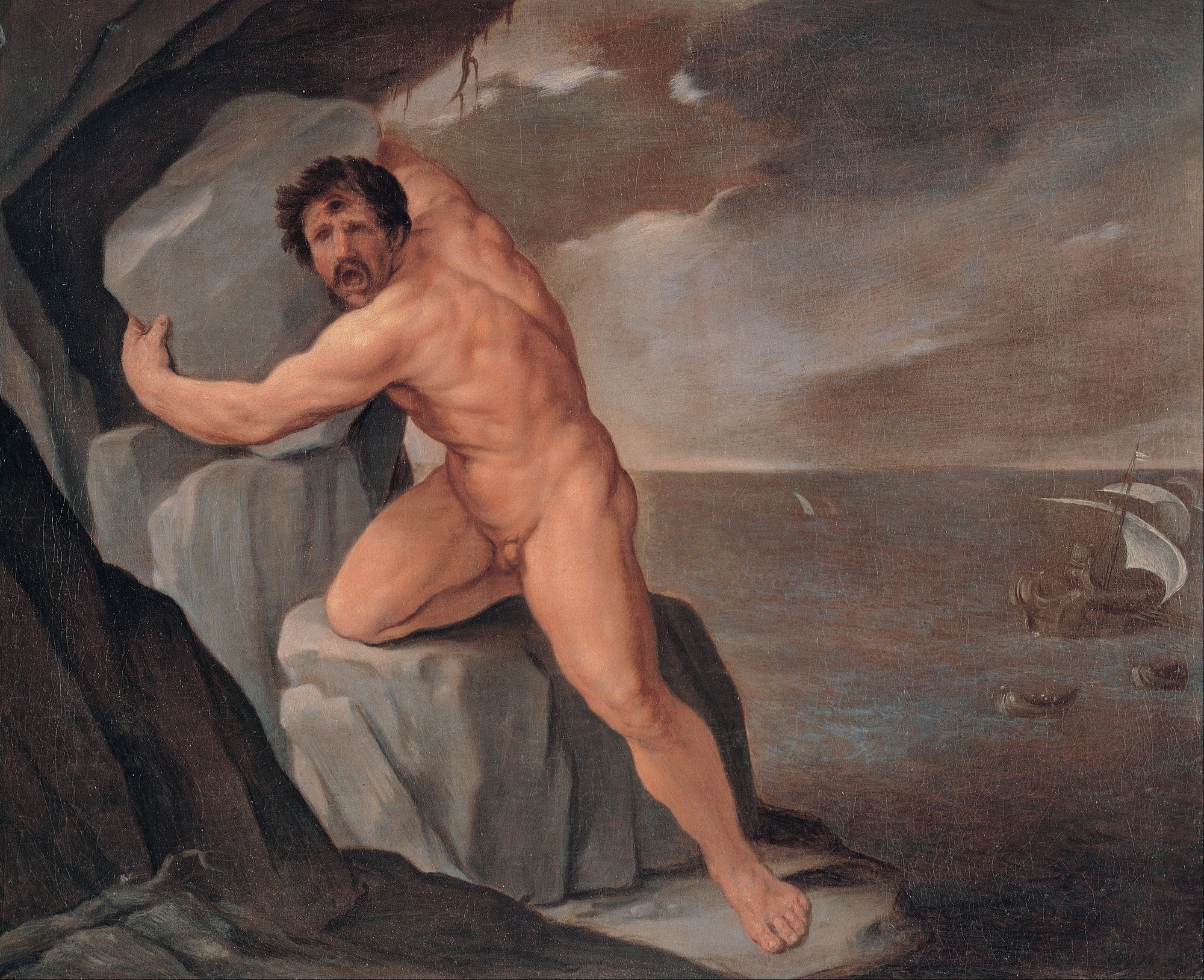
Edith Hall suggests this Odysseus came to symbolise Renaissance expansion and colonialism. The Cyclops and other “monstrous races” he encounters echo European tales of strange peoples at the world’s edge, while his victories prefigure Roman—and later European—domination of the Mediterranean.
Sinbad, Space, and the Proto–Science Fiction Epic
Some of Odysseus’s adventures resurface in the Arabic tales of Sinbad the Sailor: strange islands, enchanted beings, perilous hospitality. Brian Stableford argues that the Odyssey itself functions as a kind of ancestor to science fiction, with its voyages to unknown realms and encounters with nonhuman intelligences.
It has been explicitly reimagined as sci-fi more than any other classic. The French-Japanese animated series Ulysses 31 (1981–82) transplants the hero into the 31st century, turning gods into cosmic entities and islands into planets and starbases. The core remains: a man trying to lead his crew home through a universe of wonders and threats.

Joyce’s Ulysses: One Day as an Epic
James Joyce’s 1922 novel Ulysses is the Odyssey turned inside out. Set in Dublin on a single day, it follows Leopold Bloom (an everyman Odysseus), Stephen Dedalus (a modern Telemachus), and Molly Bloom (a reimagined Penelope).
Joyce claimed to know Homeric Greek, though some doubt his fluency, but he certainly knew the story through adaptations like Charles Lamb’s Adventures of Ulysses. He mapped his eighteen episodes loosely onto the epic’s twenty-four books, using stream-of-consciousness prose to turn interior monologue into the new “sea” his characters must navigate.
Ulysses became foundational to literary modernism, proving that the structure of an ancient epic could underlie the most experimental of novels.
Women Reclaim the Story: Penelope and Circe Speak
Recent writers have returned to the Odyssey to foreground the women it mostly leaves in the margins.
Margaret Atwood’s The Penelopiad (2005) retells the story through Penelope and the twelve enslaved women whom Odysseus and Telemachus hang after killing the suitors. Atwood was haunted by this image and uses it to question the cost of restoring patriarchal order. The triumphant homecoming becomes, in her telling, a crime scene.
Madeline Miller’s Circe (2018) similarly revisits the enchantress on Aeaea. Frustrated by Circe’s seemingly arbitrary malice in Homer, Miller imagines her transformations of sailors into pigs as acts of self-defence in a world where she lacks brute strength. Odysseus becomes one episode in Circe’s own long, fraught evolution.
An Endless Source of Stories
Each adaptation takes some element of the Odyssey—the journey, the homecoming, the trickster hero, the waiting wife—and uses it as a framework for new questions. What if the hero never settles down? What if the monsters are colonised peoples? What if the “happy ending” silences those at the bottom of the household hierarchy?
In that sense, the Odyssey is less a single tale than a narrative engine. It keeps sailing forward through time, refitted again and again for new oceans of imagination.