Watch the story on DeepSwipe
A famous city that nearly disappeared
Amorium, also called Amorion, was once one of the most important cities in Asia Minor, yet for a long time its exact location was uncertain. Its name survived on many maps from the 18th and 19th centuries, but knowing a name is not the same as knowing a site. Over time, the city that had once flourished under the Byzantine Empire faded so completely from view that its ruins ended up lying beneath and around a living village.
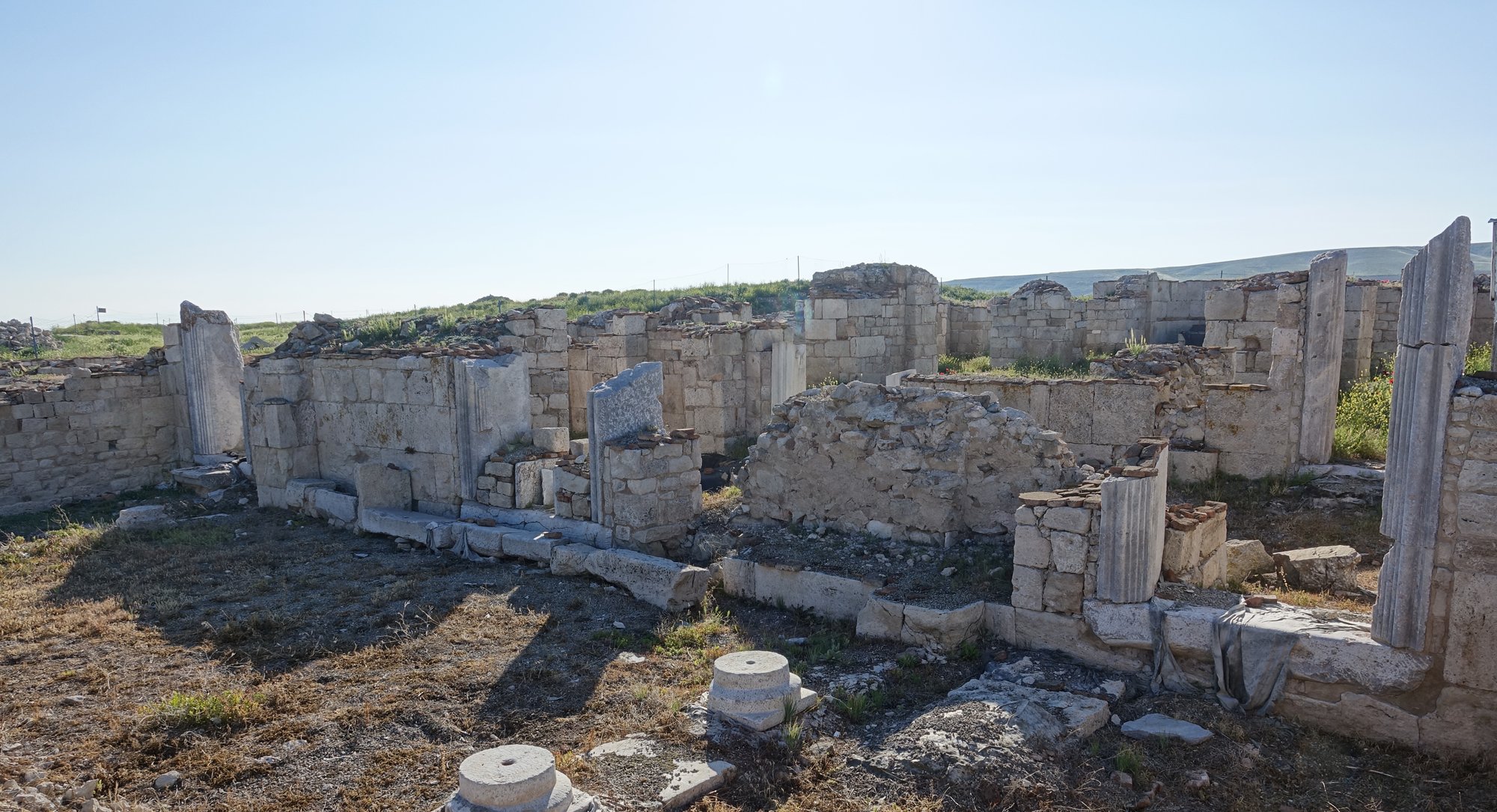
Today, Amorium is located under and around modern Hisarköy in Turkey, about 13 kilometers east of Emirdağ in Afyonkarahisar Province. The remains include a höyük, a Turkish word meaning a mound or tumulus created by layers of human settlement building up over centuries. That kind of mound is one of archaeology’s great clues: each layer can preserve traces of a different era, turning the ground itself into a record of urban life.
The story of Amorium is especially striking because this was no minor settlement. It was founded in the Hellenistic period, minted its own coins from sometime between 133 BC and 27 BC until the 3rd century AD, and later became a major Byzantine stronghold. At its height, it was the largest city in Asia Minor. Then it declined, suffered repeated attacks, and eventually slipped out of common knowledge.

Why Amorium mattered so much
Amorium’s importance came in large part from geography. It stood on the Byzantine military road from Constantinople to Cilicia. A military road was not just a route for soldiers. It was also a corridor for communication, supplies, and imperial control. A city on such a road could become both wealthy and strategically vital.
That is exactly what happened here. The city was fortified by Emperor Zeno in the 5th century, but its real rise came in the 7th century. Its central location in Asia Minor made it a key defensive stronghold against the armies of the Umayyad Caliphate after the Muslim conquest of the Levant. Because of this position, Amorium was repeatedly attacked. It was struck by Muawiyah I in 646, capitulated to Abd ar-Rahman ibn Khalid in 666, was occupied by Yazid I in 669, and then retaken by the general Andreas under Constans II.
For the next two centuries, Amorium remained a frequent target of raids into Asia Minor. It also became the capital of the Anatolikon theme. In Byzantine administration, a theme was a military and territorial district, so being a thematic capital meant Amorium was not just a city on a map but an important center of regional power.
Its fortunes rose even higher in the 9th century. In 820, Michael II, an Amorian, became Byzantine emperor and founded the Amorian dynasty. As the hometown of the ruling dynasty, Amorium entered its greatest period of prosperity. That political connection helped turn it into the largest city in Asia Minor.
Glory and destruction
The same royal connection that elevated Amorium also helped doom it. In 838, the Caliph Al-Mu'tasim launched a campaign specifically against the city. Amorium was captured and razed, a dramatic event important enough to be recounted in a poem by Abu Tammam.
Even that was not the end. The town was rebuilt, showing that Amorium still mattered after catastrophe. But it suffered again when it was burned by Thamal al-Dulafi in 931. Even so, it remained an active Byzantine city at least into the 11th century.
In 1068, the Seljuks Afshin and Ahmedsah attacked Amorium, sacked it, and killed most of its inhabitants. After the Battle of Manzikert, the city was devastated again by the Seljuks. Later, Emperor Alexios I Komnenos defeated the Seljuks at Amorium in 1116. Sources still described it as an important place in the 12th to 14th centuries, but the old greatness had long been broken by war.
This long cycle of growth, attack, rebuilding, and renewed destruction helps explain why Amorium could become both historically famous and physically hard to recognize. Cities are not lost in a single moment. Sometimes they fade through centuries of damage, abandonment, and changing settlement patterns until only buried remains are left.
Lost on the surface, preserved underground
One of the most fascinating parts of Amorium’s story is how it was rediscovered. Although the city’s name continued to appear on maps, the site itself remained uncertain for generations. In 1739, Richard Pococke rediscovered it. Later, in 1836, the English geologist William Hamilton became the first western scholar to visit the site, and subsequent maps placed it more accurately.
That gap between written memory and physical certainty is common in archaeology. A place can be known from texts, travelers, or map labels, yet still not be securely identified on the ground. In the case of Amorium, rediscovery meant linking the famous Byzantine city to the ruins at Hisarköy.
The idea of a major city lying beneath a village can sound surprising, but it is not unusual in regions with very long histories of settlement. People build, rebuild, abandon, and reoccupy the same landscapes for centuries. Walls collapse, buildings erode, and new homes rise above older foundations. Over time, what was once a city can look like little more than earth, stone, and a mound in a field.
Excavating a vanished world
Modern archaeological work at Amorium began with a preliminary survey in 1987 led by Martin Harrison of Oxford University. Excavations started in 1988. A survey is the early stage of archaeological study, when researchers inspect and document a site before or alongside major digging. At Amorium, the project focused mainly on post-classical, Byzantine remains.
In 1989 and 1990, archaeologists carried out an intensive surface survey of the man-made mound in the upper city. A surface survey studies artifacts and features visible on the ground, helping researchers map activity areas without immediately excavating everything. In 2001, Ali Kaya conducted a geophysical survey of a church in the upper city. Geophysical survey uses scientific methods to detect buried structures without fully digging them up, making it especially useful for locating walls, foundations, and other hidden remains.
These methods matter because archaeology is not only about uncovering objects. It is also about understanding urban layout, phases of construction, and how a city changed over time. At a place like Amorium, where the site spans centuries and where later life sits above earlier ruins, careful investigation is essential.
After more than 20 years of British-led excavation, fieldwork restarted in 2014 under a new Turkish team directed by Doçent Doktor Zeliha Demirel Gökalp of Anadolu University. The project has continued as an international collaboration, showing how the study of Amorium combines local stewardship with broader scholarly interest.
More than ruins
Amorium’s rediscovery and excavation matter because they reconnect the modern landscape with a city that was once central to Byzantine history. This was a place of coin production, fortification, imperial politics, religious importance, repeated warfare, and long survival. It was attacked, rebuilt, burned, sacked, and still remembered.
Now its story is being recovered layer by layer from beneath Hisarköy. What seemed to vanish from memory did not truly vanish at all. It waited underground, in its mound, its upper city, and the buried traces of churches and streets, for archaeology to bring it back into view.