The phrase “accelerating expansion of the universe” sounds simple at first. It suggests that every cosmic measure of expansion must be increasing together, like a car gaining speed. But cosmology uses the word acceleration in a more technical way, and that is where the surprise begins.
In this context, acceleration means that the universe’s scale factor is speeding up. The scale factor is a number that describes how the size of the universe changes over time. If that number grows in such a way that its second time derivative is positive, cosmologists say the expansion is accelerating.
That does not automatically mean every other expansion-related quantity rises too. In fact, one of the most confusing parts of the story is that the Hubble parameter can still decrease with time even while the universe is undergoing accelerated expansion.
Watch the story on DeepSwipe
The key distinction: scale factor versus Hubble parameter
The Hubble parameter is a number that tells us how fast the universe is expanding at a given time. It is defined as the rate of change of the scale factor divided by the scale factor itself.
This is the twist at the heart of the episode: accelerated expansion means the scale factor is speeding up, but it does not necessarily mean the Hubble parameter is going up.
Observations prefer a deceleration parameter of about q ≈ -0.55. A negative deceleration parameter corresponds to acceleration. But this value still implies that the Hubble parameter is decreasing with time, not increasing.
So both of these statements can be true at once:
- the universe is expanding in an accelerated way
- the Hubble parameter is getting smaller over time
That sounds contradictory only if we treat all “expansion numbers” as though they measure the same thing. They do not.

Why a galaxy can recede faster while the Hubble parameter falls
A useful way to picture the situation is to think about one particular distant galaxy. Because space keeps expanding, that galaxy’s recession velocity can increase with time. In other words, the rate at which its distance from us grows can become larger.
And yet, the velocity-to-distance ratio can still go down.
This is exactly the distinction highlighted by the mathematical relation for the Hubble parameter. The article explains that if the deceleration parameter is around -0.55, then the scale factor’s acceleration is positive while the time derivative of the Hubble parameter is negative.
Essentially, a particular galaxy can be receding faster and faster, while the Hubble parameter — the speed-per-distance measure — still declines. Another way the article describes it is this: galaxies crossing a sphere of fixed radius do so more slowly at later times.
That is one reason the accelerating universe is so unintuitive. Everyday language encourages us to imagine one simple “speeding up,” but cosmology separates several related ideas that do not move in lockstep.
How this strange result was discovered
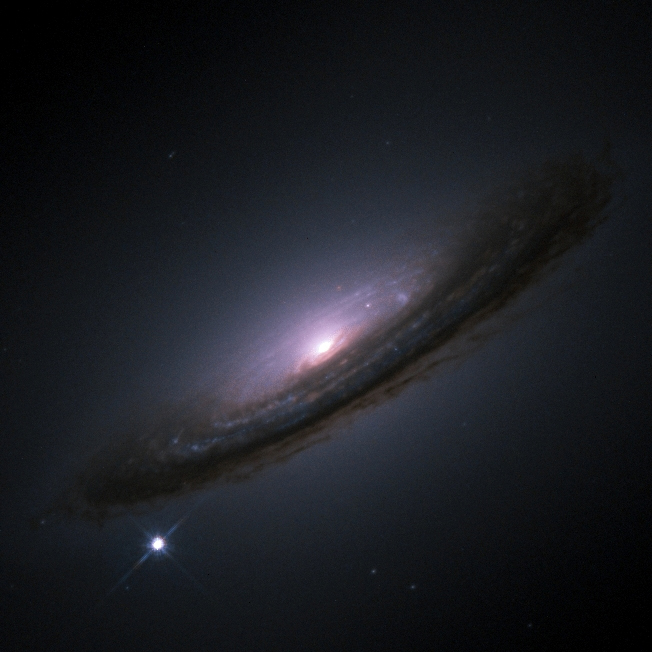
The accelerated expansion of the universe was discovered in 1998 by two independent teams: the Supernova Cosmology Project and the High-Z Supernova Search Team.
Their method relied on Type Ia supernovae. These are exploding white dwarf stars that have exceeded their stability limit. They are especially useful because they have almost the same intrinsic brightness, meaning their true luminosity can be standardized. In astronomy, such objects are called standard candles.
A standard candle is valuable because if you know how bright something really is, then how dim it appears tells you how far away it is. The farther away an object is, the dimmer it looks.
The researchers compared the distances to these supernovae with their cosmological redshifts. Redshift measures how much the universe has expanded since the light was emitted. Hubble’s law had already established that more distant objects recede faster. What shocked cosmologists was that the distant supernovae appeared farther away than expected in a decelerating universe.
For the high-redshift Type Ia supernovae, the measured distances were on average 10% to 15% greater than expected in a low-matter-density universe without a cosmological constant. That implied the universe had taken longer to expand to its present size than a non-accelerating model would predict. The natural conclusion was that the expansion had sped up.
Why this was so unexpected
Before this discovery, cosmologists generally expected the expansion to be slowing down because gravity pulls matter together. If the universe is filled with matter, then the mutual gravitational attraction of that matter should act as a brake on expansion.
That expectation was strong enough that physicists introduced a deceleration parameter, q0, specifically to describe the presumed slowdown. But observations showed that this parameter is negative.
So the surprise was not merely that the universe expands. That was already known. The surprise was that the expansion is not being steadily slowed by matter alone.
Evidence beyond supernovae
The supernova observations were the first major evidence, but they were not left standing alone.
Confirmatory evidence has also come from baryon acoustic oscillations and from analyses of galaxy clustering.
Baryon acoustic oscillations trace patterns left over from the early universe, when photons and matter existed in a hot plasma. Regions of higher density underwent cycles of compression and expansion, creating sound-wave-like vibrations. After decoupling, when photons separated from matter about 380,000 years after the Big Bang, these processes left behind a characteristic scale known as the sound horizon.
By looking at how galaxies cluster at different redshifts, astronomers can use that scale as a kind of standard ruler. Peaks found in the galaxy correlation function at about 100 h−1 megaparsecs match this picture and help confirm accelerated expansion.
Galaxy cluster measurements also support a low matter density and a non-zero dark energy component. Together, these lines of evidence strengthen the case that cosmic acceleration is a real feature of the universe.
The leading explanation: dark energy
Within general relativity, the standard explanation is dark energy, often represented by a positive cosmological constant, denoted Λ.
Dark energy is important because it has negative pressure, described as a repulsive action distributed relatively homogeneously through space. For cosmic acceleration to occur, the equation-of-state parameter w must be less than -1/3. In the simplest case, dark energy is just the cosmological constant, for which w = -1.
That simplest picture is built into the Lambda-CDM model, the standard model of cosmology. It combines the cosmological constant Λ with cold dark matter, abbreviated CDM.
According to the article, the universe is thought to have entered its dark-energy-dominated era roughly 5 billion years ago. As the universe expands, the density of matter drops faster than the density of dark energy. If dark energy is a cosmological constant, its density stays exactly constant. Over time, that allows dark energy to dominate the cosmic expansion.
A technical idea with a surprisingly human lesson
The accelerating universe is a reminder that scientific words often have sharper meanings than their everyday versions. In daily speech, acceleration usually suggests a single number climbing upward. In cosmology, the picture is subtler.
Acceleration refers specifically to how the scale factor evolves with time. That can produce a universe in which distant galaxies recede ever faster, even while the Hubble parameter declines.
So when people say the universe is accelerating, they are not saying every cosmic “speedometer” points upward in the same way. They are saying something more precise — and, in a way, more fascinating. The fabric of cosmic expansion itself has changed character.
That is what makes this one of the great conceptual twists in modern physics: the universe really is accelerating, just not in the simple sense your intuition first expects.