For much of modern cosmology, the expectation seemed straightforward: the universe began expanding, and gravity should gradually slow that expansion down.
That idea made intuitive sense. Matter attracts matter, so a universe filled with galaxies, gas, and dark matter should act a bit like an object thrown upward against Earth’s gravity. It might keep moving apart for a long time, but the expansion rate itself ought to ease off over time.
Then came one of the biggest surprises in astronomy.
In 1998, two independent research teams — the Supernova Cosmology Project and the High-Z Supernova Search Team — found evidence that the expansion of the universe is not slowing down at all. It is accelerating. In other words, distant galaxies are not just moving away from us; the speed at which they recede is increasing with time.
That discovery reshaped the standard picture of the cosmos and helped establish the modern Lambda-CDM model, the leading cosmological model, which includes cold dark matter and a cosmological constant often associated with dark energy.
Watch the story on DeepSwipe
The Original Expectation: Gravity as a Cosmic Brake
Cosmologists used equations describing how the universe expands to connect its behavior to the total energy density of the cosmos. In this framework, matter and radiation influence how the cosmic scale factor changes over time.
The scale factor is a way of describing the size of the universe relative to its present size. If the scale factor was smaller in the past, the universe itself was smaller too. A slowing universe would still expand, but it would do so with a kind of gravitational drag.
This expectation was so widely accepted that physicists even used a quantity called the deceleration parameter. The name itself reveals the mindset: they anticipated deceleration as the natural outcome.
But observations overturned that picture. The measured deceleration parameter is negative, which means the expansion is accelerating instead.

The Breakthrough Came from Type Ia Supernovae
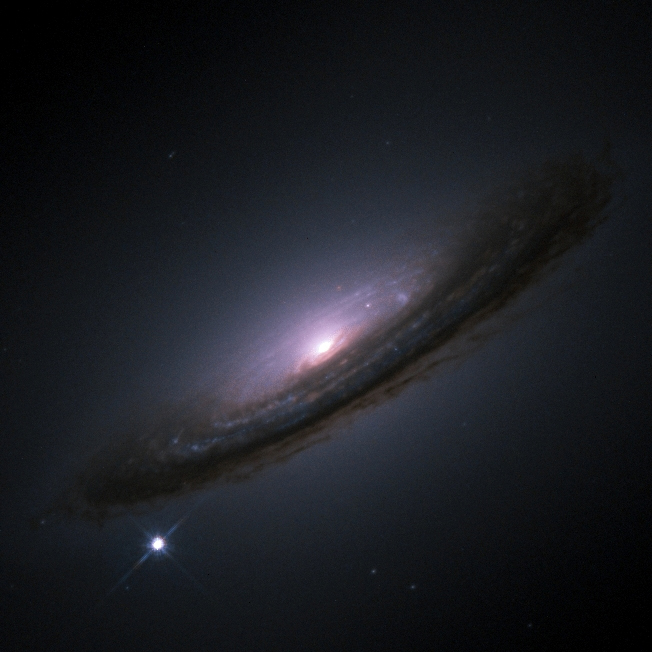
The key evidence came from Type Ia supernovae.
These are exploding white dwarf stars that have exceeded their stability limit. They are especially valuable because their intrinsic luminosity — their true brightness — can be standardized. That makes them useful as standard candles.
A standard candle is an object whose actual brightness is known or can be inferred. Once astronomers know how bright something truly is, they can compare that with how bright it appears from Earth. If it looks dimmer than expected, it must be farther away.
Researchers repeatedly imaged selected areas of the sky to discover these supernovae, then made follow-up observations to measure their peak brightness. That brightness could be converted into luminosity distance, a cosmological way of expressing distance based on how light fades with space and expansion.
They also examined spectral lines in the supernova light to determine redshift.
Redshift measures how much the universe has expanded since the light was emitted. As space expands, light waves stretch, shifting them toward longer, redder wavelengths. The larger the redshift, the more the universe has expanded during the light’s journey.
This connects to the Hubble law, which says that the farther away an object is, the faster it is receding.
What the Supernovae Revealed
For nearby supernovae, the distance–redshift relation is nearly linear, which matches Hubble’s law well. But at larger distances, the history of cosmic expansion starts to matter. If the expansion rate changed over time, the relation between redshift and distance should deviate from a simple straight line.
That is exactly what astronomers found.
The distant Type Ia supernovae were dimmer than expected, meaning they were farther away than they should have been in a universe whose expansion was slowing down. Adam Riess and collaborators reported that high-redshift supernovae were, on average, 10% to 15% farther away than expected in a low-mass-density universe without a cosmological constant.
That result was the smoking gun.
Why does “farther away” imply acceleration? Because if the universe is accelerating now, then in the past its expansion rate was lower than it is today. That means it took longer for the universe to grow from a smaller size to its current size than it would have in a non-accelerating model. A longer expansion history means light had more time to travel, making those supernovae appear more distant.
A simple example comes from a supernova with redshift z = 0.5. That implies the universe was 2/3 of its present size when the explosion occurred. In an accelerating universe, getting from 2/3 to full present size takes longer than it would in a universe expanding at a constant rate. So the light travels farther, and the supernova looks fainter.
What “Accelerating Expansion” Actually Means
The phrase can be slightly misleading if taken casually.
In technical terms, accelerating expansion means the second time derivative of the scale factor is positive. Put more simply, the size of the universe is increasing in such a way that the expansion is speeding up.
But that does not necessarily mean the Hubble parameter is increasing. In fact, observations favor a deceleration parameter of about -0.55, which implies the scale factor is accelerating even though the Hubble parameter still decreases with time.
A useful way to picture this is that any particular distant galaxy’s recession velocity increases with time, yet the ratio of velocity to distance can still decline. So the universe can be accelerating without every related quantity growing larger.
Dark Energy and the New Standard Picture
The leading explanation for this accelerated expansion is dark energy.
Dark energy is the name given to whatever is causing this cosmic speed-up. Its most important property is negative pressure, distributed relatively homogeneously throughout space. In the equations of cosmology, sufficiently negative pressure can drive accelerated expansion.
The simplest version of dark energy is the cosmological constant, often written as Lambda. In that picture, dark energy behaves like vacuum energy and has an equation-of-state value w = -1.
This leads to the Lambda-CDM model, which combines the cosmological constant with cold dark matter. It has been widely used as the standard model of cosmology because it gives a simple description in good agreement with many observations.
According to this picture, the universe entered a dark-energy-dominated era roughly 5 billion years ago, and that is when the currently accelerating expansion is thought to have begun.
More Than One Line of Evidence
The supernova results were dramatic, but they are not the only clue.
Evidence has also come from baryon acoustic oscillations and from analyses of how galaxies cluster.
Baryon acoustic oscillations trace ripples from the early universe, when photons and matter formed a hot plasma. Regions of higher density underwent compression and expansion, creating sound-wave-like patterns. When photons separated from matter about 380,000 years after the Big Bang, those patterns left behind a preferred scale in how matter was distributed.
Today, astronomers can look for that scale in the clustering of galaxies. Peaks in the correlation function show a characteristic separation of about 100 h−1 megaparsecs, which corresponds to the sound horizon. Comparing that scale across redshifts helps test different cosmological models and supports accelerated expansion.
Galaxy clusters also add support. Measuring the mass functions of clusters — essentially how many exist above a given mass threshold — at different redshifts provides values for cosmological parameters that favor a low matter density and a non-zero dark energy component.
Why This Discovery Changed Cosmology
The 1998 result was startling because it reversed a long-standing expectation. Instead of gravity steadily winning the tug-of-war, the large-scale universe appears to be dominated by something that produces repulsive behavior in cosmological dynamics.
The discovery was so significant that three members of the two supernova teams later received Nobel Prizes.
It also changed how scientists think about the fate of the universe. In models where dark energy is a cosmological constant, the density of matter keeps thinning out as space expands, while the dark energy density remains nearly unchanged. Over time, dark energy dominates more and more strongly.
That means the far future would be one of continued expansion, with the universe approaching exponential growth. In such a scenario, the cosmic microwave background is stretched to longer wavelengths and lower intensities, and the distant universe eventually becomes harder and harder to observe.
The big twist is this: one of the most important discoveries about the universe came from finding that distant exploding stars were too faint. That faintness revealed that the cosmos is not coasting, and not slowing — it is speeding up.