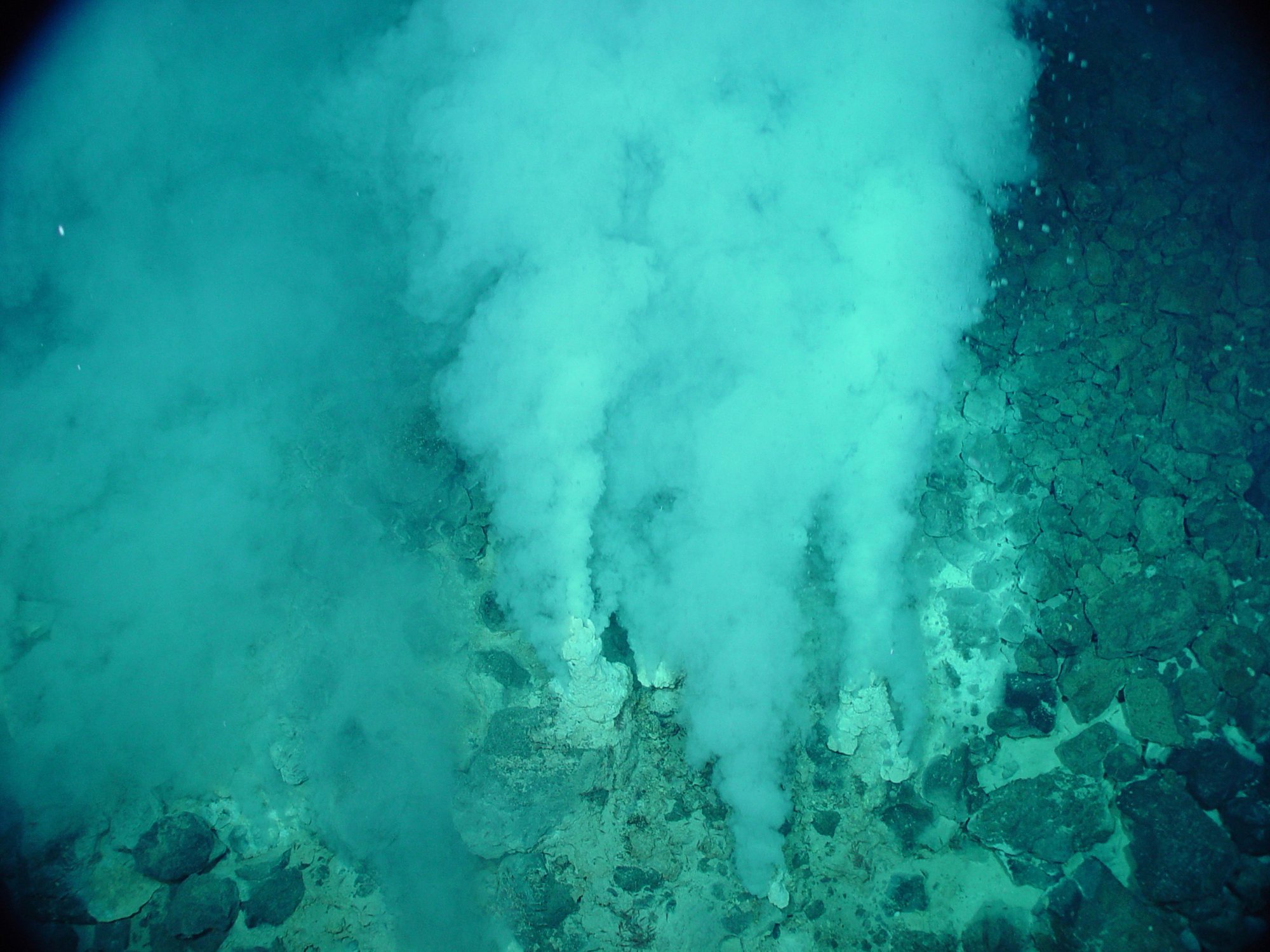
The origin of life remains one of science’s biggest mysteries, and one of the most compelling ideas points far below the ocean’s surface. In this view, life did not begin in a sunny pond or on an exposed shoreline, but inside deep-sea hydrothermal vents: places where hot, mineral-rich fluids rise through cracks in the seafloor and mix with ocean water.
This vent hypothesis is attractive because it brings together several ingredients that any origin-of-life scenario needs. It offers chemical energy, natural compartments, and a setting where simple molecules might have taken steps toward biology. Even so, the theory is not settled. Deep-sea vents are a strong candidate, but they are still part of an open scientific debate.
Watch the story on DeepSwipe
What are deep-sea hydrothermal vents?
Hydrothermal vents are openings on the ocean floor where heated fluids emerge from below. Some origin-of-life research focuses especially on alkaline hydrothermal vents, where hydrogen-rich fluids encounter carbon-dioxide-rich seawater. That meeting creates a chemical mismatch, and mismatches like that can drive reactions.
Researchers have proposed that these vents formed microscopic compartments with walls made of metal-sulfide minerals. These tiny spaces may have acted as natural precursors to cell walls, giving early chemistry a place to happen. Instead of molecules floating endlessly in the open ocean, some could have been held in confined mineral pores where reactions were easier to sustain.
This matters because life today depends on organized chemistry inside boundaries. Cells are not just bags of chemicals; they separate an internal environment from the outside world. A vent system may have provided an early physical version of that separation before true cells existed.

Tiny rock pores and the first chemical playgrounds
One reason vent models are so appealing is that they do more than provide heat. The pores and compartments in vent structures may have concentrated organic molecules and allowed repeated chemical interactions. Concentration is important because many key molecules are useful only if they meet often enough to react.
The mineral surfaces inside vents may also have helped directly. Iron-sulfur minerals in these environments have catalytic properties, meaning they can speed up chemical reactions without being consumed. In living cells, enzymes perform that role. In vents, minerals may have played a similar part before enzymes existed.
Under relevant conditions, such mineral surfaces can produce simple organic molecules from dissolved carbon dioxide when powered by voltage or by reactions involving hydrogen or hydrogen sulfide. Compounds such as methanol, formic acid, acetic acid, and pyruvic acid have been discussed in this context. These are not living things, but they are chemically interesting because they sit closer to the kinds of molecules metabolism uses.
Nature’s first batteries?
A key idea in the hydrothermal vent hypothesis is the natural proton gradient. A proton is a positively charged particle associated with hydrogen. A proton gradient means there is a difference in proton concentration across some boundary. In modern life, that kind of gradient is one of the main ways cells store and use energy.
This process is called chemiosmosis. In living organisms, chemiosmosis powers energy conversion in microorganisms and in the mitochondria of eukaryotes. The energy released by protons moving across a membrane helps generate ATP, the cell’s energy currency.
The exciting possibility is that early Earth may have supplied such gradients naturally, before life invented the machinery to make them itself. In alkaline hydrothermal vents, the contrast between vent fluids and surrounding seawater could have created an abiogenic proton motive force. In simpler terms, the environment may have produced a ready-made energy difference that primitive chemistry could exploit.
That is why some scientists describe vents as unusually elegant candidates for life’s beginnings. They may have offered not just molecules, but a built-in energy system resembling one of the most universal features of life today.
Why vents fit with ideas about early life
Hydrothermal vents also connect to what is inferred about the last universal common ancestor, or LUCA. LUCA was not the first living thing, but the common ancestor from which all modern life descends. Studies have suggested LUCA was anaerobic, meaning it lived without oxygen, and that it likely inhabited a geochemically active hydrothermal vent setting.
Its inferred biology points to dependence on hydrogen, carbon dioxide, iron, and transition metals, all features that line up well with vent environments. Some researchers have argued that early cells may even have had leaky membranes and relied on naturally occurring proton gradients near deep-sea white smoker vents.
There is also geological evidence that very early life may have been associated with hydrothermal settings. Micro-organisms reported from ancient rocks in Northern Quebec were interpreted by some researchers as having lived within hydrothermal vent precipitates soon after the oceans formed. That interpretation has been disputed, but it helps explain why vent environments remain central to origin-of-life discussions.
Protection in a violent young world
Early Earth was not a calm place. It had intense ultraviolet radiation, active volcanism, and frequent asteroid and comet impacts. In that context, the deep ocean offers an obvious advantage: shielding.
If life or pre-life chemistry developed at depths greater than about ten meters, it would have been protected from much of the harmful ultraviolet radiation reaching the surface. Ocean depth would also have reduced the effects of impacts compared with fully exposed surface environments.
For supporters of the vent hypothesis, this makes the seafloor look like a natural refuge. While the surface may have been chemically productive, it was also hazardous. Deep-sea settings offered energy, minerals, and physical protection in one package.
The strongest objections to the vent hypothesis
For all its strengths, the hydrothermal vent idea has serious criticisms.
The biggest is dilution. Seawater is vast, and critics argue that key ingredients would be too spread out to accumulate effectively. Reactions that need concentrated materials may struggle in an open ocean system where compounds are constantly dispersed.
Another problem is that some building blocks of life seem hard to produce under realistic vent conditions. No studies have yet experimentally demonstrated the de novo synthesis of sugars, amino acids, nucleobases, nucleosides, nucleotides, or membrane-forming fatty acids under plausible vent conditions. “De novo” simply means formed from scratch, rather than modified from pre-existing biological material.
There are also concerns about phosphate and potassium. Modern cells rely on phosphates in nucleotide backbones and potassium in protein-related functions, yet these elements may not have been abundant in Archaean oceans. Since phosphate often comes from weathering continental rocks on land, some scientists think surface settings may have had an advantage.
Another criticism is that hydrothermal vents are not especially favorable for condensation reactions, which are needed to link smaller molecules into larger polymers such as RNA-like chains or peptides. Polymerization is a crucial step in moving from chemistry toward biology.
Finally, some compounds once thought to be produced at vents may actually have formed through other geological processes and only later become associated with vent systems. That weakens arguments claiming vents uniquely generated all the required ingredients.
Why the debate is still open
The hydrothermal vent theory remains one of the leading explanations for abiogenesis because it solves several problems at once. It provides energy through redox reactions and proton gradients. It supplies mineral catalysts. It creates natural compartments. And it places early chemistry in a sheltered environment.
But a good origin-of-life theory must explain more than a promising setting. It must account for how the major molecular classes of life arose and began interacting: lipids for membranes, amino acids for proteins, carbohydrates such as sugars, and nucleic acids like RNA and DNA for heredity. Vent models have made progress on parts of that story, but not the whole thing.
That is why the mystery remains alive. Deep-sea hydrothermal vents may have been the cradle of life, or they may have been only one stage in a broader process that also involved surface waters, extraterrestrial organic compounds, or chemistry inside Earth’s crust. What makes the vent hypothesis so enduring is that it offers a coherent and testable picture of how non-living chemistry might have crossed the threshold toward life.
A candidate, not a final answer
So, did life begin at deep-sea vents? The honest answer is that science does not yet know. Hydrothermal vents are among the strongest ideas because they combine energy, compartments, and chemistry in a single environment. They may even echo key features seen in the earliest branches of life and in reconstructions of LUCA.
Yet important gaps remain, especially around the concentration and full synthesis of life’s building blocks. For now, deep-sea vents are not the final verdict on life’s beginnings. They are one of the best places to keep looking.